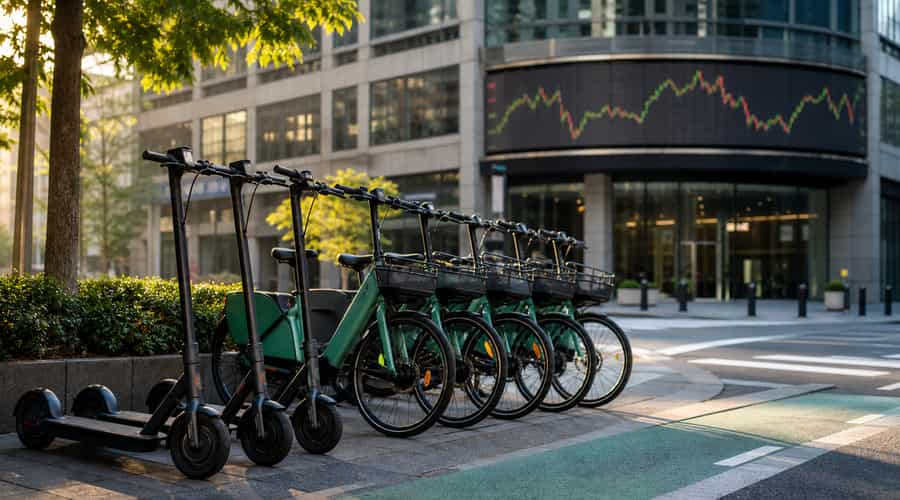
Lime's IPO is current, but the clean version of the story is not that scooters are back. It's that the last big shared micromobility survivor still needs public-market money to prove the model works.
Lime has reached the moment Bird never really got to enjoy: a conventional Nasdaq IPO with real underwriters, a recognizable ticker and Uber still sitting at the table. Investor's Business Daily reported that the San Francisco company planned to sell 6.7 million shares at $24 to $26 each, with another 276,731 shares coming from existing holders, putting Lime near a $1.8 billion fully diluted valuation at the midpoint of the range. The company is set to trade under LIME on the Nasdaq Global Select Market.
The deal is current. The victory lap can wait.
Micromobility has spent the better part of three years living down its first boom. Bird filed for Chapter 11 in December 2023 after going public through a SPAC at a $2.3 billion valuation two years earlier. Spin was folded into what became Third Lane Mobility. Lyft got out of scooters and bikes. If you were around for the early scooter wars, you remember the mess: cities waking up to fleets scattered across pavements, operators chasing permits, and investors treating short urban trips as if they were software subscriptions.
Lime survived that cycle. That matters, but it doesn't settle the argument.
Here's the thing: the financial profile underneath the offering is still uncomfortable. Lime reported $886.7 million in 2025 revenue, up 29% from $686.6 million in 2024, according to its prospectus figures cited by IBD and Axios. That is real growth. It also reported a $59.3 million net loss in 2025, wider than the $33.9 million loss in 2024. MarketWatch noted that Lime had about $261 million in cash as of March and hundreds of millions of dollars of debt due by the end of 2026. The company's own filing warned that without new funding, there was substantial doubt about its ability to continue as a going concern.
That isn't a routine risk factor. That's the center of the story.
Uber's role needs the same sober reading. Business Insider reported that Uber owned about 14 million Lime shares before the IPO, roughly a 24% stake, and had indicated interest in buying up to $20 million more in the offering. Uber's relationship with Lime goes back to a 2020 deal in which it led a $170 million investment round and transferred its Jump e-bike and scooter business to Lime. Lime also gets meaningful distribution from Uber's app, which Business Insider put at about 14% of Lime's 2025 revenue.
So no, Uber's check is not the same as a detached investor discovering the scooter category with fresh eyes. Uber already benefits when Lime stays healthy. It has Lime rentals inside its app. It has a strategic stake that would look better with a public-market price attached to it. A $20 million purchase is not nothing, but for Uber it is also a cheap way to protect a partnership that gives the app more ways to move people around cities. You'd do the same thing if the economics made sense.
The stronger case for Lime is not romance about scooters. It is that the market has been brutally cleaned out. Lime says it operates across about 230 cities in 29 countries and served 19 million riders in 2025. It has crossed one billion lifetime rides. Those are not pilot-program numbers. They show demand, habit and city-by-city operating knowledge that new entrants will not copy overnight.
But demand was never the hardest part. People will rent a scooter for a short trip if the vehicle is nearby and the price is tolerable. The harder part is keeping public hardware working in rain, traffic, vandalism and shifting municipal rules while still producing enough margin to justify the capital tied up in the fleet. Lime's revenue line says the service has customers. Its loss history says the model still has to prove itself in public.
The cities are the swing factor. In 2018 and 2019, scooters looked to many local officials like a tech company land grab on public streets. In 2026, the better version of the business looks more like contracted urban transport: limited permits, required parking zones, data-sharing rules and operators that can survive compliance costs. That is less exciting than the old pitch, but it is more investable. A messy free-for-all is bad for everyone except the company raising money before the clean-up bill arrives.
Lime has one advantage here that its dead or absorbed rivals do not. It is still in the conversation with cities. London councils complain about bikes blocking pavements, as The Times noted, but the same visibility also shows how deeply Lime has become embedded in some urban routines. The green bikes are no longer a novelty in large parts of London. They are street furniture people argue about because they actually use them.
Investors should keep that tension in view when LIME starts trading. This is not a simple comeback story for scooters, and it is not just another tech IPO surfing a reopened listing window. It is a test of whether one disciplined survivor can turn a category that burned capital into a public company that earns it. Lime has scale, Uber distribution and a cleaner field than it had five years ago. It also has losses, debt and a business that still depends on cities letting its vehicles occupy public space.
That's the real trade. Lime has earned the right to ask public investors for money. It hasn't yet earned the assumption that the scooter math finally works.
Also read: SaaS Customer Segmentation Is the Lever Most Founders Pull Too Late | Former DeepMind researchers who beat professional poker players raise a $500 million Series A to trade stocks and crypto | Etched bets $800 million that transformer silicon will outlast the GPU era