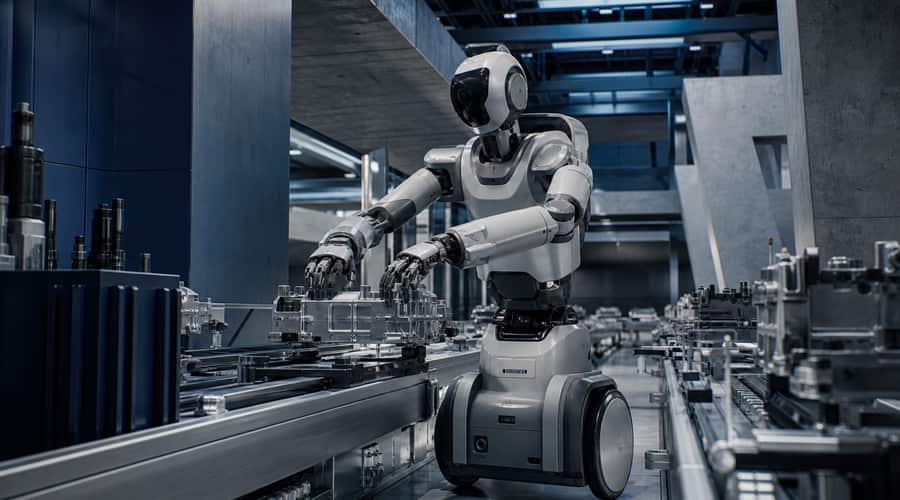
Humanoid's new $152 million round is a real European robotics milestone, but the harder test starts when its wheeled HMND 01 robots leave the funding announcement and enter factories.
Humanoid has crossed the unicorn line barely two years after Artem Sokolov founded the London robotics company in 2024. According to Reuters, the startup said on July 21, 2026 that it raised $152 million in a Series A round at a $1.35 billion post-money valuation, led by Prime Movers Lab with Schaeffler, Bosch, Fubon Financial Holding Venture Capital and Aglae Ventures joining the financing. Total funding now stands at $270 million.
That's fast. It also tells you something useful about where robotics money is moving now. Investors are no longer only paying for chatbots and model labs. They're paying for machines that can lift boxes and survive a shift around people who already have work to do.
The detail to watch isn't only the valuation. Reuters reported that Humanoid plans to use the money for its next platform, its KinetIQ AI software, industrial deployments and the start of mass manufacturing for wheeled robots. Schaeffler is not just a financial name on the cap table, either. Reuters said Humanoid recently signed an agreement with Schaeffler involving the planned deployment of thousands of robots at manufacturing facilities, while Forbes reported in May that the first phase would start in December 2026 across Schaeffler sites in Herzogenaurach and Schweinfurt.
Bosch's role is different, and it matters. The company said in May that it would serve as Humanoid's contract manufacturing partner for HMND 01 robots in Europe after a March 2026 proof of concept at Bosch's logistics environment in Buehl, Germany. In that trial, Humanoid said its robots moved boxes from conveyors to trolleys across five box sizes with varying heights and different weights. That's not a glossy stage demo. It's closer to the awkward work factories actually need automated.
The robot rolls. That is the point.
Humanoid's HMND 01 Alpha comes in wheeled and bipedal versions, but the commercial push is clearly leaning toward wheels first. Most people hear humanoid robot and imagine legs and stairs - a machine walking through a warehouse like a person. Look, that's impressive. It's also expensive and slower to certify - often unnecessary on a flat factory floor. If your customer runs even concrete, wheels are not a compromise. They're a shortcut to useful work.
Forbes reported that the wheeled HMND 01 Alpha is 220 centimeters tall and was built for industrial jobs rather than home companionship. Humanoid says KinetIQ handles fleet orchestration across wheeled and bipedal platforms. The company has also claimed 34,000 non-binding pre-orders worth about $2.4 billion in implied annual recurring revenue, a figure Forbes described as a demand signal rather than contracted revenue. You should read it that way. Pre-orders don't clock in for a shift.
Europe is catching up, not leading
Humanoid can fairly call this a European milestone. It cannot call itself the leader of the whole field. Figure AI said in September 2025 that it had secured more than $1 billion in committed Series C capital at a $39 billion post-money valuation, and BMW said in June 2026 that Figure's earlier Figure 02 deployment at Plant Spartanburg helped support production of more than 30,000 BMW X3 vehicles over ten months. Figure 03 is now moving into a logistics sequencing use case at the same South Carolina plant.
Skild AI is playing a different game. TechCrunch reported in January 2026, citing Bloomberg, that the robotics software company raised $1.4 billion at a valuation above $14 billion. Apptronik said in February that it closed a $520 million Series A extension, bringing its total Series A to more than $935 million, while TechCrunch reported its post-money valuation was about $5.3 billion. Germany's NEURA Robotics announced in June that it had lined up a Series C of up to $1.4 billion with investors including Tether, Qualcomm, Amazon, Nvidia, Bosch and Schaeffler.
So Humanoid isn't the biggest robotics bet on the table. It is one of the clearer European bets on getting industrial robots into customer sites quickly, with German manufacturing partners close by and a design that avoids some of the drama of bipedal walking.
That difference is useful. Europe has deep factory know-how, but it hasn't often turned that into venture-scale robotics companies with the speed investors now expect. Bosch and Schaeffler know hardware, supply chains, reliability and industrial procurement. Humanoid gives that base a startup vehicle. Frankly, that combination is more credible than a small team promising to build the robot, the factory and the customer channel from scratch.
The market around it is running hot. According to Dealroom data cited by Hannover Messe, robotics companies had already raised $55.8 billion by early June 2026, nearly double the previous annual record. That kind of money can pull serious engineers into the field. It can also fund a lot of expensive machines that never become everyday tools.
Humanoid's next test is plain. By the fourth quarter of 2026, Reuters reported, the company plans to begin deploying beta robots at customer sites in manufacturing, logistics, retail and other industrial sectors. That's where the story gets real. A unicorn valuation is easy to announce. A robot that keeps working when the box is dented, the trolley is slightly out of place and the line supervisor is losing patience is the thing customers will actually pay for.
Also read: Moonshot AI Is Chasing A $50 Billion Valuation After Its GPUs Ran Out • SentinelOne Founders Raise $100 Million to Secure AI Agents Inside the Enterprise • Gritt Robotics Raises $34 Million to Automate Solar Farm Construction