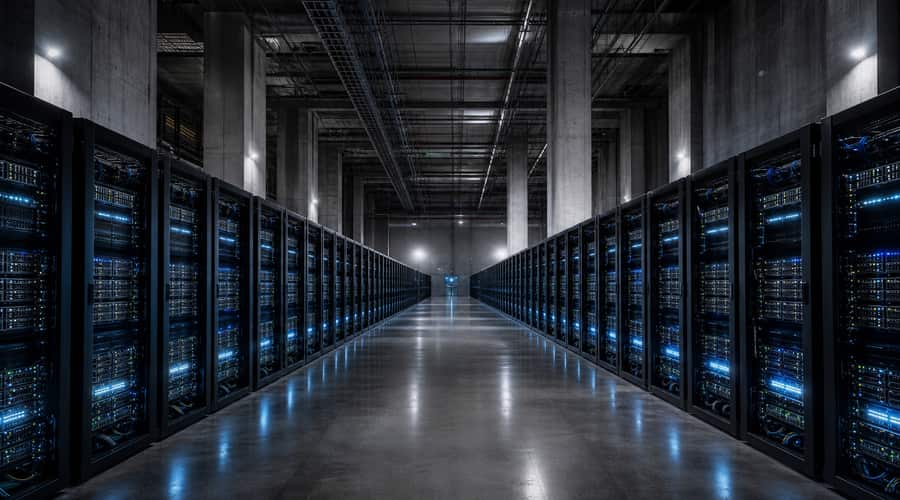
Megaport is moving from network software into the expensive business of AI infrastructure, and the size of its new capital raise shows how quickly the economics of the sector are changing.
Megaport has found itself in the middle of the AI infrastructure race, and this time the story is not just about faster connections. The Brisbane-based network-as-a-service company is raising A$827.3 million, about $594 million, after securing four AI infrastructure contracts worth roughly A$458.9 million.
That is a large move for a company best known for helping enterprises connect across cloud providers and data centres. It also says something important about where AI spending is going. The demand is no longer limited to the hyperscalers and the chipmakers. It is pulling in the companies that sit around the cloud stack and asking them to own more of the physical infrastructure behind AI.
According to Reuters, the four contracts are with US-based technology providers running AI applications, and Megaport expects them to begin contributing in the first half of 2027. The company says the contracts will require about A$369.5 million of incremental capital expenditure, mainly for high-performance Nvidia GPUs, network equipment and storage infrastructure.
This is the sharp part of the story. Megaport is not simply reselling access to someone else's compute. It is putting fresh equity to work on hardware, including an on-demand GPU pool designed for enterprise customers that want AI infrastructure without waiting through the long procurement cycles that now define the market.
Megaport has been moving in this direction for months through Latitude.sh, its compute infrastructure subsidiary. Earlier announcements showed demand for GPU, CPU, network and storage services from US technology customers, but this new raise gives the strategy a different scale. It is no longer a useful add-on to the network business. It is becoming a core growth bet.
The company says roughly A$199 million of annual recurring revenue will be recognised as the new hardware becomes operational. That matters because capital-heavy infrastructure can look attractive when contracts are locked in, hardware is deployed on time, and customers keep using capacity after the initial term. It looks much less attractive when chip supply, utilisation or pricing moves against the operator.
Megaport is trying to frame the opportunity around inference, the part of AI where models are used in live applications rather than trained from scratch. That is a sensible place to focus. Training gets the headlines because it needs huge clusters and vast power budgets, but inference is where enterprise adoption becomes repetitive, distributed and closer to the end user. Every chatbot, coding tool, search assistant and workflow agent needs compute at the point of use.
That plays to Megaport's existing network strengths. A company that already connects customers across more than 1,100 enabled data centres has a natural argument for providing compute closer to where data and applications already sit. If AI becomes a standard enterprise workload, not a side experiment, connectivity and compute start to look like one buying decision.
The reward comes with balance sheet risk
The capital raise also shows the uncomfortable side of the AI buildout. Software companies like asset-light economics. AI infrastructure does not. GPUs are expensive, delivery schedules matter, and hardware can age quickly when Nvidia or another supplier pushes out a better generation. The more Megaport owns, the more it carries that risk.
The entitlement offer is fully underwritten and priced at A$14.30 per share, a 13.9 percent discount to Megaport's last closing price on June 1. Megaport requested trading halts around the announcement, giving investors time to digest a transaction that changes both the growth outlook and the capital profile of the business.
There is a reason investors are willing to listen. AI infrastructure capacity remains tight in many parts of the market, especially for companies that need access to Nvidia GPUs without building their own data centre relationships from scratch. If Megaport can use its network footprint to deliver reliable on-demand capacity, it could become a more serious player in the emerging neocloud market.
But the neocloud label can hide a lot of complexity. Renting out GPU capacity is not the same as running a clean software subscription business. Customers will care about availability, latency, pricing, model compatibility, data security and support. Investors will care about utilisation, payback periods, depreciation and whether contracted revenue is enough to protect returns if the AI cycle cools.
Megaport has also narrowed its FY26 revenue guidance to A$307 million to A$315 million, compared with its previous range of A$302 million to A$317 million. That suggests the existing network business still has momentum, but the market will now judge the company by a broader standard. It is no longer only about ports, virtual connections and cloud routing. It is about whether Megaport can turn its network into a platform for AI compute.
The next thing to watch is execution. Contract wins are valuable, but hardware delivery, customer onboarding and GPU utilisation will decide whether this raise becomes a smart expansion or an expensive top-of-cycle purchase. For now, Megaport has made its position clear: the AI infrastructure race is spreading beyond Silicon Valley giants, and even network companies are being pulled into the business of owning the machines.
Also read: Palantir's NHS contract has become a test of AI sovereignty • Factory AI brings cost routing to enterprise coding agents • Microsoft Scout brings OpenClaw’s agent model into the office