
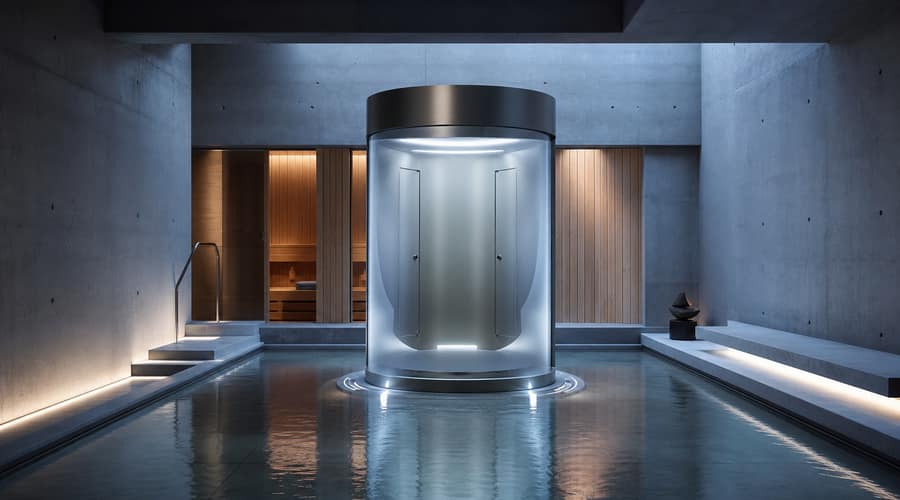
Midjourney’s first hardware bet is not another image model. It’s a full-body ultrasound scanner built for a San Francisco spa, and the gap between the promise and the proof is the story.
Midjourney has trained you to think of it as the company that turns text prompts into strange, glossy images. Now David Holz wants you to step into a pool, sink through a ring of underwater sensors, and come out with a map of your body. That is a sharp turn from Discord prompts and monthly subscriptions.
The company calls the device the Midjourney Scanner, a full-body ultrasound CT system that uses sound waves and water rather than radiation or powerful magnets. According to Midjourney’s own announcement, the scan is meant to take as little as 60 seconds, with a platform lowering you through the water at about 2 inches, or 5 centimeters, per second. The company says the ring contains half a million tiny sensing elements, each acting as a speaker and microphone, and that the system produces terabytes of data each second.
That sounds spectacular. It also needs to be read as a company claim, not a clinical fact.
The Verge reported on June 18, 2026 that Holz showed off the scanner as Midjourney’s first hardware product, with the company aiming first at body composition maps covering muscle, fat, bone, and organs. The same report said the system was developed with Butterfly Network and uses 40 Butterfly Ultrasound-on-Chip imaging modules per scanner. Holz has a hardware past from Leap Motion, so the move is not quite as random as it looks. Still, a motion-control device is one thing. A medical imaging network at global scale is another.
The spa is the distribution strategy
The first Midjourney Spa is planned for San Francisco’s Union Square by the end of 2027. Midjourney says the venue will have hot tubs, saunas, cold plunges, and 10 scanners. The format matters. This is not just wellness decoration wrapped around a scanner. It is the company’s first route to customers.
Hospitals move slowly, especially when a device touches diagnosis. Procurement takes time, doctors need evidence, insurers ask hard questions, and the FDA does not clear machines because the demo looks good. A spa lets Midjourney start with a different promise: body composition maps and personal tracking rather than disease detection. You can see why that appeals to a company that wants speed.
Look, that does not make the regulatory question disappear. Midjourney says diagnostic medical capabilities normally need FDA approval and that it will start by giving users detailed body composition maps while submitting regular test results for increased capabilities. The Verge also noted that various medical applications would require FDA clearances. If the scanner ever moves from curiosity to clinical interpretation, the label on the door will matter less than what the machine claims to tell you.
Midjourney’s ambition is much larger than one spa. Its announcement says the goal is to deploy more than 50,000 scanners worldwide by 2031, with capacity for one billion scans a month. The San Francisco site, with 10 scanners, is supposed to be the first proof that people will actually use the thing in a real location, not just watch it in a launch video.
Frankly, the number is doing a lot of work. A billion scans a month sounds less like a wellness membership plan and more like an anatomy data engine. Midjourney built its image business by learning from vast amounts of visual material. If it can collect repeated ultrasound scans tied to changes in a person’s body over time, the dataset could become more valuable than the spa or even the scanner itself.
The proof has not caught up with the promise
Ultrasound CT is not fantasy. It has been studied for breast imaging and other uses, and ultrasound is already a workhorse in medicine. The harder part is the specific claim Midjourney is making: fast, whole-body scans that can produce useful maps at a quality the company compares with MRI in many ways. Midjourney says its images cover the body down to a fraction of a millimeter and look a lot like today’s MRIs at nearly a hundred times the speed. Those are the claims that need independent validation.
There is another practical problem. Hardware punishes optimism. Midjourney has to manufacture the scanners, maintain them, run wet consumer facilities, protect intimate health data, handle service failures, and win public trust in a category where one bad answer can do real damage. Software companies often underestimate that. You cannot patch a flooded spa room from a dashboard.
The timing is current and the story is worth covering because the announcement landed this week, with The Verge’s report and Midjourney’s own pages filling in the plan. But the strongest version of the article is not that Midjourney has suddenly reinvented healthcare. It is that a profitable, independent AI image company is trying to escape the crowded image-generation race by building a medical data business through a consumer spa.
Adobe, Google, OpenAI, and a long list of smaller model companies are already chasing the image market. Midjourney can keep fighting there, but the margins of surprise are shrinking. A scanner network, if it works, gives the company something harder to copy: physical infrastructure, regulatory experience, and a stream of body data that competitors cannot scrape from the open web.
That is the real bet. Not the golden pool. Not the launch phrasing. Not the idea that a spa makes medical hardware feel friendly. Midjourney is trying to turn the body into the next image dataset, and by late 2027 in Union Square, we should know whether real people are willing to step into the water.
Also read: Noam Shazeer, the man who invented the transformer, is now working for OpenAI • Wall Street is betting on Zhipu AI as Washington's export crackdown hands Chinese models a gift • Nvidia's ENPIRE lets AI coding agents train robots to install the GPUs that run AI