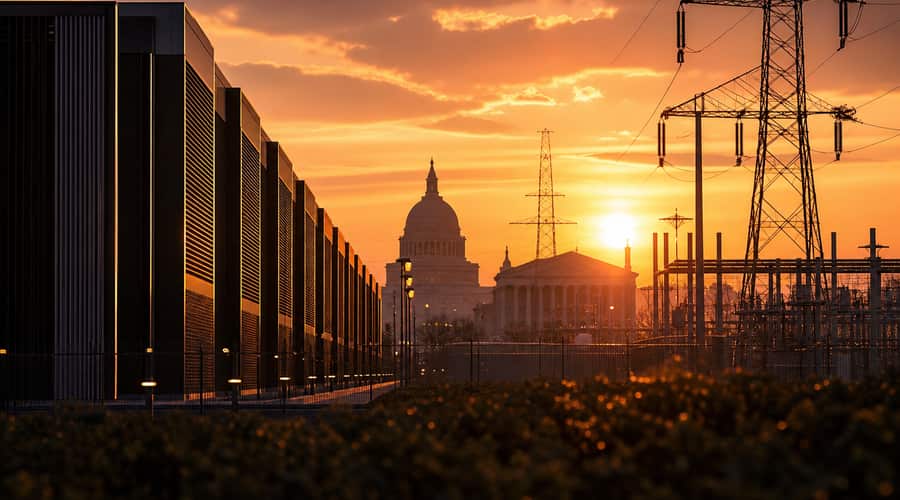
New York has moved a data center moratorium from protest language into state policy. If Gov. Kathy Hochul signs it, AI infrastructure developers will have to treat political risk as seriously as power availability.
New York lawmakers have just put a hard question in front of the AI industry: who gets to decide how fast the physical internet can grow? The state legislature passed the Responsible Data Center Development Act on Thursday, sending Hochul a one-year pause on new permits for large data centers at the same time cloud companies and AI labs are racing to lock down electricity, land and water.
This is not a symbolic scolding of technology companies. It is a practical intervention in the permitting pipeline. The bill targets large facilities with peak demand of 20 megawatts or more, the kind of sites that can change the economics of a local grid before a single server rack goes live. For developers, that means New York is no longer just a real estate and tax incentive market. It is becoming a policy test case.
According to Bloomberg Government, the package now heads to Hochul after lawmakers advanced a one-year moratorium on new permits for energy-intensive facilities, with unions and economic development groups already pushing back. That last part matters. The politics are not neatly anti-tech. They are a fight between ratepayers worried about utility bills, environmental advocates focused on resource use, construction trades looking at jobs, and cities that want investment without inheriting the hidden costs.
The moratorium is the headline, but the rest of the bill is where the longer-term signal sits. State Senate materials say the measure would require public hearings before future permits, direct the Department of Environmental Conservation to study statewide impacts, create separate water and electric rate classes for large data centers, and set energy efficiency goals for facilities above certain thresholds.
That is a different model from the usual local fight over a zoning meeting or a single substation upgrade. New York is trying to create a statewide framework before the next wave of hyperscale projects arrives. The bill also includes host community benefits, labor standards, and a renewable energy target that phases toward 90 percent by 2040. Whether every provision survives implementation is almost secondary. The message to the market is already clear: AI infrastructure will be asked to pay its full bill, not just its land acquisition cost.
There are limits. The bill text says the moratorium would not apply to modifications, renewals, reissuance or recertification of previously issued permits. It also would not apply to large data centers that began construction on or before the effective date. Public research institutions used for research purposes are carved out. So the immediate damage is not likely to be a blanket shutdown of every active project in the state.
Still, projects that have not yet secured key state approvals may now face a very different timeline. That uncertainty is what investors notice first. Data center economics depend on sequencing: power interconnection, permitting, financing, customer commitments and construction all have to line up. A one-year delay can change the return profile of a project, especially when AI demand is growing quickly but the cost of capital and power remains volatile.
AI companies now have a grid problem
For AI companies, the New York vote lands at an awkward moment. Models are getting larger, inference demand is rising, and cloud providers are treating capacity as a strategic asset. But the industry has been selling AI as software while asking communities to absorb the physical side of that software: transmission upgrades, water consumption, noise, diesel backup generation and land use.
That gap is now closing. Earlier this year, Maine lawmakers passed a similar state-level measure before Gov. Janet Mills vetoed it. Denver approved a one-year local moratorium in May. National politicians, including Bernie Sanders and Alexandria Ocasio-Cortez, have also pushed for a federal pause on AI data center construction. New York is different because it is a major economy with a governor who has actively courted technology investment while also speaking to affordability and energy concerns.
The public mood is not hard to understand. A Quinnipiac University poll cited by AFP found 65 percent of Americans opposed having a data center built in their community. That does not mean voters are rejecting cloud computing or AI services. It means they are skeptical of projects that promise innovation but arrive as higher bills, louder facilities and infrastructure strain that residents never agreed to subsidize.
This is where real estate developers and AI infrastructure firms need to be more disciplined. Communities are not just looking for job numbers in a press release. They want to know who pays for grid upgrades, how much water a facility will use, what happens during peak demand, and whether promised benefits are enforceable. Companies that cannot answer those questions early will keep running into blunt political tools.
Hochul now has the decisive move. She can sign the bill, veto it, or push for changes that soften the moratorium while preserving ratepayer and transparency rules. Whatever she does, the broader trend is already visible. Data centers are moving from quiet industrial assets into the center of AI policy, and the next permitting fight may be less about whether AI is useful and more about who carries the cost of making it run.
Also read: Quilty shows why founders should not sell prediction as certainty • Europe's Qwant switch gives local search startups a real opening • Shield AI's drone incidents turn defense-tech speed into an investor test