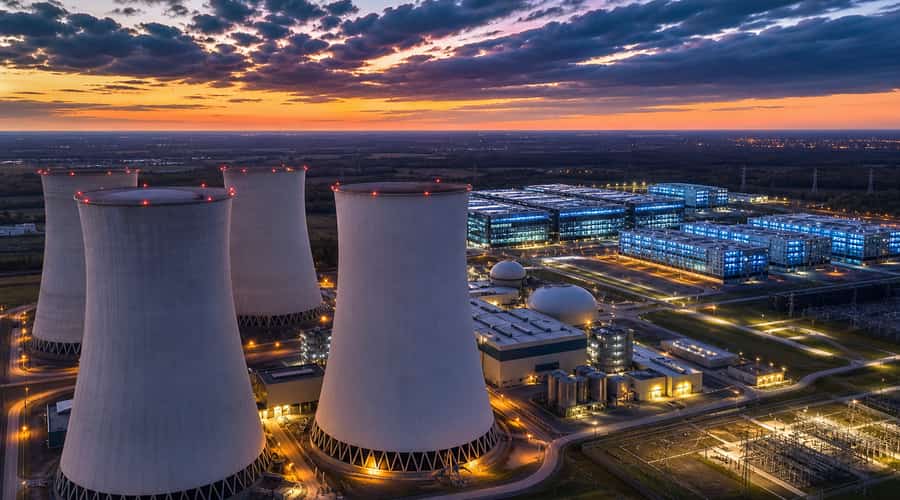
AI's power problem is no longer a spreadsheet concern. The companies building the biggest models are now treating nuclear plants, old and new, as core infrastructure.
The energy problem was always going to catch up with the AI boom. Chips get faster, models get larger, data centers multiply, and then someone has to ask where the electricity is coming from at 3 a.m. on a hot August night. According to the Electric Power Research Institute, US data center electricity use could climb as high as 426 terawatt-hours by 2030. You don't solve that with a slide deck about clean power. You solve it with steel, turbines, transmission lines and plants that can run nearly all the time.
That is why nuclear has moved from a policy argument into the middle of the AI buildout. Solar and wind will keep getting built, and they should. But an AI campus with hundreds of thousands of chips needs firm power, not just cheaper power when the weather cooperates. The US Energy Information Administration puts nuclear's recent capacity factor above 90 percent, far ahead of solar and wind. For a hyperscaler trying to keep model training online, that difference is not academic. It's the operating model.
The federal government has made the same calculation. President Trump signed a package of nuclear executive orders on May 23, 2025, including an order pushing the Nuclear Regulatory Commission toward decisions on new reactor applications within 18 months and license renewals within 12 months. Reuters reported at the time that the administration wanted US nuclear capacity to rise from about 100 gigawatts now to 400 gigawatts by 2050. The Department of Energy's Reactor Pilot Program then set a goal of getting at least three advanced test reactors to criticality by July 4, 2026.
Frankly, those targets are aggressive enough to make any serious energy investor squint. Nuclear projects have missed deadlines for decades. But the policy direction is clear, and capital is already moving as if the old timelines are being challenged.
Palisades is the best proof. The Michigan plant in Covert Township shut down in 2022, was bought by Holtec International, and then became the first serious US test case for restarting a retired commercial reactor. The Department of Energy finalized a $1.52 billion loan guarantee for the restart, while Michigan added state support. Holtec is targeting a mid-2026 return for roughly 805 megawatts of generation. A dormant nuclear plant coming back to life is not a small story. It tells you how valuable existing baseload power has become.
Corporate America read the room early. The Associated Press reported in January 2026 that Meta signed nuclear agreements with Vistra, TerraPower and Oklo to support up to 6.6 gigawatts of power by 2035, including power for its Prometheus AI data center cluster in New Albany, Ohio. The TerraPower portion includes two Natrium units expected to deliver 690 megawatts by 2032, with options for more. Oklo is tied to a planned 1.2-gigawatt campus in Pike County, Ohio. Vistra brings the practical piece: power from reactors that already exist.
Microsoft made a different kind of bet. In September 2024, Constellation said it would spend about $1.6 billion to restart Three Mile Island Unit 1, now renamed the Crane Clean Energy Center, under a 20-year power agreement with Microsoft. The unit is expected to return in 2028, subject to approvals. The important number is 835 megawatts, because that is the kind of always-on power a large AI customer can actually plan around.
Amazon went even closer to the source. It paid $650 million in 2024 for a Pennsylvania data center campus next to Talen Energy's Susquehanna nuclear station, then expanded the arrangement so Talen can supply up to 1,920 megawatts through 2042. Google is in the mix too, with a 2024 agreement with Kairos Power for 500 megawatts of advanced nuclear capacity by 2035. Add the announced commitments together and the rough figure passes 9.8 gigawatts. These are not branding exercises. These are land, load and power decisions.
Here is the thing for investors: the near-term trade is not only small modular reactors. Most commercial SMR capacity is still a 2030s story, however excited the market gets about Oklo, NuScale, TerraPower or Kairos. Oklo did get a fresh regulatory milestone this month, with Barron's reporting that its Aurora project passed an Energy Department safety analysis review. That is progress. It is not electricity on the grid.
The money that shows up sooner is tied to assets already in motion: utilities with operating nuclear fleets, restart candidates, fuel services, licensing work, grid interconnection and the engineering firms that know how to get a nuclear project through paperwork without losing years. Constellation and Vistra have already repriced because investors can see the contracts. The harder work now is finding the suppliers and regional power markets that benefit before the next reactor opens.
The New Data Center Map Is a Power Map
Site selection has changed. Data center operators still care about land, fiber, taxes and water, but power now sits at the top of the page. Pennsylvania, Illinois, Ohio and Michigan are not suddenly interesting by accident. They have nuclear plants, grid infrastructure and industrial land close enough to make a hyperscaler listen.
A Gartner report cited by TechRadar this week warned that power constraints could become a bigger limit on data center growth than chips by 2030. Goldman Sachs has made a similar point, estimating that data center power demand could rise sharply this decade and that the grid will need hundreds of billions of dollars in upgrades. You can argue about the exact forecast. You can't argue with the behavior of the buyers. Meta, Microsoft, Amazon and Google are locking down electricity years before some of the projects will produce a watt.
The conclusion is plain. AI is turning nuclear from a culture-war energy topic into a procurement problem. The winners won't only be the companies with the most futuristic reactor renderings. They will be the operators that can deliver firm megawatts, the regions that can connect them, and the suppliers that can keep the nuclear buildout from getting trapped in the same old delays.
Also read: Enterprise AI is entering its ROI reckoning and the startups that survive will have the numbers to prove it • Epic Games is handing Unreal Engine 6 the keys to generative AI and the model that wins the default slot wins the industry • Allbirds sells its sneakers for $39 million and bets what's left on AI infrastructure