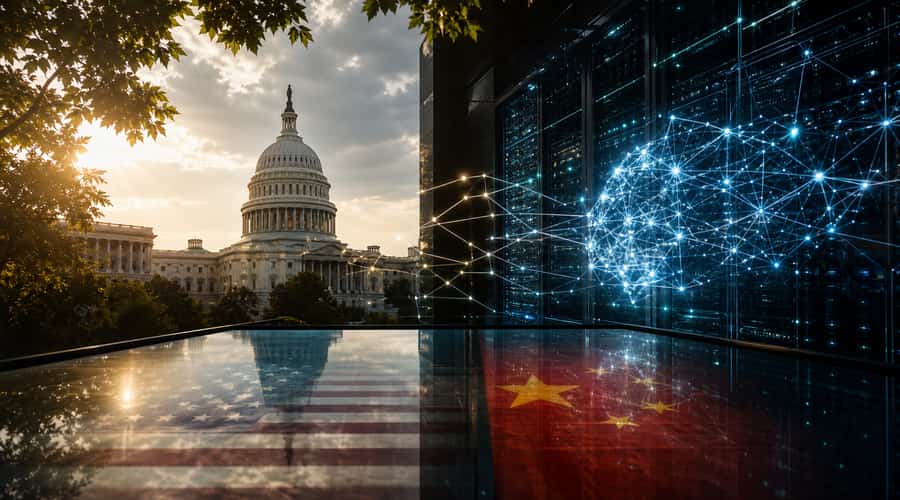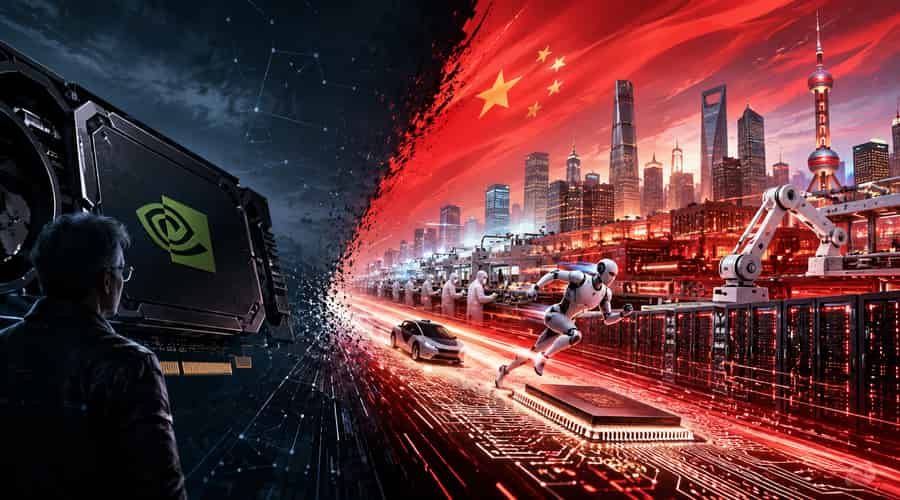
Nvidia's China problem has moved from export paperwork to market reality. Huawei's Ascend orders show that Chinese AI buyers are no longer waiting for Washington or Santa Clara to decide what comes next.
Jensen Huang has been warning for months that if Nvidia is pushed out of China, Huawei will fill the space. Now he is saying the quiet part plainly. In a CNBC interview reported this week, the Nvidia chief said the company has largely conceded China's AI chip market to Huawei, a remarkable admission from the company that still sets the pace for AI infrastructure in most of the world.
The number that makes the statement matter is not Nvidia's share price, or even its latest quarterly growth. It is Huawei's reported order book. According to a Reuters report citing the Financial Times, Huawei expects revenue from its AI chips to reach about $12 billion this year, up from $7.5 billion in 2025, based on orders it has already received. Most of that demand is tied to the Ascend 950PR processor, which entered mass production in March, with an upgraded 950DT planned for the fourth quarter.
That is no longer a workaround. It is a market.
For years, the debate around U.S. chip controls has been framed around whether China could get access to Nvidia hardware through official licenses, gray-market channels or watered-down products like the H20. That question still matters, but it is no longer the whole story. Chinese companies now have a different calculation in front of them: build around a foreign supplier that can be blocked again, or move faster on a domestic stack that Beijing clearly wants to support.
Huawei does not need to beat Nvidia everywhere to win this particular fight. It needs to be strong enough inside China, available enough for Chinese buyers and aligned enough with the country's industrial policy. That is a very different bar from global technical leadership, and Huawei appears to be clearing it faster than many outside observers expected.
The Ascend 950PR is important because it gives Chinese hyperscalers and model labs something concrete to plan around. ByteDance, Alibaba and Tencent have all been reported among the large domestic buyers increasing orders for Huawei chips. That matters because AI infrastructure is not purchased in isolation. Once procurement teams, software engineers, cloud platforms and model developers standardize around one stack, switching back is not as simple as ordering a different accelerator.
Nvidia's advantage has always been the full package: chips, networking, CUDA, developer familiarity and a software ecosystem that turns raw compute into usable capacity. Huawei is still behind that full stack at the frontier. But China has scale, government pressure and a large enough domestic customer base to make the learning curve worth climbing. Every Ascend deployment gives local engineers more reason to optimize for Ascend, and every optimization makes the next deployment easier.
This is where export controls have an unintended effect. They were designed to slow China's access to leading AI compute. In the short term, they have done that. Nvidia's most advanced Blackwell and Rubin systems remain outside China's reach, and Huawei still has to deal with constraints around manufacturing, memory and software maturity. But restrictions also forced Chinese buyers to treat domestic chips as a strategic priority rather than a backup plan.
Nvidia loses more than a sale
For Nvidia, the immediate revenue hit is only part of the issue. China has been one of the world's largest AI markets, and Huang has previously described it as too important for American technology companies to abandon. If Nvidia is absent while Chinese AI infrastructure hardens around Huawei, the company risks losing not just 2026 orders, but influence over how a huge developer market builds and trains models over the next decade.
That is why Huang's language matters. CEOs usually leave themselves room. They talk about uncertainty, long-term opportunity and customer engagement. Saying Nvidia has largely conceded the market to Huawei sounds different. It tells investors that China cannot be modeled as a normal rebound story, at least not for now.
There is still a possible reopening path. U.S. approvals for some Nvidia chips have moved back and forth, and Nvidia has continued to look for products that might satisfy Washington while still being useful to Chinese customers. But Beijing has its own priorities. If Chinese authorities want national champions to absorb the demand, approval from Washington may not be enough to restart Nvidia's business at scale.
The broader lesson is that AI supply chains are becoming political infrastructure. Chips are no longer just performance products sold to the highest bidder. They are part of national strategies, export regimes, cloud buildouts and model ecosystems. Huawei's $12 billion target shows what happens when those forces line up behind a domestic alternative.
For investors and founders, the practical takeaway is simple. Nvidia still dominates the global AI buildout, and nothing in China changes that overnight. But China is becoming a more separate AI hardware market, with its own suppliers, constraints and incentives. The next thing to watch is whether Ascend can move from large procurement numbers to proven frontier-scale training performance. If it can, Nvidia's China exit will look less like a temporary disruption and more like the beginning of a permanent split in the AI stack.
Also read: Google turns Gemini Omni into a new front door for AI video • A fake disease shows why medical AI needs proof, not polish • Google DeepMind shows AI can now solve real research math