Nvidia's concession in China is not just a sales problem. It is a signal that the AI hardware market is being split by policy, supply chains, and national industrial strategy.
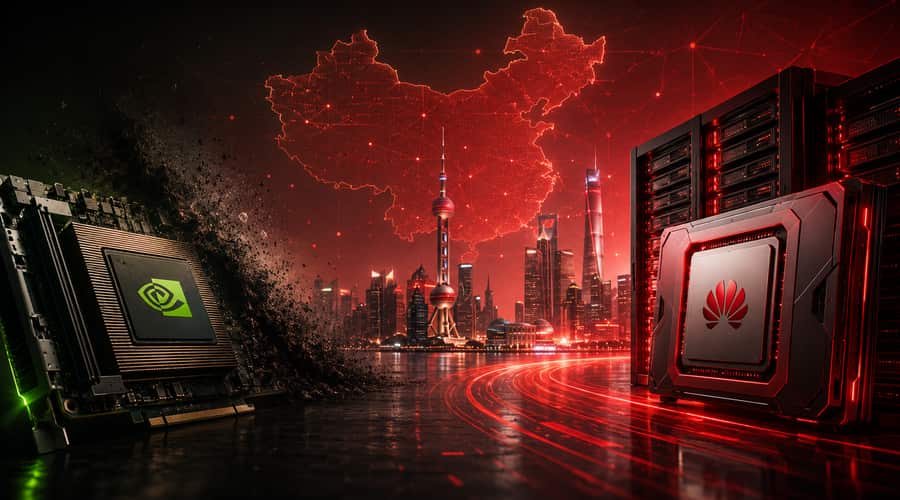
Jensen Huang has now said the quiet part out loud. Nvidia, the company that still defines the global market for AI accelerators, has \"largely conceded\" China's AI chip market to Huawei after years of U.S. export controls and Beijing's push to build around domestic suppliers.
According to CNBC's report on Huang's remarks, the Nvidia CEO said Huawei is \"very, very strong\" in China and that local chip companies are doing well because Nvidia has effectively evacuated the market. That is a blunt admission from a company that once had a commanding position in one of the world's most important AI demand centers.
The timing matters. Huang made the comments as Nvidia reported another huge quarter, with revenue rising 85% to $81.62 billion, while also telling investors not to count on China reopening as a meaningful market anytime soon. The company can still grow at extraordinary speed without China, but the strategic cost is becoming clearer. A market that once helped underwrite Nvidia's data center expansion is being rebuilt around competitors that Washington's restrictions were supposed to contain.
How Huawei gained ground
The shift did not happen because Chinese buyers suddenly stopped wanting Nvidia chips. It happened because access became unreliable. U.S. restrictions first limited exports of Nvidia's most advanced data center GPUs, then tightened further around China-specific products such as the H20. More recently, reports suggested some Chinese companies had received U.S. approval to buy H200 chips, but Beijing's own stance has remained a major obstacle.
That uncertainty creates a powerful incentive for Chinese cloud providers, AI labs, and state-linked buyers to standardize around local hardware. Huawei's Ascend chips may not match Nvidia's strongest systems across every workload, but the enterprise market does not run on benchmark charts alone. Buyers need supply, service, software support, and permission to deploy at scale. In China, Huawei increasingly has the advantage on all four.
This is why Huang's language carries more weight than a normal competitive comment. Nvidia is not saying Huawei has picked up a few customers. It is acknowledging that the structure of the market has changed. Once developers rewrite workflows, procurement teams approve new vendors, and cloud platforms tune services around domestic accelerators, that business does not simply snap back when a license changes.
The startup problem
For startups, the lesson is practical. Any company building AI products for China, selling into Chinese enterprises, or relying on Chinese cloud capacity now has to think beyond Nvidia's CUDA-centered world. Portability across accelerators is no longer a nice technical hedge. It is becoming a requirement for market access.
That changes engineering roadmaps and investor models. A startup that assumes one global compute stack may find itself locked out of China or forced into expensive rewrites later. A company that designs early for multiple backends, even imperfectly, has more room to operate if customers demand Huawei, Cambricon, or other domestic options. The same applies to inference providers, model platforms, and enterprise software vendors that need predictable deployment across regions.
Investors should also be careful with simple market-size arguments. China remains a huge AI market, but it is not equally open to every supplier. Western companies cannot automatically treat Chinese demand as addressable revenue, and Chinese hardware companies now have a protected proving ground where volume, customer feedback, and government preference can reinforce each other.
A split AI economy
The larger point is that export policy has turned into market design. Washington wanted to slow China's access to frontier AI hardware. One result has been to accelerate China's willingness to fund, buy, and tolerate the rough edges of domestic alternatives. That does not mean Huawei has caught Nvidia everywhere. It does mean Huawei has the one thing any platform needs to mature: committed customers with few better choices.
Nvidia still has the stronger global software ecosystem, the deepest accelerator roadmap, and demand from U.S. hyperscalers that remains difficult to overstate. But China is different now. Huang's concession suggests the company is planning around a world where the biggest AI hardware market outside the U.S. may no longer be meaningfully available to it.
The next question is whether this split stays contained inside China or spreads into a broader contest for emerging markets, where price, financing, political alignment, and supply guarantees can matter as much as raw performance. Nvidia's growth story remains enormous, but the China chapter now has a different shape. For founders and investors, the safest assumption is that AI infrastructure will be less global, less standardized, and more political than it looked even a year ago.