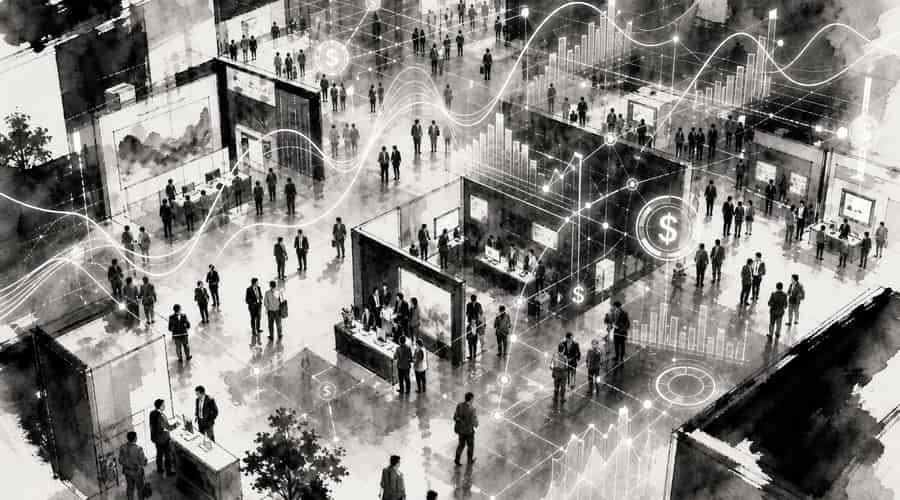

Fears over potential disruption to shipping through the Strait of Hormuz are sending ripples through Middle East financial markets, with AI-driven trading systems amplifying volatility in ways that are catching analysts off guard.
It does not take much to spook a market that sits this close to the world's most consequential oil chokepoint. In the first two weeks of April 2026, traders across Gulf exchanges have been navigating a cocktail of geopolitical tension, spiking insurance premiums on tanker routes, and an almost eerie silence from official channels about what comes next. The result has been a level of intraday volatility that has not been seen in the region since the height of the Red Sea shipping crisis in 2024.
At the center of it all is the Strait of Hormuz, the narrow waterway between Iran and Oman through which roughly 20 percent of the world's traded oil passes every single day. Renewed tensions involving Iranian naval posturing and a series of unconfirmed incidents involving commercial vessels in late March have been enough to send risk models into overdrive. Brent crude briefly touched $96 a barrel in early April before retreating, but the psychological damage to market confidence has lingered.
What makes this particular episode of Hormuz anxiety different from previous ones is the role that AI-powered trading systems are playing in magnifying the noise. Quantitative hedge funds and institutional desks running large language model-assisted sentiment analysis have been reacting to every snippet of news, every naval communique, and every satellite image of tanker traffic with a speed that human traders simply cannot match. The result is that price swings that might once have taken days to develop are now playing out in minutes.
Market participants in Riyadh, Dubai, and Abu Dhabi are watching this dynamic with a mixture of fascination and concern. Saudi Aramco's stock has seen unusual intraday swings, while the Dubai Financial Market General Index has struggled to hold gains even on days when broader emerging market sentiment has been relatively constructive. Analysts at regional brokerages say their institutional clients are increasingly asking the same question: are the machines reading the situation correctly, or are they creating a feedback loop that is detached from the actual probability of a Hormuz disruption?
That question matters enormously because the base case, according to most regional security analysts, remains that a full closure of the strait is unlikely. Iran has historically used the threat of Hormuz disruption as a negotiating tool rather than an action it would actually take, given that it depends on the same waterway for its own oil exports. But in a market environment where AI systems are trained to weight tail risks heavily, the mere credibility of the threat is enough to keep volatility elevated.
The Sovereign Wealth Factor
Adding another layer of complexity is the behavior of the Gulf's sovereign wealth funds, which have spent the past three years dramatically expanding their exposure to global technology and AI infrastructure assets. The Public Investment Fund of Saudi Arabia, Abu Dhabi's Mubadala, and the Qatar Investment Authority have collectively deployed tens of billions of dollars into data centers, semiconductor supply chains, and AI startups. Those bets are now sitting inside portfolios that are simultaneously being buffeted by oil price uncertainty, US-China trade tensions, and the kind of geopolitical risk premium that Hormuz uncertainty tends to produce.
For these funds, the calculus is not straightforward. Higher oil prices driven by supply fear are good for revenues in the short term, but sustained instability in the region makes it harder to attract the foreign direct investment and the technology partnerships that their diversification strategies depend on. The Vision 2030 narrative that Saudi Arabia has been selling to Silicon Valley and Asian tech giants requires a degree of regional stability that right now feels harder to guarantee.
What Comes Next
Diplomats and market watchers will be keeping a close eye on back-channel communications between Washington, Tehran, and Riyadh over the coming weeks. Any signal that tensions are de-escalating could trigger a sharp reversal in the risk premium that has built up in energy and Gulf equity markets. Conversely, any further incidents in or near the strait could send algorithmic trading systems into another round of aggressive repositioning.
For the technology and AI investment story that the Gulf has been building so carefully, the timing is awkward. The region is in the middle of a genuine transformation, with massive data center projects underway, homegrown AI companies attracting serious venture capital, and a young population hungry for the kind of tech economy that diversification promises. None of that fundamental story has changed. But when the world's oil markets are on edge and trading algorithms are amplifying every tremor, even the most compelling long-term narrative has to compete with the anxiety of the moment. The strait has a way of reminding everyone that in the Middle East, geography is never really background noise.