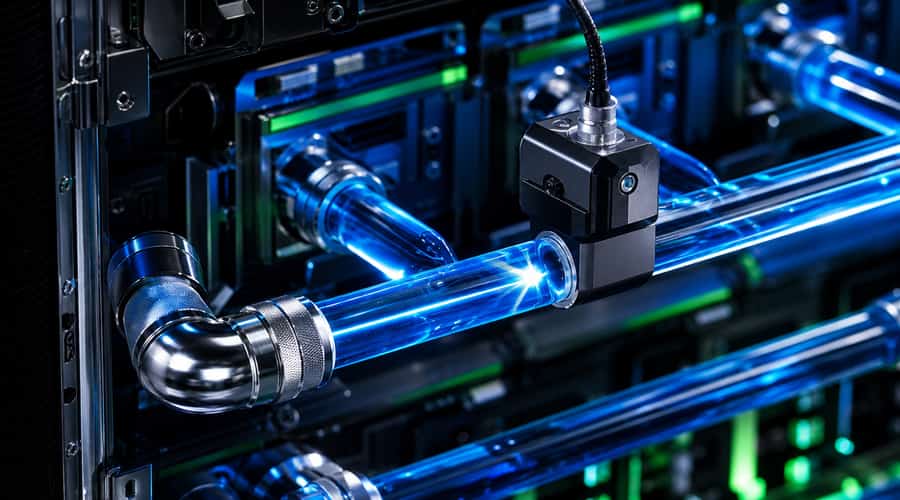
Omen AI just raised $31 million because one of the AI buildout's strangest risks is also one of its most physical: bacteria growing inside the coolant lines around GPU racks. Chips get the headlines, but the fluid now needs its own watchdog.
Bacteria don't care how expensive your GPU cluster is. They colonize coolant lines, form biofilms, clog flow paths, and can force a full system flush that takes a rack offline for five or six hours. At the scale of modern AI infrastructure, that's not a maintenance nuisance. It's a costly outage sitting inside a hose.
According to TechCrunch, San Francisco-based Omen AI said on June 29 that it had raised a $31 million Series A led by Nava Ventures, with participation from CRV, Vanderbilt University, Mann+Hummel, Starhill Holdings, Hard Launch Capital and personal investments from executives at Bridgestone, GM, Johnson Controls and TensorWave. Omen's own June 30 announcement put total funding at $41.5 million since the company's 2024 founding.
The product is narrow in the best possible way. Omen attaches spectroscopic sensors directly to fluid systems and reads coolant health in real time, instead of making operators pull samples and send them to a lab. The company says both its permanent sensor and portable diagnostic unit analyze 21-plus elemental signatures at once, including metal content, bio-contamination and wear patterns. The point isn't to wait for a temperature alarm. The point is to catch the chemical evidence before thermal performance starts to slide.
A founder who followed the fluid
The founder story behind Omen is, frankly, more interesting than most Series A announcements. Zach Laberge started his first company in 2020 at age 14, TechCrunch reported, raising $3 million to install sensors on construction equipment and later dropping out of high school to keep building it. That company, Frenter, eventually shut down. He started Omen in 2024 with a focus on fluid monitoring for industrial machines, where engines, hydraulics and cooling loops all leave clues in oil, coolant and water.
Caterpillar dealerships became early customers. That mattered. Caterpillar is also a major supplier of gas-powered turbines and generators for data centers, and TechCrunch reported that those dealership relationships helped pull Omen toward buildings filled with fluid systems, from HVAC equipment to direct chip cooling loops.
This wasn't a cosmetic pivot. It was a customer lead that opened into a bigger market.
Laberge is 21 now. He has just raised $31 million for a company built around a problem most people outside data center operations wouldn't think to ask about. Youth isn't a credential, and it shouldn't be treated as one. But there is something useful in the outsider's eye here: a lab-testing workflow that operators had tolerated for years looks absurd once you compare it with the uptime demands of AI compute.
The cooling loop is now critical infrastructure
The timing of the raise isn't incidental. McKinsey's latest data center research puts global demand at about 220 gigawatts by 2030, up from roughly 82 gigawatts in 2025, and it says AI workloads will account for most of that growth. The racks are getting denser. Air cooling has limits. Direct liquid cooling is moving from specialist equipment toward normal planning for high-power GPU deployments.
That changes the risk map. A conductivity sensor and a periodic lab sample may have been acceptable when operators could live with a day or two of uncertainty. That patience disappears when an AI cloud provider is selling capacity by the megawatt and training jobs are booked against expensive hardware. A bacterial bloom that spends 48 hours developing while the sample is still in transit is exactly the kind of quiet operational failure investors tend to miss until it costs real money.
Omen's strongest claim isn't only the box on the pipe. It's the data gathered around the box. Every monitored system can add to a library of chemical signatures, helping the company learn what normal looks like across coolant chemistries, flow conditions and machinery types before flagging what isn't normal. That kind of edge compounds if deployment keeps growing.
The customer and investor mix is the tell. Omen says its technology is deployed with data center customers managing 10 to 14 gigawatts of capacity, and its industrial fleet customers include Carolina CAT and dealerships across the US and Canada. Mann+Hummel is an investor, not a confirmed customer in the materials I found, so it shouldn't be used as proof of customer traction. Precision matters here.
There is still a real risk that a hyperscaler eventually builds part of this monitoring layer in-house, the way large cloud operators often do once a category looks important enough. Don't dismiss that. But Omen is betting that the messiest part of the problem sits below the software layer, in coolant chemistry, machine wear and field deployment. A general infrastructure team can build dashboards. It takes a different company to build a reliable sensor business around what is growing in the loop.
The AI buildout has generated endless coverage of chips, power contracts and land. The fluid running through those GPU racks barely gets mentioned. Laberge noticed it early, and Omen now has fresh capital, industrial relationships and live deployments to test whether coolant intelligence becomes a normal line item in AI infrastructure.
Also read: The Trump administration wants equity in AI companies and every founder just got a co-investor they never pitched • Sila raises $300 million to scale battery anode production as AI and defense replace EV as growth engine • Four Rapyd executives who scaled payments past $1 billion just raised $8 million to fix the chaos they lived through