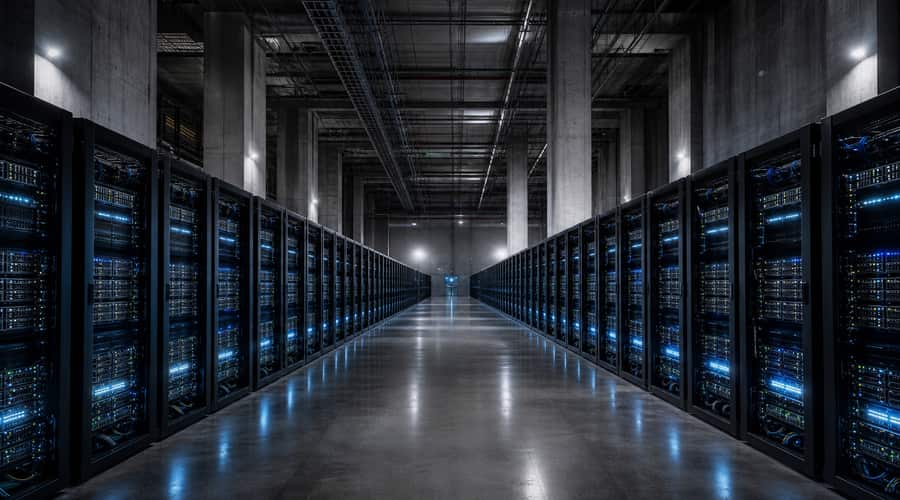
OpenAI securing 10 gigawatts of AI computing capacity ahead of its original 2029 target is the clearest signal yet that the AI competition is being decided in power contracts and data center deals, not just benchmark scores.
Sam Altman said it plainly when the Nvidia deal was announced: everything starts with compute. Bloomberg reported today that OpenAI has signed contracts totaling 10 gigawatts of AI computing capacity, hitting a figure it had originally planned to reach by the end of the decade. That is not a marginal acceleration. It is a statement about where the real competition is happening. The best model in the world cannot reach users without infrastructure behind it. By locking in that infrastructure years ahead of schedule, OpenAI is trying to ensure the next phase of the AI race is fought on terrain it has already claimed.
The 10-gigawatt figure is worth putting in context. One gigawatt can power roughly 750,000 homes. Ten gigawatts of AI data center capacity represents a truly massive physical commitment. OpenAI assembled this through a series of deals: the Stargate partnership with Oracle and SoftBank for up to 4.5 gigawatts, a landmark agreement with Nvidia for up to 10 gigawatts of data center systems backed by up to $100 billion in Nvidia investment, and a separate deal with Broadcom for custom chips and networking at a similar scale. Each of those agreements alone would be the largest infrastructure commitment in most companies' histories. Together, they suggest OpenAI is trying to make the compute layer itself a barrier to entry.
That is the strategic logic here. If OpenAI controls more physical AI capacity than any rival can access in the near term, then its ability to train better models, serve more users and offer lower latency becomes a structural advantage rather than a temporary one. It is the same kind of logic that drove cloud giants to build before demand fully arrived. The company that has the infrastructure when customers need it captures the economics. The company that waits for confirmed demand before building often arrives too late. OpenAI is clearly betting that AI demand will continue to grow and that capacity secured now will look cheap later.
The complication is that 10 gigawatts of data center capacity comes with a financial obligation that is hard to ignore. At roughly $40 to $50 billion per gigawatt, the full buildout could represent hundreds of billions of dollars in commitments across its partners. That is not all OpenAI's money directly. Much of the capital flows through Nvidia's investment commitment, Oracle's construction budgets and SoftBank's infrastructure spending. But the commercial relationships underlying those deals require OpenAI to be a credible long-term partner, which means its revenue outlook matters more, not less, as the infrastructure scale grows.
OpenAI projected revenues of around $12.7 billion for 2025, and its ambitions for 2026 and beyond are substantially higher. But the company still generates enormous operating losses, partly because of the cost of compute it is already running and partly because the infrastructure commitments are only just beginning to come online. The gap between what OpenAI earns today and what it has committed to building is large enough that investors and partners are effectively betting on a version of OpenAI that does not quite exist yet. That is a common situation for companies making infrastructure bets, but it is a more acute version of it when the scale is this large and the competitive environment this fast-moving.
The Broadcom deal adds another layer. That partnership involves OpenAI co-developing custom AI accelerators, which is a direct attempt to reduce dependence on Nvidia for future compute. If OpenAI can move a meaningful part of its workload to its own chips, it gains pricing leverage, architectural flexibility and the ability to build hardware specifically for the tasks its models need. That is a longer-term play, but it fits the same pattern. Every deal OpenAI makes in hardware and infrastructure is an attempt to convert a vendor relationship into something more durable.
What The 10GW Moat Means
For the rest of the market, the implications are uncomfortable. If OpenAI has already secured the compute it needs for the next several years, and competitors have to fight for the remaining supply of chips, power contracts and data center capacity, then the infrastructure gap may already be baked in. Anthropic, xAI and Mistral all need compute too. They are raising money and signing deals, but the combination of Stargate, Nvidia, Oracle and Broadcom gives OpenAI a pool of committed capacity that rivals would struggle to match in the near term. In an industry where the cost of falling behind on infrastructure shows up in training runs, inference speed and product availability, that matters.
It also means the AI market is becoming more capital-intensive, not less. The narrative that open-source models and inference efficiency would democratize the stack has not been wrong, but it has not made the infrastructure race irrelevant either. Efficient models still need to run somewhere, and running at scale still requires power, chips and data centers. The companies that have secured those inputs early have locked in a form of insurance against the next round of demand that competitors and newcomers cannot easily replicate by writing a check today.
OpenAI hitting 10 gigawatts ahead of schedule is a self-reinforcing signal. Partners take bigger bets on companies with more capacity. Enterprise customers sign longer agreements with providers who can guarantee scale. Investors price in a larger addressable market if the supply constraint is already resolved. By moving fast on infrastructure, OpenAI is trying to turn physical capacity into a compounding advantage. Whether the revenue eventually justifies the commitment is the question the market has not fully answered. But the bet itself is now clearly placed, and it is one of the largest in the history of the technology industry.
Also read: Anthropic's Mythos fight shows frontier AI is becoming strategic access infrastructure • Samsung just showed where the AI money is really landing • Thomas Reardon is betting AI's next bottleneck is power