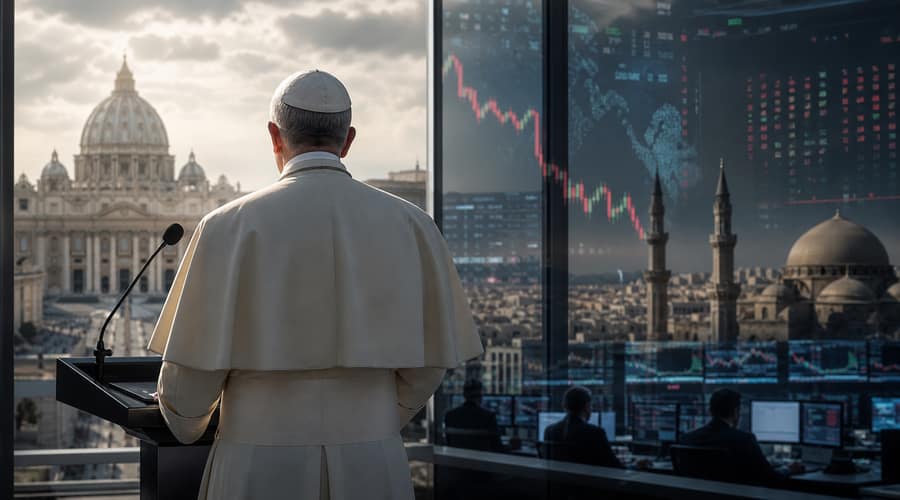
Pope Leo XIV's condemnation of a U.S. missile strike that killed over 100 children at an Iranian school has ignited a diplomatic firestorm with the White House, compounding the geopolitical volatility that continues to disrupt global energy and digital asset markets.
A single Tomahawk missile has done what months of battlefield calculations could not: it has drawn the Vatican into open confrontation with the United States. The February 28 strike on the Minab Girls' School in southern Iran killed 165 people, according to a preliminary Pentagon inquiry completed on March 11. Human Rights Watch and Amnesty International later confirmed that more than 100 children died in what both organizations described as an unlawful attack. The sheer scale of the civilian toll transformed this from a military footnote into a global moral crisis.
Pope Leo XIV wasted no time making his position unmistakable. On March 15, he demanded an immediate ceasefire and denounced the "atrocious violence of war." By April 10, he went further, explicitly rejecting theological justifications for the conflict with a blunt statement: "War is not waged in God's name." The parents of the Minab victims published an open letter to the Pontiff on April 19, pleading for moral accountability. The Vatican responded the following day by declining to engage in a political debate with Washington, instead reaffirming its focus on the humanitarian catastrophe unfolding in Iran.
President Trump chose escalation over restraint. On April 13, he labeled Pope Leo XIV "weak" and "terrible" on foreign policy, accusing the Pontiff of ignoring Iranian aggression while fixating on American military actions. The administration's stance has placed American Catholics in an increasingly uncomfortable position. The U.S. Conference of Catholic Bishops has defended the Church's "Just War" tradition in response to comments from Vice President Vance, even as several cardinals have followed the Pope's lead in speaking out against the humanitarian toll.
The rift has fractured the Western alliance in plain view. Italian Prime Minister Giorgia Meloni called Trump's attacks on the Pope "unacceptable," a striking rebuke from a leader typically aligned with Washington on security matters. In a genuinely bizarre twist of geopolitics, the Iranian President condemned the "insult" directed at Pope Leo XIV by American leadership, creating a moment of rare public alignment between Tehran and the Vatican. While visiting Cameroon, the Pope sharpened his rhetoric further, criticizing "a handful of tyrants" who spend billions on war, language widely interpreted as directed at the Trump administration. He later stated he has "no fear" of speaking out, making clear he has no intention of backing down.
What This Means for Markets
Geopolitical chaos of this magnitude does not stay contained in diplomatic circles. Oil markets have been roiled by the conflict, with prices spiking on threats of escalation and the potential blocking of the Strait of Hormuz. As the Financial Times recently noted, a deep skepticism has settled into energy trading desks regarding any peace signals, keeping prices stubbornly elevated. American consumers are feeling the consequences directly: gasoline prices have reportedly reached $4.00 per gallon, eating into household budgets and dampening consumer sentiment at a moment when the domestic economy was already fragile.
Equity markets have mirrored the instability. The Dow Jones experienced its best single-day gain in a year following a brief and ultimately failed ceasefire announcement in early April, only to give back ground as the reality of a protracted conflict set in. Crypto assets, often pitched as geopolitical hedges, have oscillated in lockstep with risk sentiment rather than demonstrating any meaningful decoupling. When the White House signals a "long battle" ahead following Iranian retaliatory strikes, digital asset investors have demonstrated the same risk aversion gripping traditional markets, raising real questions about Bitcoin's viability as a safe haven during genuine geopolitical crises.
The path forward offers few reassuring signals. Trump has maintained an unapologetic stance, and the Vatican has made clear it will not be drawn into a political sideshow while civilian casualties mount. With no ceasefire in sight and both sides entrenched, the probability of further escalation remains high. Investors should watch three things carefully: any movement in Strait of Hormuz shipping traffic, the trajectory of U.S. consumer spending as fuel costs bite harder, and whether the papal rhetoric inspires broader international coalitions to pressure Washington and Tehran toward negotiations. The Minab tragedy has already changed the diplomatic landscape. Its full economic impact is still unfolding.