Proception has settled Tesla's trade secret lawsuit and raised $11 million, which tells you two things at once: robotic hands are suddenly valuable enough to fight over, and investors are still willing to back a founder who just walked out of court.
Zhongjie "Jay" Li left Tesla in September 2024 after working on advanced robotic hand sensors for Optimus, the humanoid robot program Elon Musk has repeatedly pitched as central to Tesla's future. By June 2025, Tesla had sued him and Proception in federal court in San Francisco, alleging that Li downloaded sensitive design files, source code, specifications and prototype videos to personal devices before leaving the company. The complaint was blunt. Tesla said Proception had moved too fast to look clean.
Now the case is over. As TechCrunch reported, Tesla's lawsuit was dismissed after a settlement with Li and Proception, and the company announced an $11 million seed round the same day. First Round Capital partner Bill Trenchard led the financing, with Y Combinator and BoxGroup also participating. You don't need to pretend the timing was subtle. A trade secret lawsuit is a hard thing to carry into a robotics fundraise. Settling it cleared the room.
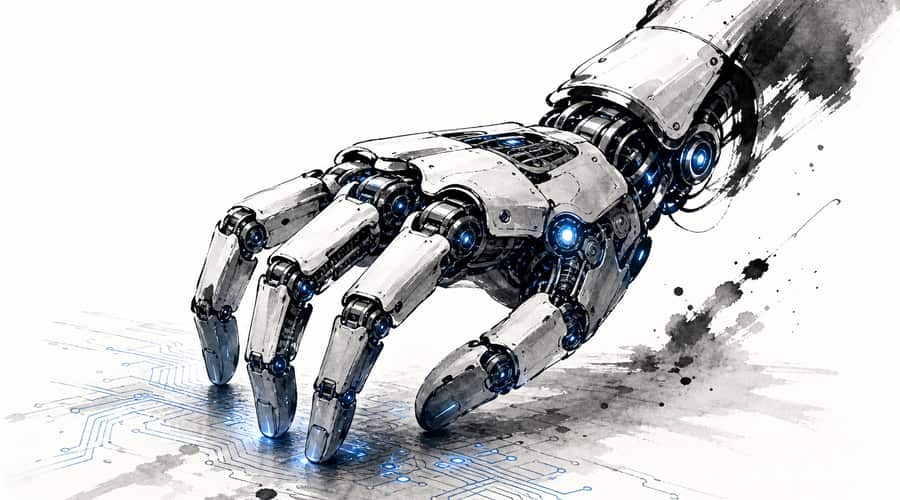
Trenchard gave TechCrunch the investor case in one sentence, saying Proception could have "the best hand in the market, maybe the most sophisticated hand today, and the underlying data and models to support that." That's a big claim for a company that was just accused by Tesla of building on stolen work. It may also be exactly why investors stayed interested. In humanoid robotics, the hand is not a decorative part. It is where the robot either becomes useful or remains a demo on a stage.
Proception's product is not just a robot hand. The company is also building a sensor-heavy glove with 22 degrees of freedom and multiple joints per finger, designed to capture human hand interaction data without putting a robot through every trial. That detail matters. If you can collect dexterous manipulation data directly from human hands, you can train robotic systems without making every expensive mistake through hardware first. Researchers understand the value of that immediately.
Li's pitch is straightforward: Proception wants to supply robotic hands to companies that don't want to spend years building their own dexterous manipulation stack. That's a real opening. Tesla, Figure AI, Agility Robotics, Unitree, UBTech, 1X, you name it, are all chasing machines that can do more than walk across a factory floor. A humanoid that can't reliably grasp, twist, pinch, lift and release is still unfinished, no matter how well it balances.
The fight was always about know-how
Tesla's June 2025 complaint, first reported by Bloomberg and then picked up widely, alleged that Li worked at Tesla from August 2022 to September 2024 and incorporated Proception less than a week after leaving. Tesla also claimed Proception showed robotic hands within five months that bore a "striking resemblance" to Optimus designs. Those are allegations, not findings. The settlement terms are confidential, and that means you don't know what Li agreed to, what Proception changed, or whether Tesla walked away with restrictions that shape the startup's roadmap.
Here's the thing: that uncertainty is now part of the business model for contested spinouts. The people who know how to build these systems are not sitting outside the industry waiting to be hired. They are inside Tesla, Boston Dynamics, Nvidia-backed robotics labs and Chinese manufacturers with state support behind them. When they leave, they carry expertise in their heads even if every laptop is clean. The legal fight begins when a former employer argues that know-how crossed the line into stolen files.
Tesla has good reason to be aggressive. In its Q1 2026 update, the company said first-generation Optimus production lines were being installed at Fremont in anticipation of volume production, with Musk talking about a path toward far larger scale later. Whether you believe Tesla's timeline or not, the company is spending real engineering attention on Optimus. A former engineer building a rival hand supplier is not a side issue to them.
Proception also has a reason to move quickly. Robotics hardware punishes slow companies. If your customer is a lab or humanoid startup that needs dexterous hands now, it won't wait politely while you spend four years proving purity. That is why the settlement and the fundraise belong in the same story. The legal cloud did not make the company uninvestable. It made the diligence harder.
China adds pressure to all of this. The Financial Times reported this month that China is pushing robotics and embodied AI as part of a broader answer to demographic decline, with companies and local governments trying to move humanoids from showcase floors into factories and services. Business Insider also reported that BYD wants humanoid robots in its car showrooms within one to two years. You don't have to buy every forecast to see the direction. The race is becoming industrial, not theatrical.
For founders leaving a major robotics program, Proception is not a permission slip. It is a warning with a check attached. The legal bill is real. The distraction is real. Confidential settlement terms may limit what you can build or sell, and you may never be able to explain those limits publicly. But if you have a product investors believe customers need badly enough, the money can still come after the lawsuit. Frankly, that is the more useful lesson than pretending this was a clean victory for either side.
Also read: OpenAI scrambles to fix Codex as coding agent usage blows past its own capacity models • Asian AI rivals fill the gap left by Anthropic's export ban and match frontier performance for a fraction of the cost • Millennium Management is building its own AI lab and that changes the competitive calculus for quant finance