FINMA is showing what AI supervision now looks like in practice: daily blockchain monitoring, anomaly checks before inspections, and early tools for spotting insider trading in crypto markets.
Financial firms have spent years adding machine learning to trading, fraud detection, compliance, and customer checks. Regulators have not always moved at the same pace. You can live with that gap for a while if the market is slow. You cannot live with it forever when crypto trades around the clock and AI-driven firms can move faster than a supervisor can read a filing.
Switzerland's Financial Market Supervisory Authority, FINMA, is now giving you a clearer view of the next phase. Reuters reported on June 26 that FINMA chair Marlene Amstad, who also chairs the IOSCO SupTech Forum, described a generative AI system that reads the large document sets supervisors handle before an on-site inspection and flags anomalies for closer review. A second AI model then checks those outputs for hallucinations before they reach a human examiner.
That last part matters. FINMA isn't just dropping a chatbot into a regulator's workflow and calling it supervision. It is building a check into the system because a false pattern can waste time, and a missed one can let a real problem keep moving. Accuracy is not a nice extra here. It is the job.
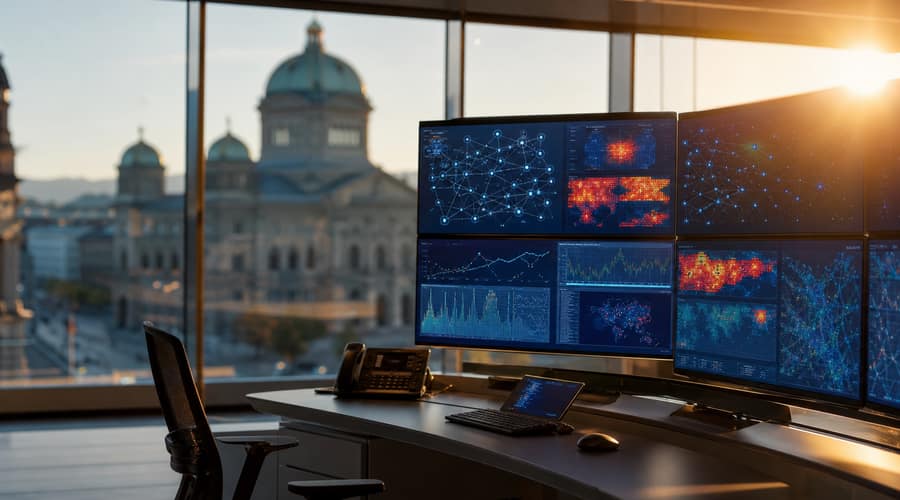
The crypto work is more direct. FINMA has built a real-time dashboard that pulls blockchain data daily, combines it with quarterly reported figures, and uses that mix to watch concentration risk at institutions and on individual blockchains. It also looks at operational risk at token level. On top of that, the regulator is developing AI tools to detect suspicious trading patterns and assess whether those patterns point to insider trading. According to Reuters, some of these tools came out of a June hackathon where about 100 policy specialists and technologists worked together.
That is the story. A regulator is no longer waiting for periodic reports and then trying to reconstruct what happened after the fact. It is moving closer to continuous supervision, using the same kind of data speed that markets themselves already use.
FINMA is still the exception. IOSCO's SupTech report, published June 18, surveyed 49 jurisdictions and found that many authorities remain in partial implementation. A separate Cambridge Centre for Alternative Finance survey of 130 regulatory bodies found that only 18% had scaled AI adoption. Nearly half were still exploring AI or not engaged with it at all. Consumer and investor protection was the most developed area, with more than 75% of authorities reporting some SupTech activity there, while digital assets and other domains remained below the halfway mark.
You should read that 18% figure carefully. It means the regulatory map is becoming uneven. A crypto exchange, fintech lender, or AI-driven trading firm may face one supervisor with daily data tools and another still working through pilots, procurement, cyber-risk concerns, and staffing shortages. Compliance risk is not spread neatly across borders. It depends on who is watching and what they can actually see.
IOSCO is trying to narrow that gap. Its members oversee more than 95% of global securities markets, and Amstad's role at the SupTech Forum gives FINMA's work a wider audience than Switzerland alone. In May, IOSCO published its AI Supervisory Toolkit, meant to give securities regulators a practical framework for AI oversight. The point is not hard to understand: if firms use AI to trade, lend, screen, and route money, supervisors need tools that can keep up with that speed.
Frankly, the firms most exposed are not the largest exchanges. The big platforms already expect inspection, reporting demands, and expensive compliance build-outs. The tighter squeeze lands on mid-sized crypto firms, DeFi projects with institutional on-ramps, AI prop shops, and fintech lenders that assumed regulators would stay slower than their own systems. That assumption is getting weaker.
There is also a useful warning here for anyone building AI inside a financial business. FINMA's two-model hallucination check may be more disciplined than the validation process some firms use for their own internal tools. If a regulator can show that it checks AI outputs before acting on them, the same question comes back to the market: do you?
The lazy framing is to call this an arms race. Don't bother. Regulators are not trying to out-trade trading firms or out-code software companies. They are trying to reach the point where AI-assisted oversight can catch patterns that human review misses at scale. FINMA appears to be moving toward that point in Switzerland. IOSCO's survey shows how far many other regulators still have to go.
The important fact is not that every supervisor has arrived. They have not. The important fact is that the model is now visible: daily data, automated anomaly detection, human review, and AI checking AI before the result becomes a supervisory lead. If you operate in crypto, fintech, or AI-led finance, you should assume that the slowest regulator you deal with today is not the one you will deal with tomorrow.
Also read: Meta is building a prediction market app called Arena and the existing players should be worried • The New York Times is now arguing Microsoft built a machine specifically designed to steal journalism • OpenAI is raiding Apple's Vision Pro talent as the headset quietly dies