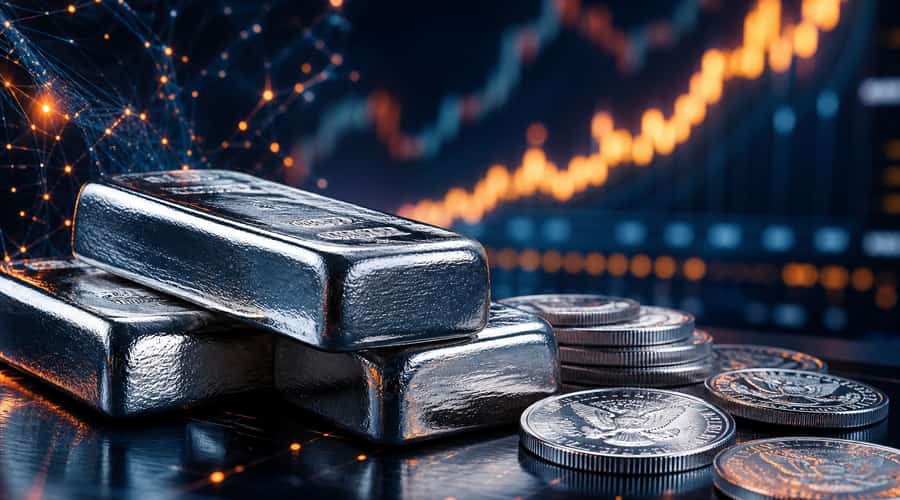
A wave of small business owners who bought silver during the 2023-2024 bull run are now liquidating those holdings at a loss to cover operational costs , and it's quietly reshaping the secondary market.
The post reads like dozens of others circulating on Reddit and X right now: a spouse watching a small business struggle, a stack of physical silver sitting in a safe, and a painful question about whether to sell. What started as a personal financial confession has become a genuine trend, surfacing a cohort of retail investors caught between two crises at once , a stalling Main Street economy and a silver spot price that's retreated sharply from where many of them bought in.
Silver is currently trading in the $28.00 to $29.50 per ounce range, down roughly 12% from its Q1 2026 highs. For anyone who accumulated physical silver during the 2023 rally , when spot prices regularly cleared $32.00 an ounce , that math is brutal. Selling now means locking in a real loss, not just a paper one. Yet that's exactly what a growing number of people are doing, not because they've lost faith in the metal, but because the rent is due and the line of credit is closed.
The Federal Reserve's decision to hold rates elevated through early 2026 has made small business borrowing expensive enough that many owners simply stopped trying. Meanwhile, the U.S. Census Bureau's March retail sales figures, released earlier this month, showed discretionary spending contracting more sharply than economists projected , bad news concentrated heavily among independent Main Street operators who don't have the balance sheet resilience of chains. When the bank says no and customers aren't spending, the safe in the home office starts looking like a checking account.
On r/Silverbugs and r/personalfinance, the mechanics of this situation are being dissected in real time. Users debate the ethics of selling on a dip versus holding through what many still believe is a temporary price correction. Some are exploring the secondary dealer market rather than spot-price-based buyers to recover closer to their cost basis. Others are asking whether partial liquidation , selling enough silver to buy three or four months of runway , is smarter than a full exit. The financial calculus is messy, and the emotional weight is heavier still when a partner's livelihood is the variable being optimized.
What distress selling does to the market
Precious metals have always attracted investors precisely because they're meant to be the asset you don't touch when things get hard. Physical silver, in particular, carries a cultural weight in the retail investing community , something you hold through cycles, not something you offload at the first sign of stress. When that psychology breaks down at scale, it matters for price discovery. An increase in physical supply hitting the secondary market from motivated sellers tends to cap near-term price recovery, regardless of what macro conditions might otherwise support a rally.
This isn't a market-moving volume event in the way institutional repositioning would be, but it functions as a pressure valve. Every stack sold by a retail investor in distress is one fewer buyer waiting on the sideline for a dip, and one more unit of physical supply available to dealers and re-sellers. If the small business liquidity crunch deepens through Q2 , which the March spending data suggests is plausible , that pressure could persist long enough to meaningfully delay any return toward Q1 price levels.
There's also a broader economic signal embedded in this trend that deserves attention beyond the metals community. Household safety nets built on tangible assets are being drawn down five years into the inflationary cycle that began post-pandemic. When families start selling their crisis hedges to manage a crisis, the hedge has already failed , not as a store of value in the abstract, but as a practical instrument for people who needed liquidity faster than the market could provide it at acceptable prices.
For anyone holding silver and watching a similar situation unfold, the most useful lens isn't whether to sell , it's whether the business in question needs a one-time cash injection or ongoing support. Silver sold today to cover April's invoices won't be there for May. The investors navigating this most thoughtfully on the forums aren't the ones asking whether silver is a good long-term hold. They already know the answer to that. They're asking how to make a finite asset last long enough to reach the other side of whatever this moment turns out to be. That question , how to endure rather than just react , is the one worth sitting with.
Also read: J.P. Morgan calls gold's rally a secular trend and raises its price target to $2,950 with $3,000 in sight • How to tell if your inherited silverware is worth more than its weight in silver • How to tell if your inherited silverware is worth more than its weight in silver