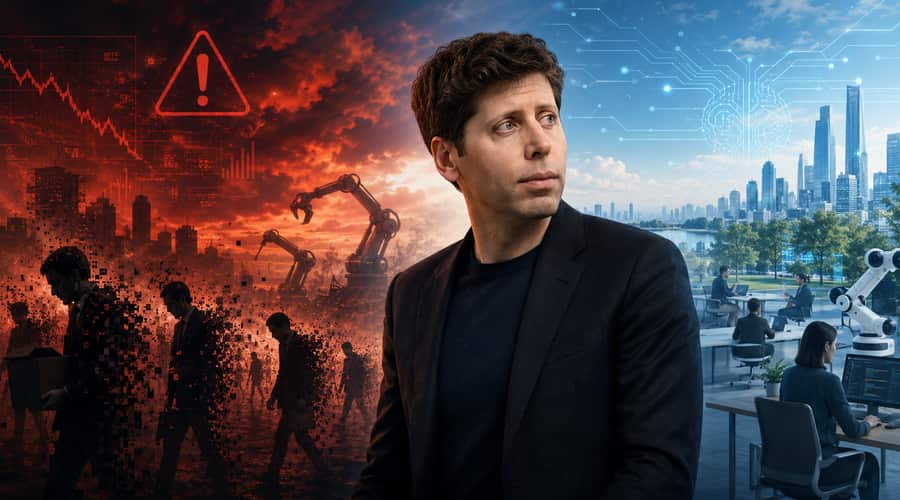
Sam Altman is now saying the AI jobs wipeout he once warned about is probably not coming. That shift matters because it changes the tone of the entire AI labor debate.
OpenAI chief executive Sam Altman used a public appearance in Sydney this week to walk back one of his most attention-grabbing warnings about artificial intelligence, saying the feared "jobs apocalypse" now looks unlikely. Reuters reported that Altman told a Commonwealth Bank of Australia event he had expected far more damage by now, especially in entry-level white-collar work, but that the evidence had forced him to rethink that view.
That is a notable reversal. Altman has been one of the loudest voices in the sector when it came to the social risks of AI, and his earlier warnings helped shape how founders, investors and corporate buyers talked about the technology. When someone with that profile publicly says he was wrong about the pace of job destruction, it does not end the debate, but it does change the framing. The story is no longer simply about how fast AI can replace work. It is now also about how slowly businesses absorb it, and how much of the human element still sits inside most jobs.
According to Reuters, Altman said OpenAI's technical predictions about how quickly models would improve had been broadly right, but that the company had been "pretty wrong" on the social and economic consequences. He told CBA chief executive Matt Comyn that he was glad to be wrong because he had expected more impact on entry-level office jobs than had actually happened. That nuance matters. Altman is not saying AI cannot disrupt employment. He is saying the timeline, and perhaps the shape of that disruption, is proving different from what many people in the industry assumed.
For startups building AI-native products, the shift lands at an awkward and useful moment. Many founders have spent the last two years pitching automation, efficiency and headcount reduction to skeptical buyers, while also navigating investor pressure to show real revenue rather than vague promise. Altman's new tone gives enterprise buyers a little more room to talk about augmentation instead of layoffs, which may make procurement conversations easier in industries where AI adoption has been slowed by fear and internal resistance.
There is also a broader credibility issue at play. The AI sector has relied heavily on dramatic claims to attract attention, talent and capital, but those claims can become a burden when reality arrives more slowly than the hype cycle promised. If the most prominent executive in the market now says the feared labor shock is overstated, others may follow. That does not mean the underlying risk disappears. It means the narrative is shifting from immediate mass displacement to uneven, task-level change that may take longer to show up in payroll data.
Altman's comments also echo a growing split inside AI leadership. Some executives continue to stress large-scale job loss as an inevitable consequence of the technology, while others are starting to sound more cautious about timing. Reuters noted that Altman still believes the jobs picture will be very different from what people expected, but he no longer thinks the industry is heading straight toward the kind of apocalypse some have described. That sounds like a correction, not a retreat.
What it says about OpenAI
The timing is hard to ignore because OpenAI itself is in a new phase. Reuters has previously reported that the company is laying the groundwork for a possible public listing that could value it at as much as $1 trillion, with filings potentially in the second half of 2026 and a listing target that could land in 2027. In that context, Altman's Sydney remarks look less like a casual opinion and more like part of a broader effort to present OpenAI as a mature platform company rather than a source of social panic.
That does not mean the comments were scripted for investors. But public language matters when a company is moving toward a capital markets story. A softer line on labor displacement makes OpenAI easier to sell to enterprises, regulators and public market investors who want growth without the optics of mass replacement. It also helps keep the company on the right side of customers who want AI tools to improve work, not simply eliminate workers.
For readers in the startup world, the takeaway is straightforward. The AI market is still real, the adoption curve is still moving, and companies will keep automating tasks where they can. But the loudest warning from the sector's most visible figure is no longer as absolute as it once sounded. That gives founders a better opening to build products around workflow gains, human oversight and measurable productivity, which is likely where the strongest enterprise demand will live.
The bigger point is that AI's labor story is becoming less theatrical and more practical. That is not a weaker story. It is a more credible one.
Also read: Kirkland Ellis is betting 500M that legal AI should be built, not bought • Salesforce is betting debt and buybacks can steady its AI-era story • Taiwan's AI debt surge shows how far the buildout has spread