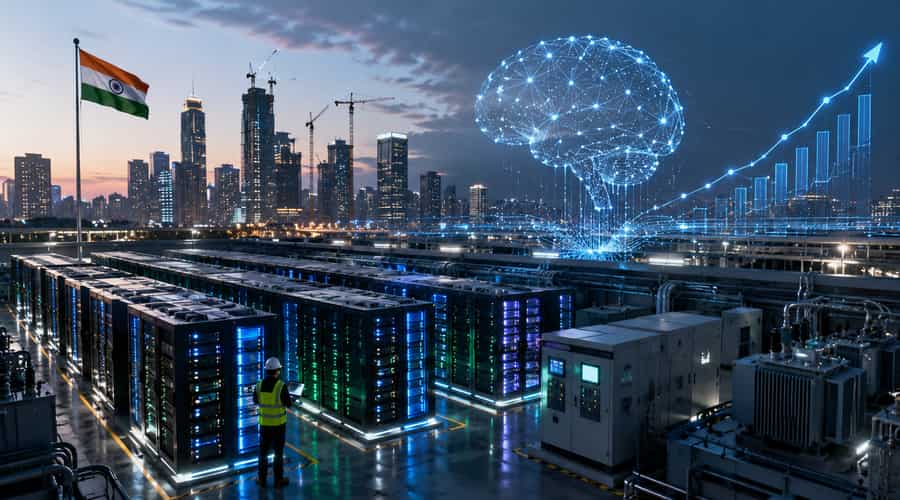
Schneider Electric’s India data center business is growing faster than its wider local operations, showing that the country’s AI infrastructure boom has moved from ambition to execution.
India’s AI story is no longer just about models, talent and software services. It is now about substations, cooling systems, power distribution and the ability to keep racks of servers running every hour of the day. That is why Schneider Electric’s latest comments matter.
The French industrial group expects its India data center business to outpace its broader operations in the country over the next four to five years, driven by demand for AI-ready infrastructure. Sumati Sahgal, Schneider Electric’s vice-president for Secure Power and Data Centres in the Greater India Zone, told Reuters that data centers already account for 15% to 20% of the company’s India business and are growing at a double-digit pace.
That may sound like a supplier update. It is more than that. Schneider sits in the physical layer of the AI economy, supplying the electrical, cooling and energy management systems that cloud providers and data center operators need before a single GPU can generate revenue. When that part of the stack starts reporting faster growth, it tells investors and founders that AI capital spending has started landing in the ground.
For the past two years, much of the market conversation has focused on Nvidia, cloud software and large language models. Those remain important, but they are not the whole story. AI systems need dense power, reliable cooling and industrial-grade controls. That makes companies like Schneider Electric, Legrand, Vertiv and Eaton central to the next phase of the buildout.
India is a useful test case because the demand is visible from several directions at once. Microsoft has said its biggest India data center is on track to go live by mid-2026, with country head Puneet Chandok pointing to strong demand for Azure cloud services and Copilot. Reuters has also noted that Microsoft, Alphabet and Amazon see India as a major AI market because of its large internet user base and deep pool of technology talent.
The local capacity gap is equally important. India produces and consumes a large share of global data, but its share of global data center capacity remains small. That mismatch is now pulling in hyperscalers, regional cloud players, real estate groups and infrastructure suppliers. Schneider’s own view is that India’s data center capacity could rise from about 1.5 gigawatts today to 6 or 7 gigawatts by 2030.
That kind of growth changes the vendor map. The opportunity is not limited to the companies selling servers or cloud subscriptions. It extends to switchgear, transformers, liquid cooling, backup power, monitoring software, construction services and renewable procurement. In other words, the picks and shovels of AI are starting to look more industrial than digital.
Power will decide how fast India can move
The harder question is whether India’s grid can keep up with the speed of demand. Data centers are not ordinary commercial buildings. They need large blocks of stable electricity, often in locations where transmission capacity, land availability and local permitting all have to line up at the same time.
This is where the story becomes practical for entrepreneurs and investors. A data center plan is only as good as its power strategy. Grid connection delays, equipment shortages and rising cooling requirements can turn a strong market into a slower buildout. In mature markets such as the United States, utilities and regulators are already wrestling with the strain of AI-related load growth. India now has a chance to build with those lessons in mind, but it does not have unlimited time.
Schneider’s comments also show why investment may spread beyond the established hubs of Mumbai and Chennai. Sahgal pointed to states such as Gujarat and Rajasthan as companies look for new locations closer to customers and power availability. That regional shift could create opportunities for local developers, utilities and service providers, but it may also force states to compete on grid readiness rather than just land incentives.
For startups, the opening is not only in building AI applications. There is room for software that manages energy use, tools that improve cooling efficiency, platforms for power procurement and services that help operators plan capacity. The businesses that reduce friction in the physical buildout may become as valuable as some of the companies building on top of it.
There is still a risk of overenthusiasm. Data center forecasts can move faster than actual construction, and AI demand is expensive to serve. The winners will be the companies that can convert announced capacity into operating capacity without letting power costs, water use or reliability problems undermine the economics.
Still, Schneider Electric’s signal is hard to ignore. India’s AI infrastructure market is moving into a revenue stage, not just a planning stage. The next thing to watch is whether the country’s power and cooling ecosystem can scale as quickly as the cloud companies want it to. That will decide how much of the AI boom India actually captures.
Also read: AI is turning bug hunting into a security arms race • TSMC workers are testing the price of the AI chip boom • Washington’s quantum bet faces a legal test over equity stakes