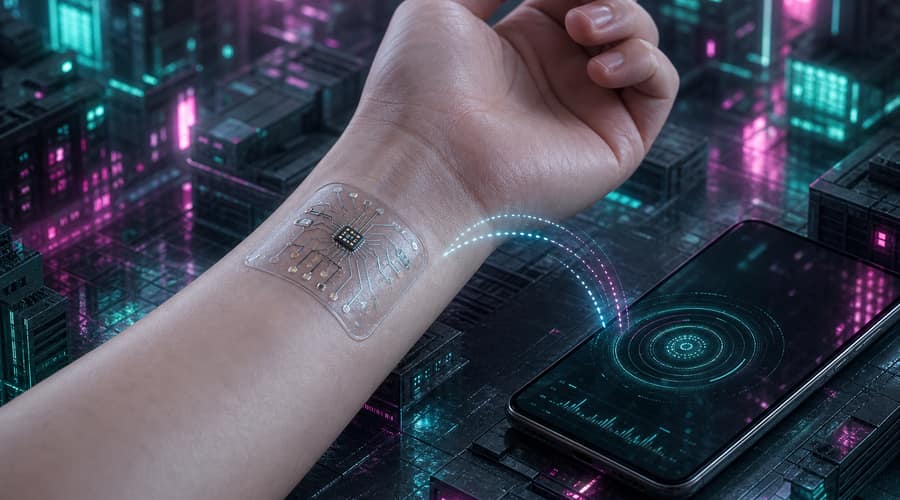
A NUS-led team has built a battery-free skin sensor network for continuous systolic blood pressure monitoring, but the work is still a research prototype, not a clinic-ready device.
The promise here is not that a cuff has disappeared from tomorrow's pharmacy shelf. The useful part is narrower and more interesting: researchers led from the National University of Singapore have shown a battery-free epidermal sensor network that can monitor systolic blood pressure continuously while separating wireless power delivery from data transmission.
According to the Nature Electronics paper, published on April 10 and included in the journal's May 2026 issue, the system uses epidermal sensors connected through a dual-mode metamaterial textile. Power is delivered at 13.56 MHz, while biological data is sent back over a 2.4 GHz channel. That separation is the engineering point. A wearable medical device that tries to power sensors and move data through the same small body-worn system has to fight interference, heat, battery limits and ordinary human movement at the same time.
The device does not measure blood pressure the way a cuff does. It uses synchronized epidermal sensors to collect physiological signals and infer systolic blood pressure continuously, including during dynamic settings such as exercise. In the paper's figures, the authors describe continuous multimodal measurements during daily activities including commute, sleep and exercise. That is the use case conventional cuffs handle badly, because a cuff gives you a reading at a moment in time and often interrupts the person being measured.
The author list matters because this is not a single-lab gadget being pushed through a press release. Selman A. Kurt, Kevin Albert Kasper and Qinghao Xu are listed as equal contributors, with John S. Ho of NUS among the corresponding authors. The affiliations also include the University of Arizona and Tsinghua Shenzhen International Graduate School, which makes the project more of a cross-border engineering effort than a simple Singapore-only story.
The clinical reason to care is straightforward. The World Health Organization's latest hypertension fact sheet estimates that 1.4 billion adults aged 30 to 79 worldwide had hypertension in 2024, and roughly 600 million of them were unaware they had it. Blood pressure also changes across the day. Sleep, exercise, stress, meals and the first stretch after waking can all matter to diagnosis. A single reading in a doctor's office is useful, but it is a thin slice of a moving condition.
There is a hard limit to the story, and it should stay visible. The Nature Electronics paper establishes a technical approach for continuous systolic monitoring with battery-free epidermal sensors. It does not establish that the system is ready for broad clinical use. No industry partner has been named in the paper, no commercial launch date has been set, and the device still sits in the research-prototype category.
Other wearable blood pressure systems are further along in different ways. A 2023 Nature Communications paper described a thin wristband-style system for continuous wireless artery blood pressure monitoring, tested in initial trials on 87 volunteers and clinical tracking of two people with hypertension. That device used a rechargeable lithium-ion battery and a pressure adaptation unit, so it solved a different problem. The NUS-led work is more focused on making the body-worn sensor network battery-free.
That distinction is why the NUS approach is worth watching. Batteries sound like a small nuisance until the user is elderly, managing several prescriptions, or expected to wear a monitor through sleep and normal movement. Removing the battery from the sensor patches does not solve validation, manufacturing or medical approval. It does remove one of the reasons wearable health devices fail outside the lab: people eventually stop charging and wearing them.
Don't expect this to replace cuff monitors next year. The paper's real contribution is the wireless architecture, a sensor network powered through a metamaterial textile while sending data on a separate channel. The next question is less glamorous and more important: whether the system can hold up in larger, messier studies with the people who would actually need it.
Also read: Stripe is quietly building the infrastructure that makes stablecoins unavoidable for global commerce • China closes a quantum computing supply gap by mass-producing silicon-28 • NewCore launches with $66 million to give AI agents proper enterprise identities