AI investors are no longer only paying for the companies building models. They are paying for the memory bottlenecks those models cannot run without.
SK Hynix is now close enough to a $1 trillion market value that the question is no longer whether AI has created another semiconductor winner. The better question is whether public markets have started to value supply-chain chokepoints more aggressively than the model labs that made artificial intelligence famous in the first place.
Reuters reported on May 14 that SK Hynix had a market capitalization of roughly $948 billion, based on Wednesday's share price and exchange rate, after its shares rose more than 200% this year and 274% in 2025. That is a remarkable move for a memory company, a sector investors historically treated as cyclical, capital intensive and brutally exposed to price swings. The difference this time is that AI servers do not just need powerful processors. They need high-bandwidth memory, conventional DRAM and storage in volumes the industry was not built to supply this quickly.
Samsung Electronics crossed the $1 trillion mark earlier in May. If SK Hynix follows, South Korea would become the first country outside the United States with more than one trillion-dollar company. That would be more than a national bragging point. It would show how deeply the AI trade has moved into the industrial base of countries that control the components sitting behind Nvidia GPUs, cloud data centers and every large model rollout.
The early AI stock market story was easy to understand. Investors bought the companies selling chips, renting cloud compute or building frontier models. Nvidia became the shorthand for the entire cycle because it had the part everyone needed and almost nobody else could supply at scale. But as the buildout has matured, the market has started to look past the processor and into everything that lets the processor work.
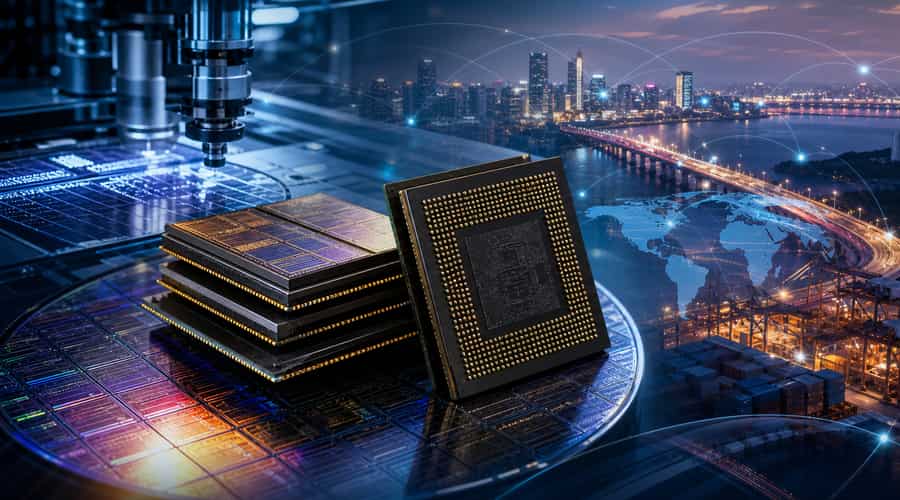
That is where SK Hynix has gained its power. High-bandwidth memory, or HBM, is stacked close to advanced processors so AI systems can move data quickly enough to train and run large models. Without it, the most expensive accelerators lose efficiency. With too little of it, cloud companies cannot deploy capacity as fast as demand arrives. This is why a company once seen mainly through the boom-and-bust lens of memory pricing is being re-rated as an AI infrastructure company.
The shift matters because it changes how investors think about who captures value. Model labs may have the brands, the talent and the product excitement, but many are still private, heavily funded and expensive to operate. Memory makers, by contrast, are already public, profitable and sitting on a supply constraint that customers cannot easily route around. When scarcity moves from software access to physical capacity, the market follows the factory floor.
There is also a broader Asian market structure story here. South Korea and Japan have become cleaner public-market routes into the AI buildout for investors who do not want to bet only on U.S. mega-cap technology stocks. That helps explain the speed of the rally. It also explains the discomfort. IG analyst Fabien Yip has described parts of the Korea and Japan AI trade as driven by fear of missing out, especially around companies linked to AI infrastructure. That does not make the trade wrong, but it does mean price can move faster than fundamentals can prove themselves.
Scarcity has to keep doing the work
The case for SK Hynix depends on memory scarcity lasting long enough to justify the valuation. So far, the supply backdrop supports the bulls. Samsung, SK Hynix and Micron are all trying to add capacity, but advanced memory is not a simple switch. HBM needs complex production, packaging and customer qualification. Conventional DRAM supply is also tightening because capacity is being pulled toward higher-margin AI products.
That squeeze is already showing up beyond the data center. Smartphone makers, PC suppliers and consumer electronics companies are facing a market in which AI customers get priority and everyone else pays more or waits longer. For SK Hynix, that is a strong pricing environment. For the rest of the technology supply chain, it is a cost problem that can eventually show up in device prices and margins.
The risk is that investors start treating scarcity as permanent. Memory has always had a habit of turning shortage into expansion, then expansion into oversupply. This cycle may be different in duration because AI demand is unusually large and customers are trying to secure supply years ahead. But it is still a manufacturing cycle. New fabs, better yields, Samsung's push to regain ground in HBM and Micron's own AI memory strategy all matter. The more capital floods into the shortage, the more important timing becomes.
Labor is another pressure point. Samsung workers in South Korea rallied on April 23 over bonuses and threatened an 18-day strike starting May 21 if talks fail, at a moment when the memory market is already tight. A disruption at one of the world's largest chipmakers would not automatically benefit SK Hynix in a clean way. It could push prices higher, but it could also make customers more nervous about geographic concentration in memory supply.
For now, SK Hynix has become one of the clearest examples of how AI is redrawing market leadership. The companies building models still matter, but the public-market winners are increasingly the companies that remove friction from the physical buildout. If SK Hynix crosses $1 trillion, it will not just be a stock milestone. It will be a sign that investors see memory as one of the central gates into the next phase of AI infrastructure.
The next thing to watch is not only the share price. It is whether HBM shortages, conventional DRAM pricing and customer prepayments keep moving in the same direction. If they do, South Korea's AI trade has room to run. If supply catches up faster than expected, today's trillion-dollar logic will face the oldest memory-market test of all: what happens when scarcity fades.
Also read: China's AI listings face a liquidity test in July • Cerebras IPO puts a public price on the AI infrastructure boom • Blackstone brings the AI data center trade to public investors