Solana's Q1 2026 report shows a network that kept growing while its token struggled, and that split is now the real story.
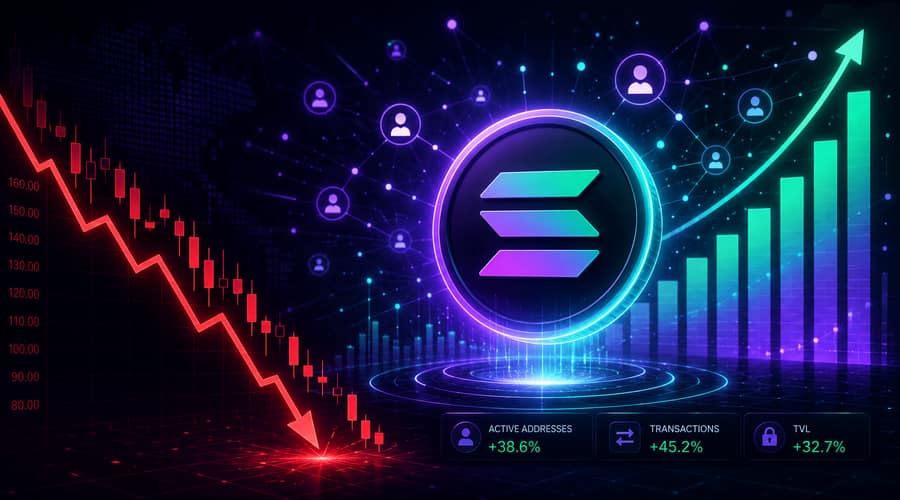
Solana just delivered a quarter that would have looked bullish in almost any other market. According to Messari's newly released State of Solana Q1 2026 report, the network generated about $342.2 million in chain GDP, its real-world asset market cap climbed 43% quarter over quarter to $2.01 billion, and on-chain activity kept expanding even as SOL fell roughly 30% to 35% during the same period.
That divergence matters because it separates usage from speculation. A token can trade lower while the network underneath it gets busier, and that is exactly what Solana's latest numbers suggest. For founders, infrastructure investors, and protocol teams, the signal is simple enough: the chain's demand profile is no longer easy to dismiss as a price-driven reflex.
The headline metric is the one that usually gets the most attention, and for good reason. Solana processed more than 10 billion non-vote transactions in Q1 2026, a quarterly record cited across recent coverage of the report, while broader Artemis data put total transactions for the period at 25.3 billion. That scale is not just a vanity figure. It says the chain is still behaving like a high-throughput venue for trading, payments, and application traffic, even when the broader market is less forgiving.
Economic activity followed the same path. Artemis data, cited in recent market analysis, put Solana's total network activity at $1.1 trillion in the quarter, its first trillion-dollar quarter. Active address figures vary by methodology, but several trackers showed user activity running well above late-2025 levels for much of the period. The network also handled a rising share of on-chain spot trading, with Blockworks-linked reporting putting Solana at 41% of total market share in the quarter.
That combination is the reason the report has resonated beyond crypto traders. It points to a chain whose utility layer is maturing on its own timetable. If users are still transacting, building, and settling value when the token is under pressure, then the ecosystem's economic base may be wider than its price action implies.
What the price missed
The token market told a different story. SOL started the year in the $120 to $125 range, then lost roughly a third of its value by the end of the quarter, according to the figures circulating with Messari's release and related coverage. That is the sort of move that usually cools enthusiasm around an ecosystem, but Solana's on-chain data did not follow that script.
Instead, the report showed resilience in the parts that matter most to developers and institutional users. RWA activity rose sharply, stablecoin usage remained strong, and Solana's app economy continued to produce meaningful revenue. Pump.fun led application revenue in the quarter with about $124.7 million, while Solana's real economic value slipped only slightly to $89.5 million, still enough to place it near the top of the chain rankings behind Hyperliquid.
That split is important because it changes how the network is judged. For a long time, Solana was often described through the lens of token volatility, outages, or memecoin cycles. The Q1 data pushes the conversation toward throughput, settlement, and app-level monetization. Those are the metrics that matter when a startup is deciding where to launch and when a fund is deciding which infrastructure bet deserves a longer horizon.
Why founders care
For builders, the most useful part of the report is not the quarterly record itself, it is the shape of the demand behind it. Solana's RWA market cap moved above $2 billion, and tokenized assets became one of the faster-growing segments in the ecosystem. That is the kind of movement that can pull in teams working on DeFi, payments, tokenized funds, and settlement rails, especially if they want a chain that can handle real throughput without making every transaction feel expensive.
The next step is technical as much as commercial. Solana's Alpenglow upgrade is aimed at cutting finality from about 12.8 seconds to roughly 150 milliseconds, with recent reporting pointing to testing and a possible 2026 rollout window. If that lands, it would strengthen Solana's case in areas where speed is not a nice-to-have but a core product feature, including trading, payments, and tokenized finance. In other words, the roadmap is starting to look like a business argument, not just an engineering one.
That is why the market split is worth watching. Price still moves sentiment, and sentiment still matters, but Solana's Q1 report suggests the network is no longer living and dying by the same cycle as its token. The usage base is broadening, the revenue profile is deepening, and the institutional conversation is shifting accordingly. For the people building on top of it, that is the part that counts.
Also read: JPMorgan to Hire More AI Talent, Fewer Traditional Bankers, and What It Means for Startups | Gemini 3.5 Flash takes the lead in Zapier's AutomationBench | Kalshi's new backing shows prediction markets have won over Wall Street