SpaceX is no longer treating Starlink mobile as a side business for dead zones. After a record IPO, a $25 billion bond sale, and a $17 billion spectrum deal, it is moving toward the carriers' home turf.
The Financial Times reported this week that SpaceX president Gwynne Shotwell told investors during the company's IPO roadshow that the group is considering a Starlink retail mobile product for US consumers. She also floated something more expensive and more threatening: SpaceX could build its own terrestrial mobile network in the US to handle dense urban traffic.
That is the part AT&T, Verizon and T-Mobile should read twice. Starlink has already proved that satellites can fill gaps where towers do not reach. A ground network would be a different claim altogether. It would mean SpaceX wants to sell you mobile service under its own name, not only sit behind another carrier's plan when your phone loses signal on a rural highway.
The pieces are no longer theoretical. The Associated Press reported in September 2025 that SpaceX agreed to buy EchoStar's AWS-4 and H-block spectrum licenses in a $17 billion transaction, split between $8.5 billion in cash and $8.5 billion in SpaceX stock. SpaceX also agreed to cover about $2 billion in EchoStar debt interest payments through November 2027. The deal included a long-term commercial arrangement that would let Boost Mobile users connect through Starlink's next-generation direct-to-cell service.
Spectrum is not a press-release asset. It is the thing you need before you can credibly pretend to be a carrier, and SpaceX has now bought a serious chunk of it. The Financial Times noted that SpaceX would still be far behind the big three carriers in overall spectrum depth, with about 65MHz against roughly 1,020MHz for larger rivals. That gap matters, especially in cities. But it does not make the move harmless. A company does not spend $17 billion on wireless licenses because it wants to remain a subcontractor forever.
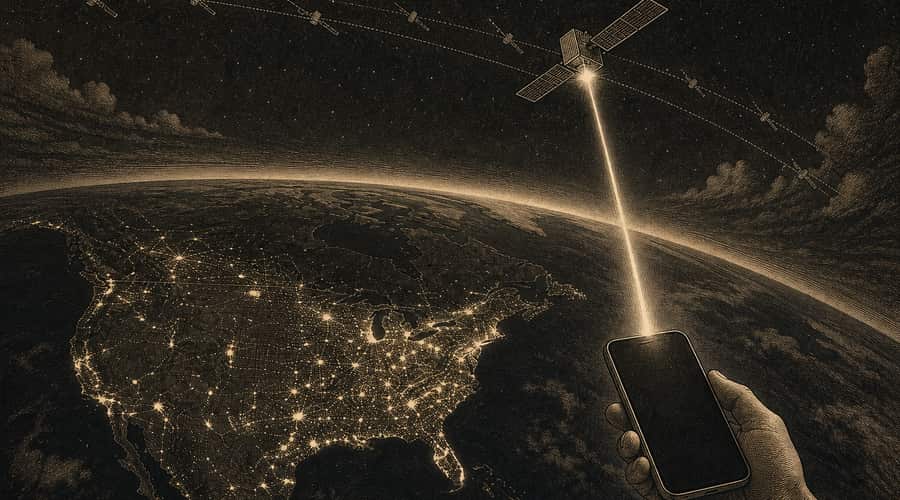
For now, the product most US consumers can actually touch is T-Mobile's T-Satellite service. It launched commercially in July 2025 with Starlink direct-to-cell coverage for texts, emergency messaging and selected app data outside ordinary tower range. Android Central reported that the service is included on T-Mobile's higher-tier plans and is available to other wireless users, including AT&T and Verizon customers, for $10 a month.
That arrangement is useful for T-Mobile and useful for SpaceX. It also keeps Starlink subordinate to somebody else's pricing, customer relationship and retail brand. If SpaceX sells mobile contracts directly, the power balance changes. You would no longer think of Starlink as the emergency layer underneath your carrier. You would start comparing it with the carrier itself.
The financing backdrop makes the timing harder to ignore. MarketWatch reported that SpaceX's first bond sale as a public company drew as much as $89 billion in demand and was increased to $25 billion from an initial $20 billion target. The Wall Street Journal reported that the deal included five maturities and that a $6 billion, 10-year note priced at a spread of 1.4 percentage points over US Treasurys. The money is real. So is the pressure to justify it.
Allianz chief investment officer Ludovic Subran told the Financial Times that the bond sale looked like a sign of bubble territory, with companies taking advantage of high equity prices and friendly credit markets while they can. That criticism should not be waved away. SpaceX's public valuation depends on investors believing Starlink can grow beyond home broadband, government contracts and rural coverage. A consumer mobile story helps sell that belief.
Frankly, the story is credible enough to make the carriers uncomfortable. Starlink says it has more than 10 million customers across 160 countries and territories, while The Guardian recently put the figure above 12 million active users. T-Mobile has already put Starlink in front of ordinary phone customers. EchoStar's spectrum gives SpaceX a path away from total dependence on partners. The next-generation Starlink mobile satellites add the other missing piece: capacity.
Starlink has said its V2 satellites are designed to deliver 100 times the data density of the current V1 generation, with early testing expected around early 2027, according to reports from Tom's Hardware and TechRadar. Do not treat that as a finished network. Satellite mobile service still has hard limits, especially indoors, in crowded cities and anywhere bandwidth has to be shared across a large coverage area. But the direction is plain. Texting from space was the demo. Mobile broadband is the prize.
The carriers know it. The Verge reported in May that AT&T, T-Mobile and Verizon had agreed in principle to form a joint venture aimed at reducing US wireless dead zones, including investment in satellite-based direct-to-device technology. Those three companies do not usually join hands unless the alternative looks worse.
SpaceX still has to build the retail service, win regulators over, price it sensibly and prove that satellite plus a terrestrial network can handle normal consumer expectations. That is a lot of work. But the old comfort for carriers, that Starlink was only useful where their networks were absent, is wearing thin. Once SpaceX owns spectrum, satellites, launch capacity and the customer relationship, the question is no longer whether it can annoy the big carriers. It is how much business it wants to take from them.
Also read: GCash parent Mynt files for a $1.5 billion IPO that would reset what Southeast Asian fintech is worth • The Pentagon is formalizing AI's role in military targeting and the procurement stakes run into the billions • X Money rolls out to more verified users and its 6% savings rate is just the opening move