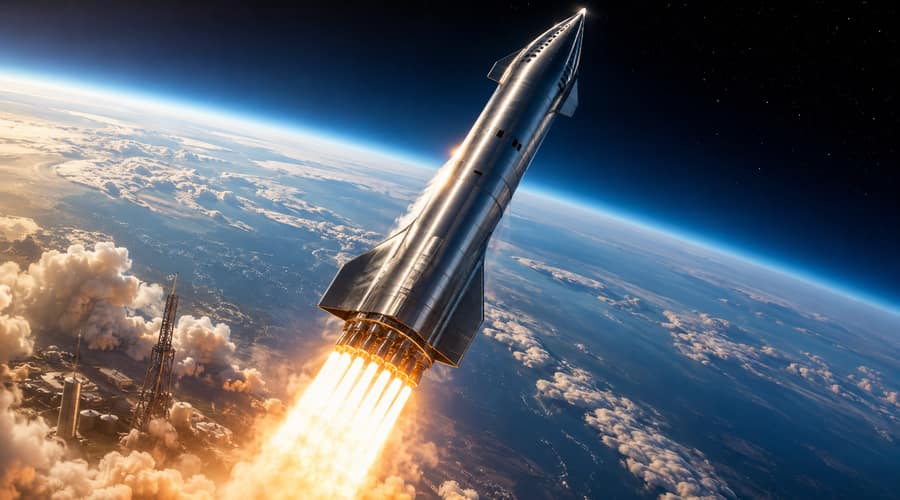
SpaceX's first Starship V3 flight reached space, released Starlink test payloads, and survived enough of its hourlong trip to strengthen the IPO story. The harder question is whether investors will accept a business case that still depends on turning spectacular tests into routine transportation.
SpaceX gave public markets exactly the kind of image it wanted two days after putting its IPO plans in front of investors: the most powerful rocket ever built rising from Starbase, Texas, and sending a redesigned Starship across the world toward the Indian Ocean. It was not a clean flight. The Super Heavy booster failed to complete its return profile, and the ship dealt with engine trouble before splashdown. But for a program built around fast iteration, Flight 12 looked like progress where it mattered most.
The launch took place on May 22 at 5:30 p.m. Central Time after a scrub the previous day. The 407-foot vehicle was the first Starship V3 to fly, using SpaceX's third-generation Raptor engines and a redesigned stack that the company needs for two very different customers: Starlink and NASA. According to the Associated Press, the rocket carried 20 mock Starlink satellites and released them during the roughly hourlong test flight, while SpaceX also used modified Starlink hardware to inspect the ship's heat shield from space. That detail matters because future versions of Starship are supposed to return to the launch site, not simply survive a one-way demonstration.
The timing was difficult to miss. SpaceX's public IPO filing landed on May 20, with reports pointing to a potential valuation around $1.75 trillion and a listing as soon as June. The filing ties much of the company's future to Starship becoming a reusable heavy-lift system that can launch next-generation Starlink satellites and eventually support lunar missions. In plain terms, SpaceX is asking investors to value the company not only on what Falcon 9 and Starlink already do, but on what Starship might make cheap enough to do at scale.
The Booster Failure Still Matters
The most obvious blemish came from the booster. After stage separation, Super Heavy attempted its planned return sequence over the Gulf of Mexico, but it did not complete the burn as intended. SpaceX was not trying to catch the booster with the launch tower on this test, so losing it did not erase the rest of the mission. Still, reusing the booster is central to the Starship cost story. If that part remains inconsistent, the economics become less clean.
The upper stage gave SpaceX more to work with. Starship continued through space, deployed payloads, re-entered, performed its landing flip, and reached the Indian Ocean before erupting on impact, an outcome SpaceX said was expected. That is the awkward but familiar language of modern rocket development. A test can end in fire and still move the program forward if the data answers the right questions.
That distinction will matter to investors. Traditional aerospace programs sell reliability early and iteration quietly. SpaceX does the opposite. It makes the failures public, absorbs the embarrassment, and uses the data to compress the engineering cycle. That has worked before with Falcon 9. The IPO question is whether public shareholders will tolerate the same rhythm when the valuation is no longer private-market theory.
Starship Is Becoming The Business Plan
V3 is more than a taller rocket. The new design is meant to handle heavier payloads, faster refurbishment, and the kind of satellite deployment cadence that Falcon 9 cannot match forever. Starlink is already a large part of SpaceX's revenue base, and the next generation of satellites will demand more lift, more volume, and lower launch costs. Starship is the answer SpaceX is selling.
NASA adds another layer. The agency is relying on Starship as part of the Human Landing System effort for Artemis, while Blue Origin is developing its own Blue Moon lander under a separate NASA contract. Administrator Jared Isaacman has kept pressure on the 2028 lunar landing goal, and that puts SpaceX in a useful but constrained position. Government anchor missions bring credibility and funding, but they also bring schedules that cannot be managed like internal product roadmaps.
For startups building around the space economy, the signal is simple. If Starship moves from test flights to routine payload delivery, the cost structure for satellites, space stations, in-space manufacturing, and orbital data services changes quickly. If it does not, many plans built around cheaper access to orbit stay trapped in pitch decks.
The next milestone is not only another flight. It is the market's judgment on whether SpaceX can turn a development program with visible failures into a public company valued like a global infrastructure platform. Flight 12 helped that argument, but it did not settle it. Investors will now watch for repeatability: more payload deployment, better booster performance, and proof that Starship can become a service rather than an event.