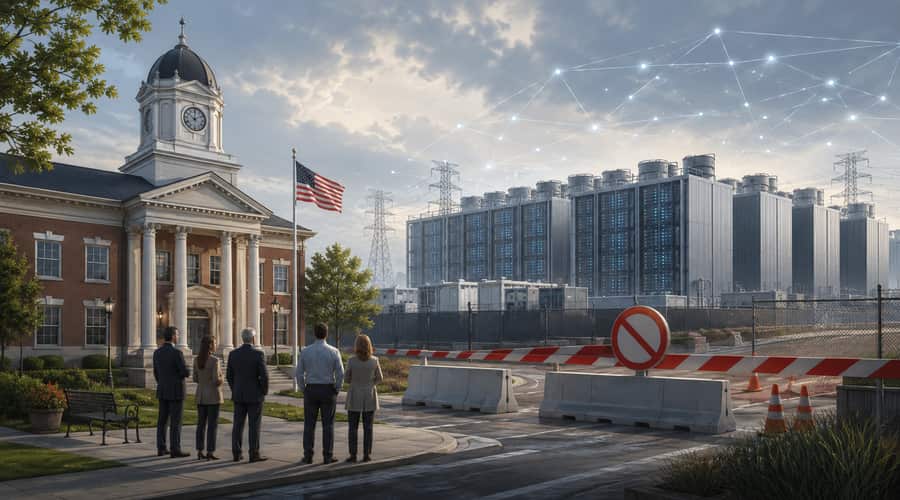
A Missouri suburb just voted 7-1 to block data centers, turning the AI build-out into a local land-use fight. The vote is a warning about water, secrecy, and the new politics of digital infrastructure.
The St. Charles City Council voted on May 19 to amend its zoning code and exclude data centers from every permitted and conditional land-use category. The move made permanent a one-year moratorium that followed months of public anger over Project Cumulus, a proposed 440-acre facility near the city's well field and Highway 370. For AI infrastructure builders, the signal is clear: a project can have capital, power demand, and a willing developer, but still fail if residents decide the risk is too high.
Ward 3 Councilman Vince Ratchford, who sponsored the change, captured the council's position when he said there was no place in the community for data centers as they currently exist. As Spectrum News reported, the 7-1 vote made St. Charles the first Midwest city with a data center ban and the fourth in the country, according to Interconnected Capital's tracker. That matters because zoning fights are becoming part of the AI supply chain.
How Project Cumulus Collapsed Under Public Pressure
The dispute began with Project Cumulus, a proposed data center from CRG Cumulus LLC, the development arm of Clayco. Clayco founder Bob Clark said a project like it could have brought $2 billion in craft labor construction payroll, more than 100 permanent high-paying jobs, and tens of millions of dollars in annual tax revenue. He also argued that the project would have funded upgrades to St. Charles' water system, which has faced contamination concerns. That economic case did not carry the room.
Residents focused on a different balance sheet. They raised concerns about construction dust, 24-hour noise, electricity use, backup fuel storage, wetlands, and the site's proximity to the city's drinking water source. One resident, John Henderson, put the worry plainly: that the city would allow someone to build on its water source. The Missouri Department of Conservation also raised questions after learning the project was a data center, not simply light industrial development, and reports at the time said the facility could discharge about 5 million gallons of water a day into Dardenne Creek.
The developer withdrew its application before the council could vote on the original proposal. That withdrawal did not end the dispute. It hardened it. Residents had already seen enough to decide that the process itself was part of the problem, especially after city officials signed nondisclosure agreements that kept the end user's identity hidden. Mayor Dan Borgmeyer later acknowledged that the city had not provided enough information and said there would not be another NDA. In a local land-use fight, secrecy can be more damaging than an unfavorable environmental report.
Zoning Is Becoming An AI Bottleneck
St. Charles is not an outlier. Communities across the US are starting to examine what AI infrastructure means on the ground. Data centers need large electrical loads, substantial cooling plans, backup generation, road access, and often hundreds of acres. Those details matter more when the site sits near homes, floodplains, wetlands, or drinking water infrastructure. For founders and infrastructure investors, site selection is no longer just a technical exercise. It is a political one.
The traditional development playbook depends on speed, confidentiality, and a promise of future tax revenue. St. Charles rejected that sequence. The new ordinance defines data centers broadly and removes them from the city's normal approval paths unless local leaders rewrite the rules again. That raises the procedural bar. It also gives other municipalities a model if they want time to study water use, energy demand, noise, and emergency response before projects arrive.
Regional leaders are now caught between two pressures. Business groups warn that bans can make Missouri look uncertain at a time when other states are competing hard for AI infrastructure. Residents counter that uncertainty is exactly what they were handed when a Fortune 100 end user was kept private and public officials could not answer basic questions. Both sides have a point. Data centers can bring construction jobs and tax revenue, but the permanent employment count is often modest compared with the size of the facility and the infrastructure burden around it.
The practical lesson for AI builders is not to avoid St. Charles or Missouri. It is to change the order of operations. Bring the tenant into the public conversation early. Publish water and power assumptions. Fund independent environmental review before residents demand it. Explain backup generation, wastewater, noise, and emergency response in plain language. A community benefits agreement will not mean much if the community believes the real deal was negotiated behind closed doors.
That is why this vote matters beyond one suburb. The AI boom is usually described in terms of chips, models, capital spending, and hyperscaler strategy. St. Charles shows another constraint: local trust. If companies need low-latency capacity near specific metro areas, they cannot assume zoning will absorb whatever the market wants to build. The next phase of AI infrastructure will be shaped as much by city councils and water boards as by GPU supply. Smart founders will plan for that before the permit clock starts.
Also read: Tencent Hy-MT2 proves specialized AI models have edge • VinFast debt transfer sparks governance concerns • VinFast debt move raises governance questions