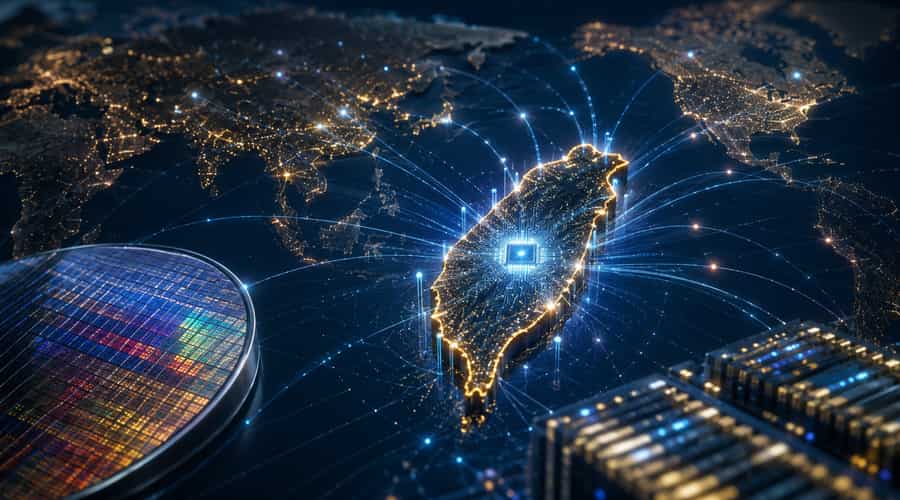
Taiwan has moved past India to become the world's fifth-largest stock market, and the reason is not complicated: investors are paying up for the companies that make AI possible.
Taiwan's rise in the global market rankings is really a story about where capital believes the AI economy is being built. The island's listed companies were valued at about $4.95 trillion as of Monday, just ahead of India's $4.92 trillion, putting Taiwan behind only the United States, mainland China, Japan and Hong Kong.
That is a remarkable shift for a market attached to an economy far smaller than India's. But equity markets do not rank countries by population or long-term growth narratives. They rank them by the cash flows investors are willing to underwrite today, and right now the strongest conviction trade in global equities is still advanced semiconductors.
Data compiled by Bloomberg put Taiwan's market value ahead of India's on May 25, with the move powered mainly by Taiwan Semiconductor Manufacturing Co., the foundry at the center of the AI hardware chain. TSMC manufactures advanced chips for Nvidia, Apple and other major technology companies, giving Taiwan a direct link to the spending boom in AI servers, accelerators and data center infrastructure.
TSMC is not just another large stock inside Taiwan's market. It is the market's gravitational center. The company represents more than 42% of the Taiex benchmark, so every major reassessment of demand for AI chips quickly becomes a reassessment of Taiwan's entire equity market.
That concentration cuts both ways. It gives global investors a clean way to express confidence in the AI infrastructure cycle, but it also means Taiwan's headline market value is heavily dependent on one company's execution, pricing power and geopolitical resilience. If TSMC keeps converting demand for advanced nodes into revenue growth, Taiwan's premium can hold. If AI spending slows or customers pull back, the same concentration can work in reverse.
For now, investors are not treating that risk as enough reason to stay away. Nvidia's accelerators, Apple's custom silicon and hyperscaler demand from companies building massive compute capacity all point back to high-end fabrication. TSMC sits in the middle of that system, and the market is assigning value accordingly.
This is why Taiwan's move past India matters beyond the ranking itself. It shows that AI is no longer just lifting software names or a handful of U.S. mega-cap stocks. It is changing how investors value entire national markets when those markets contain bottleneck assets the rest of the world cannot easily replace.
India's setback is about rotation, not a broken story
India has not suddenly lost its appeal. Its market climbed the global league table on the back of strong domestic growth, rising retail participation, policy optimism and the view that it could benefit from supply chain diversification. Those themes still matter, especially for investors with a long horizon.
But the market has been more vulnerable as global capital rotates toward harder AI exposure. India's listed universe is broader and more domestic in nature, with banks, consumer companies, industrials and conglomerates carrying much of the index weight. That gives investors exposure to a large economy, but it does not offer the same direct link to the AI infrastructure buildout that Taiwan now offers through TSMC and its surrounding technology supply chain.
That distinction is important. In a normal cycle, investors might reward India's breadth because it signals durability. In the current cycle, they are rewarding scarcity. There are many markets tied to consumption growth. There are far fewer markets with a national champion sitting at the center of advanced chip manufacturing.
The result is a clean example of how market narratives can change faster than economic narratives. India's long-term story remains intact, but Taiwan has the asset investors want most right now. In equity markets, timing matters. Capital tends to move toward the strongest immediate earnings signal, and AI hardware still has that signal.
The next question is allocation
The bigger issue now is whether this ranking shift changes institutional behavior. Emerging-market funds have traditionally treated India as a core growth allocation, while Taiwan has often been seen through the narrower lens of technology and semiconductor exposure. That line is becoming harder to maintain.
There is also a practical policy angle. Under a new Taiwan guideline reported alongside the market milestone, funds focused only on Taiwanese stocks can hold up to 25% of assets in a single listed company if that company accounts for more than 10% of the exchange's weighting, up from the previous 10% cap. That matters because concentration is no longer just a market feature. It is becoming something regulators and asset managers are being forced to accommodate.
If foundry capacity and advanced packaging are now viewed as essential AI infrastructure, Taiwan may attract capital from investors who previously focused on U.S. chip designers or broad Asian benchmarks. That does not mean every portfolio manager will rush to buy Taiwan at any price. It does mean the island's equity market is likely to be discussed less as a regional market and more as part of the global AI supply chain.
The risk is that this creates a market too dependent on one idea. AI demand is strong, but expectations are already high. A delay in data center spending, a margin squeeze in chip manufacturing or a geopolitical shock around Taiwan would have an outsized impact because so much of the market's recent strength rests on the same foundation.
Still, the milestone is hard to ignore. Taiwan passing India is not simply a league table curiosity. It is a sign that investors are putting a higher value on the infrastructure behind AI than on many broader growth stories. The next phase to watch is whether that preference spreads further into Asian indexes, semiconductor suppliers and capital equipment companies, or whether the market begins to ask how much AI optimism has already been priced in.
Also read: Pony AI is raising the bar for robotaxi scale in 2026 • Quantinuum tests public appetite for quantum computing with its IPO • Ferrari’s first electric car tests how far a luxury brand can stretch