Tesla's Cybercab is no longer just a show car, but the public-road claim needs cleaning up. The real story is production, federal rulemaking, and whether Tesla can turn cheap hardware into a service that matches Waymo's head start.
The Cybercab story is moving fast, but you shouldn't confuse speed with proof. Tesla has built its first production Cybercab at Gigafactory Texas, a two-seat vehicle with no steering wheel and no pedals, and federal regulators are now considering rules that would make that kind of vehicle easier to certify. What I could not verify is the article's strongest claim: that a fleet of controlless Cybercabs began operating on Austin public streets on June 30 with Texas DoT sign-off.
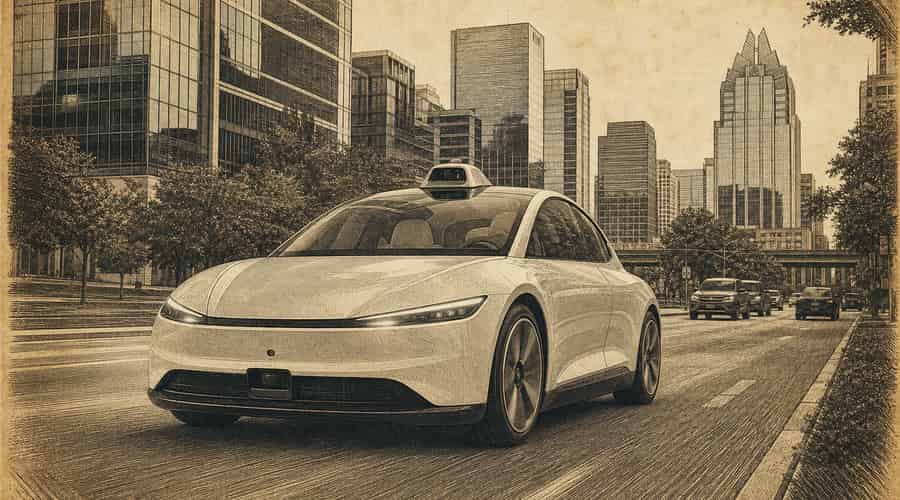
That distinction matters. Business Insider reported in February that Tesla said the first production Cybercab had rolled off the line at its Austin-area factory, with Elon Musk congratulating the team publicly. The vehicle itself is real enough. It was unveiled in October 2024 as Tesla's purpose-built robotaxi, not a modified Model Y, and its whole pitch is that it removes the human driver from the design instead of merely telling the driver not to touch the wheel.
But a production milestone is not a commercial robotaxi launch. It isn't even the same thing as broad public-road deployment. If you're reading this as an investor, founder, supplier, or just someone trying to understand how close autonomous transport really is, that is the line to keep bright. Tesla has a car. It still needs approval, validation, and a service model that survives contact with city streets.
Car and Driver reported this week that NHTSA has proposed changing federal safety standards so vehicles designed only for automated driving systems would not need manual brake pedals. Business Insider described the same proposal as part of a wider federal push to let purpose-built driverless vehicles shed traditional controls, including steering wheels and pedals, without relying so heavily on case-by-case exemptions. Public comment runs until July 27.
That is the freshest part of the story, and frankly it is more important than an unverified Austin fleet count. Current federal rules still make vehicles without human controls awkward to certify at scale. Companies can seek exemptions, but those are limited, and the old framework was written for cars humans operate. If NHTSA changes the rule, Tesla's Cybercab, Amazon's Zoox, and any similar vehicle get a clearer path from factory line to fleet.
The hard part is still the driving
Tesla's advantage is not hard to understand. A camera-only autonomous vehicle with fewer sensors and no manual controls should be cheaper to build than a more heavily equipped robotaxi, if the software can do the job. Tesla has argued for years that vision and neural networks can solve autonomy at scale. Waymo took the slower, sensor-heavy route, with lidar, radar, mapping, and years of fully driverless commercial service behind it.
Waymo is ahead. Don't dress that up. Publicly available figures show Waymo operating in multiple U.S. metro areas, with hundreds of thousands of paid rides each week and years of driverless passenger service in Phoenix, San Francisco, Los Angeles, Austin and other markets. Reuters reported Waymo opened driverless service to the public in Phoenix back in 2020. Tesla launched its own limited robotaxi service much later, first with Model Y vehicles and safety monitoring, then with a gradual move toward unsupervised operation in parts of Texas.
The Cybercab could still change the economics. A purpose-built vehicle that Tesla can manufacture in large numbers at Gigafactory Texas would give the company something different from today's Model Y robotaxi fleet. No driver seat. No pedals. No pretense that a human is supposed to take over. That is cleaner hardware for a driverless business, but cleaner hardware does not make the car safer by itself.
You can't cut corners on autonomy. Early Tesla robotaxi rides in Austin drew federal attention in 2025 after videos showed driving errors, including wrong-lane behavior and awkward stops. Those incidents do not prove Tesla cannot solve the problem, but they do show why regulators and city officials will not treat a slick vehicle design as enough. A robotaxi has to deal with road works, emergency vehicles, cyclists, bad lane markings, impatient drivers, and passengers who expect the car to behave like a calm professional, not a beta test.
The strongest version of this story is not that Tesla suddenly beat Waymo on June 30. It didn't. The strongest version is that Tesla now has the physical Cybercab, NHTSA is moving toward rules that fit vehicles without human controls, and Texas remains the most natural proving ground for Tesla's autonomous ambitions because the factory, the political climate, and the existing robotaxi service are all there.
That is still a big story. It is just not the story the original draft claimed. The next real milestone is not another photo of a gold two-seater near Austin. It is verified public deployment under clear rules, with enough miles, passengers, and incident data for you to judge whether Tesla's cheaper hardware can carry the weight of its more aggressive software bet.
Also read: Etched bets $800 million that transformer silicon will outlast the GPU era • ForthWrite Founder Curtis Boortz on the Email AI That Gets Better at Sounding Like You Specifically • Bending Spoons prices its Nasdaq IPO above range as Wall Street bets on AI-powered software roll-ups