The Bank of England's AI warning isn't about science-fiction trading bots. It's about something more ordinary and more dangerous: too many financial firms using similar systems that may all sell at once.
If you run money, build fintech tools, or sell AI into a bank, this is the part to pay attention to. Sarah Breeden, the Bank of England's Deputy Governor for Financial Stability, has been blunt about the risk building around stretched markets. As The Guardian reported on April 24, Breeden told the BBC she was worried about several risks crystallising together: a macroeconomic shock, a loss of confidence in private credit, and a sharp readjustment in AI-linked valuations.
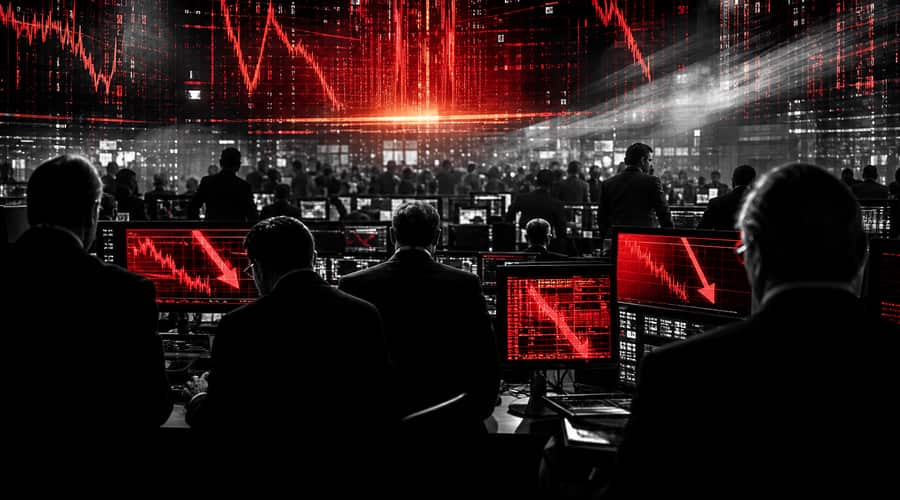
That isn't the same as saying one rogue AI trader will crash the market. Frankly, that version is too neat. The real concern is less cinematic and much more familiar to anyone who remembers a crowded trade. When similar firms use similar models, trained on similar data, with similar incentives, you don't need a mastermind to get a stampede. You just need the same signal flashing red on too many screens at the same time.
The UK's Treasury Committee made that point in January when it warned that regulators were taking too much of a wait-and-see approach to AI in financial services. According to The Guardian's report on the committee's findings, more than 75% of City firms were already using AI, with banks and insurers among the heaviest adopters. MPs said AI could amplify herd behaviour during economic shocks, with firms making similar financial decisions and risking a financial crisis.
That's the core of the Bank of England problem. Herding isn't new. Quant funds, risk parity strategies, leveraged bond trades, you name it, finance has always found ways to make independent actors behave as if they were in the same room. AI can make that behaviour faster, less visible, and harder to interrupt. A human portfolio manager may hesitate for a minute. A trading system doesn't need the minute.
The Bank has already acknowledged the wider danger. In its response to the Treasury Committee, reported by The Guardian, a Bank spokesperson said it had taken steps to assess AI-related risks and had highlighted the possible implications of a sharp fall in AI-affected asset prices. That dry institutional sentence carries more weight than it looks. Central banks don't write those lines because they enjoy speculating about software. They write them because the plumbing of the market is changing faster than the supervisory toolkit.
The timing makes the warning harder to dismiss. The Bank for International Settlements said in its annual economic report on June 28 that the AI investment boom could turn into a painful bust if expected returns disappoint. The Wall Street Journal reported that the BIS expects the five largest hyperscalers to spend more than $1 trillion on AI capital expenditure across 2025 and 2026. That is a huge bet sitting on equity valuations, debt financing, data-center supply chains and supplier contracts.
You don't have to believe every AI stock is a bubble to see the risk. If the market decides the payback period is longer than advertised, the first move is lower valuations. Then comes the financing problem. The BIS warned that borrowers across the AI supply chain could struggle to replace lost revenue and service debt if hyperscalers slow their spending. Add AI-driven trading systems reacting to the same repricing, and the market stress becomes easier to transmit.
This is where the trading-agent story earns its place. The danger isn't that AI knows too much. It may be that, under pressure, too many systems know the same thing in the same way. Research is still thin here. A May 2026 review paper on agentic trading screened 77 studies and found that only a small subset had closed-loop evaluation, with weak reporting on transaction costs, execution timing and reproducibility. For a field moving into real markets, that's not a comforting base.
For founders, the message is direct. If you're selling autonomous decision tools into finance, a glossy demo won't be enough. Banks and asset managers will need to show regulators how models behave under stress, how overrides work, what data they depend on, and whether different systems converge on the same action when volatility jumps. If your product can't answer those questions, your customer inherits the risk.
For investors, Breeden's warning is not a reason to assume disaster tomorrow. It is a reason to stop treating AI risk as a vague governance slide. The specific issue is correlated behaviour under stress, backed by high valuations and growing private credit exposure. That combination has caused trouble before without AI. AI just gives it a faster engine.
The fix won't be one rule. You can require stress tests for AI-led market shocks. You can demand clearer accountability when models make decisions. You can build circuit breakers that assume machine-speed trading rather than human-speed hesitation. But regulators still need a better view across firms, because firm-by-firm testing won't show you what happens when everyone's model points in the same direction.
The Bank of England is right to push this now, before a real test arrives. Markets don't usually break because one firm makes one bad decision. They break when too many firms discover they made the same decision together.
Also read: Call center giants are being repriced out of existence before AI has finished the job • The AI notetaker sitting in your Zoom call may be your next legal liability • SAP reorganizes its executive board around AI as investor patience runs thin