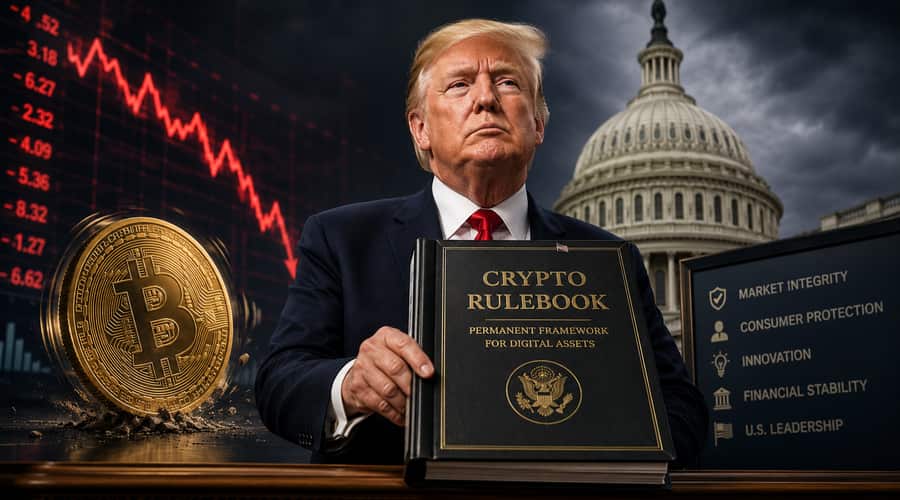
Trump is trying to turn a political win into a durable market structure, and the timing matters because crypto is still trading on leverage, policy hopes and nervous positioning.
President Donald Trump is again casting himself as the political force that rescued crypto from Washington hostility, blaming former SEC chair Gary Gensler and an "anti-crypto army" for pushing innovation overseas while promising to lock in a lasting framework for the industry. The message landed as Bitcoin slipped in a sharp but familiar move, underscoring how quickly this market can separate political theater from actual price action.
Trump's latest remarks fit into a broader White House push that has already tried to rebrand the United States as the "crypto capital of the world." The administration has tied that pitch to a series of policy steps, including the March 2025 executive order creating a Strategic Bitcoin Reserve and a U.S. Digital Asset Stockpile, according to a White House fact sheet. That effort is not just about symbolism. It is about giving crypto a place inside the federal policy machine instead of leaving it at the mercy of enforcement-first regulators.
The more important story, though, is Congress. The Senate Banking Committee said on May 14 that it had advanced H.R. 3633, the Digital Asset Market Clarity Act of 2025, after months of negotiations. Other coverage put the vote at 15-9, with all Republicans and two Democrats supporting the bill. The legislation is meant to draw the lines crypto companies have wanted for years, setting out when digital assets fall under the SEC, when they fall under the CFTC, and how market participants should register, disclose risks and protect customers. In plain English, it is an attempt to stop the regulatory whiplash that has defined the sector since the last bull cycle.
The CLARITY Act is not just another crypto bill with a shiny name. Bloomberg reported that the measure would make the CFTC the primary regulator for large parts of the crypto market while leaving the SEC in charge of digital securities. CNBC also described the committee vote as the first time a broad legislative framework for the crypto industry had cleared a congressional committee. That matters because crypto investors are not really buying the current price action, they are buying the expectation that U.S. rules will become clearer and less punitive.
The bill's political path is still messy. The House passed its version of the CLARITY Act on July 17, 2025, by a 294-134 vote, but the Senate has had to work through competing priorities from banking, market structure and consumer protection camps. Democrats are still pressing over issues such as illicit finance, DeFi oversight and the treatment of yield on stablecoins, while Republican backers say the bill would finally give developers and exchanges the certainty they need to build at home. That is the core tension in Washington right now, whether clarity means freedom to innovate or a softer touch for an industry that has already stretched the limits of disclosure and compliance.
Trump's argument is that the answer is obvious. If the U.S. does not codify the framework now, he says, the next administration could reverse course and push activity offshore again. That is not a crazy fear in crypto, where policy cycles have often mattered as much as product cycles. The industry has spent a decade arguing that it cannot scale properly while every new token launch, custody product or DeFi protocol gets treated as a fresh regulatory puzzle.
Why prices moved anyway
The other half of the story is the market, and here the price action looked less like a referendum on Trump's comments than a routine flush. Market observers pointed to over-leveraged positions unwinding, which is consistent with how crypto has behaved through nearly every major drawdown. Recent market coverage put Bitcoin near the low 70,000s, with reports noting that it lost the 74,000 level after Trump's statement and later dipped toward 73,000. That kind of move hurts, but it is also the sort of move traders have come to expect when funding gets crowded and sentiment turns fragile.
That is why the policy angle matters so much. When leverage is high, the market needs a narrative to hold together. A durable U.S. framework is a stronger narrative than a single price target, and it is the one crypto executives are betting on. If the CLARITY Act keeps moving, the sector could emerge with a more defined split between securities and commodities oversight, clearer rules for DeFi developers, and a better chance of keeping liquidity and talent in the U.S. rather than chasing friendlier jurisdictions overseas.
There is still a long road between committee approval and an actual law. But the direction of travel is now obvious enough. Washington is no longer debating whether crypto exists. It is debating who controls it, how it should be supervised, and whether the next version of the market will be built inside the U.S. system or around it.
Also read: A massive IBIT block trade is testing the market's faith in spot Bitcoin • Trump-linked crypto venture faces collapse after token bet burns 1.5B • Pentagon hands Dell a 9.7 billion software contract that could reshape federal IT