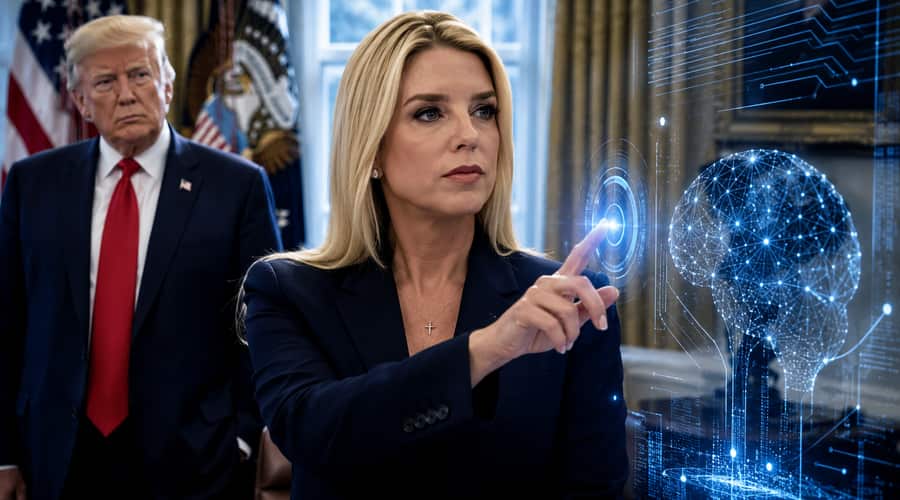
President Trump has put Pam Bondi on a White House AI advisory panel, and the move says as much about enforcement as it does about innovation.
Former Attorney General Pam Bondi has been named to a White House advisory committee focused on artificial intelligence policy, according to Axios, with Reuters later carrying the report. The detail that matters is not just who is joining the panel, but what kind of background she brings with her. Bondi is a law enforcement figure, and that changes the way the appointment reads.
The committee sits inside the administration's broader AI machinery and is led by David Sacks and White House science adviser Michael Kratsios, Axios reported. It also includes a roster of high-profile technology names, among them Nvidia co-founder Jensen Huang, Meta chief Mark Zuckerberg and Oracle co-founder Larry Ellison. That mix suggests the White House wants technical muscle and political discipline in the same room, which is exactly why Bondi's presence is notable.
Bondi's appointment comes about a month after Trump ousted her from the Justice Department. Reuters reported that the White House has not yet publicly commented on the move, which leaves some of the practical details open, but the signal is already clear enough. The administration is not treating AI policy as a narrow technology issue. It is treating it as a matter of regulation, enforcement and national security.
Bondi's professional history is the key to understanding the appointment. She has spent much of her public career in the world of policing, prosecutions and legal risk, not product development or venture capital. That matters because AI policy now sits at the intersection of all three. The central questions are no longer just about what models can do. They are about who is liable when they fail, how content is moderated, and when the government should step in.
For startup founders, that raises the stakes. A panel with a former top prosecutor on it is more likely to think in terms of misuse, fraud, surveillance and public harm than in terms of speed and experimentation alone. That could have consequences for enterprise AI deployment, especially in sectors where sales cycles already depend on legal review, procurement checks and internal risk sign-off. If the White House leans harder on enforcement, some companies will move more slowly even if the underlying technology is ready.
There is also a more specific issue around policing and surveillance. AI tools are already being tested in face recognition, evidence review, threat detection and automated monitoring. Those uses promise efficiency, but they also carry obvious civil liberties questions. A law enforcement veteran on an AI panel is likely to be more comfortable with public safety arguments, while also being attuned to the legal exposure that comes with deploying those systems badly. That combination could shape how far the administration is willing to go on police use cases.
The policy signal
The bigger message is that the White House appears to be tightening its grip on AI governance through a structure that blends industry influence with executive-branch authority. That is not unusual in Washington, but the composition of this panel suggests the administration wants to keep control of the conversation rather than leave it to regulators, agencies or Congress. When the council includes both senior tech executives and a former attorney general, the direction of travel becomes easier to read.
It points toward a more assertive stance on AI misuse. That could mean sharper attention to harmful content, deeper scrutiny of model accountability and more willingness to treat certain AI deployments as a national security issue. The administration has already made clear that it sees AI as strategic infrastructure, not just software, and Bondi's role fits that approach. As Axios reported, she is also expected to take on a newly created role related to national infrastructure, which reinforces the sense that AI is being folded into a wider security frame.
For investors, that matters almost as much as for operators. Advisory structures often look symbolic, but in practice they can shape what gets prioritized, what gets delayed and which issues are framed as urgent. A panel built around national security and enforcement will not produce the same regulatory tone as one built around pure innovation. That difference can affect whether startups spend the next year racing to ship or spending it in legal review.
The story is still developing, but the direction is already visible. Trump is placing AI policy closer to the center of executive power, and he is doing it with a former top law enforcement official at the table. For the industry, that is a reminder that the next phase of AI regulation may be less about abstract principles and more about consequences.
Also read: Former Google and Apple researchers back AI's missing feedback layer • Cognition's funding talks show how far AI coding bets have run • China is locking down its AI talent as the race with the US hardens