
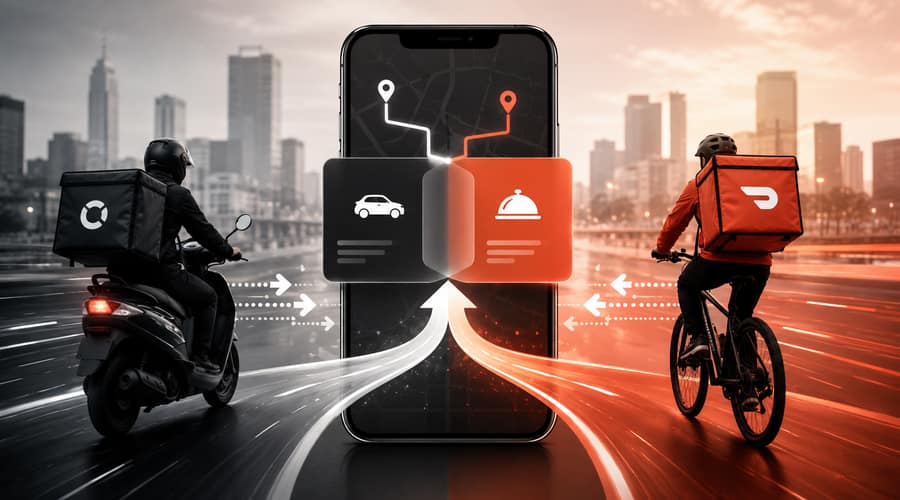
Uber and DoorDash are circling Delivery Hero because food delivery may now be too expensive to win one market at a time.
Uber and DoorDash are no longer just fighting for restaurant orders. They are testing whether the next phase of food delivery belongs to operators big enough to buy scale before rivals can defend it.
According to a Reuters report citing the Financial Times, the two U.S. platform companies have held exploratory talks with investors in Delivery Hero about a possible takeover bid for the Berlin-listed delivery group. There is no formal offer on the table, and this could still end with nothing. But the fact that Uber and DoorDash are being linked to the same target says a lot about where the industry has arrived.
Delivery Hero is not a minor regional asset. It owns brands including foodpanda and operates across large parts of Europe, the Middle East and Asia. Its first-quarter update showed gross merchandise value of about €12.5 billion, up 8.8% year over year on a like-for-like basis, and total segment revenue of roughly €3.7 billion. That is serious reach. It is also exactly the kind of sprawling footprint that has become hard to manage in a sector where investors now want cash discipline, not just growth.
Uber already has a seat close to the table. Delivery Hero confirmed this week that Uber had raised its shareholding to 19.5%, with a further 5.6% held through options. That followed an April deal in which Uber agreed to buy a 4.5% stake from Prosus for about €270 million at €20 per share. For a company that has spent years building Uber Eats into a global profit contributor, this is not passive curiosity. It is a strategic probe.
Food delivery has always looked simple from the outside. A customer orders, a courier collects, a restaurant gets paid and the app takes a cut. The real economics are much harder. Demand has to be dense enough, courier supply has to be reliable enough and marketing spend has to be controlled enough for the platform to make money after incentives, support costs and regulation.
That is why consolidation keeps returning to this sector. DoorDash expanded internationally through Wolt and has also moved on Deliveroo. Uber has bought, sold and swapped assets in different countries when the market structure did not make sense. Delivery Hero itself has spent years assembling and pruning a global portfolio, including Glovo in Europe and foodpanda in Asia.
The lesson is clear. In delivery, being number two or three in a market can be expensive. Being number one can still be difficult, but at least the operator has a chance to spread logistics, advertising, merchant tools and subscription benefits across a larger customer base. That is the business case behind any serious look at Delivery Hero.
For entrepreneurs, this is the part worth paying attention to. Platform businesses can look unbeatable once they reach scale, but the path to that scale is often full of capital strain. Delivery Hero generated strong revenue growth in 2025 and reported positive adjusted EBITDA, yet it still posted a consolidated net loss of €698 million for the year. Growth helped, but it did not remove the pressure.
A Joint Bid Would Send A Bigger Signal
The more unusual angle is the idea that Uber and DoorDash could be speaking with investors around the same target. These are direct competitors. They battle for restaurants, couriers, grocery partners and subscription users. A joint structure would therefore raise obvious regulatory questions, especially in Europe, where competition authorities already watch delivery markets closely.
Still, there is a reason such a structure might be discussed. Delivery Hero is large, geographically complicated and politically sensitive. It includes markets where one buyer may want the asset and another may prefer that the asset not fall fully into a rival's hands. A split, partnership or coordinated approach could become a way to divide regions, reduce financing burden or make a transaction easier to explain to regulators.
That does not mean regulators would welcome it. Food delivery touches small restaurants, gig workers, grocery chains and consumers who are sensitive to fees. Any deal that reduces competition in major cities would be examined carefully. The industry wants better unit economics, but governments will ask whether those economics come from operational efficiency or simply from having fewer choices in the market.
Delivery Hero is also going through its own reset. Co-founder and CEO Niklas Östberg is set to hand over the role by March 31, 2027, with the company beginning a search for a successor. Activist investor pressure has pushed the group toward a strategic review, and that changes the tone around every asset sale, partnership and takeover rumor. When leadership is changing and large shareholders want value unlocked, outside bidders tend to move closer.
The practical takeaway is that delivery is entering a more disciplined phase. The pandemic growth story is over. Investors now care about market position, cash flow and whether companies can turn logistics networks into repeatable profits. If Uber and DoorDash move from exploratory talks to a real proposal, the question will not simply be who wins Delivery Hero. The better question is whether global food delivery can finally make its economics work without shrinking the field too far for everyone else.
Also read: Megalodon shows startups must treat CI pipelines as production assets • Meituan pushes open avatar video deeper into startup territory • Ordinary WiFi is becoming a new biometric risk for startups