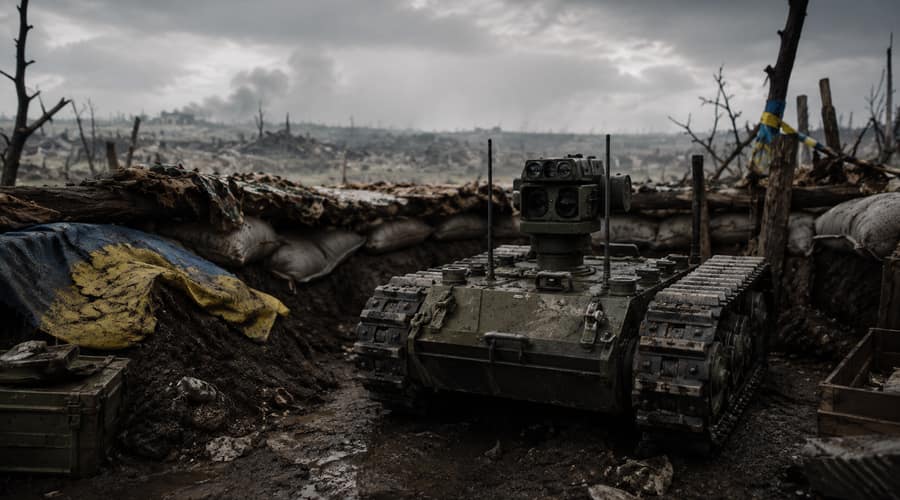
A Ukrainian machine-gun robot held a frontline position for 45 days, showing how quickly unmanned ground systems are moving from battlefield experiment to operational habit. The harder question now is whether Ukraine can scale that advantage before Russia catches up.
A single Droid TW 12.7, a remote-controlled Ukrainian ground combat vehicle armed with a 12.7 mm machine gun, defended a key intersection against repeated Russian assaults for six weeks last summer. That is the part that matters. Not because one robot changes the war by itself, but because it points to a front line where fewer soldiers have to sit in the most dangerous places.
According to a May 19 report from Defense One, a 3rd Army Corps spokesperson called the mission Ukraine's first fully robotic defensive operation of a position. The robot was operated from about 10 kilometers away and used aerial drones for surveillance and target confirmation before the human operator engaged. The unit said the system disrupted every attempted breakthrough and prevented infiltration without Ukrainian casualties at that position.
The operation was not a one-off demonstration for cameras. Ukraine has been pushing unmanned ground vehicles into routine work because the battlefield gives it little choice. Ukrainian defense analyst Olena Kryzhanivska has reported that ground robots now handle about 80 percent of logistics tasks on parts of the front, from moving ammunition to evacuating wounded soldiers. Ukraine's Ministry of Defense wants that figure to reach 100 percent, and in April the government said it planned to contract 25,000 unmanned ground systems in the first half of 2026, roughly twice the 2025 volume.
The economics of expendable robots
The argument for ground robots is brutally practical. A UGV that costs $10,000 to $30,000 can replace a human trip through artillery, mines, FPV drones, and thermal surveillance. Losing the machine still hurts. Losing a trained soldier hurts far more, morally and militarily.
Ukrainian manufacturers are trying to make that math even easier. TAF Industries has promoted its Legit line as a lower-cost platform, with a 43 kg S1 logistics variant priced around $5,000 and a 110 kg L1 combat model priced around $11,400. These are not polished defense products built for decade-long procurement cycles. They are wartime tools designed to be repaired, replaced, and improved quickly after direct feedback from units that use them.
The procurement system is changing with the hardware. Ukraine has spent more than 14 billion hryvnia, about $330 million, through digital channels that let frontline units order drones, ground robots, and electronic warfare systems from domestic manufacturers. Defense Minister Mykhailo Fedorov said Ukrainian forces carried out more than 9,000 UGV missions in March alone. President Volodymyr Zelenskyy has also pointed to more than 22,000 unmanned missions over a recent three-month period, framing each one as work that did not have to be done by a person under fire.
Ground robots face harder terrain
Still, ground robots are not just aerial drones with wheels. Battery life is the first constraint. A Ukrainian army spokesperson told Defense One there is never enough charge, with the main answers being larger batteries or multiple swappable packs. Ammunition creates the same problem. A machine gun can hold a position only as long as it has rounds, and resupplying a robot under fire can become a mission of its own.
Training is also more demanding than outsiders often assume. Operating a UGV means reading terrain, navigating obstacles, managing communications, and understanding when the machine can or cannot move. A drone pilot does not automatically become a ground robot operator. The difference matters because a stuck robot is not just a lost asset. It can expose routes, force recovery attempts, or leave a gap in a defensive plan.
DevDroid, the company behind the Droid TW 12.7, is already working on one of the major limits. It has shown a hybrid version with a fuel-powered generator that can recharge batteries while the vehicle is stationary or moving, extending operating range from roughly 20 to 40 km to about 80 to 100 km. CEO Yurii Poritskyi has warned that by autumn the front-line kill zone may expand further, which would make longer-range ground systems less of an upgrade and more of a requirement.
The human still makes the lethal call
Ukraine has also drawn a clear line around autonomy. Civilian populations still live in contested areas, and Ukrainian officials have been careful to keep human operators in the decision loop for lethal force. In the Droid TW 12.7 mission, aerial surveillance confirmed targets and the remote operator made the engagement decision. The robot executed the task, but it did not choose whom to shoot.
That distinction will become more important as the technology improves. Ukraine's K2 Brigade has built what BBC Russia editor Vitaly Shevchenko has described as the world's first dedicated uncrewed ground vehicle battalion. Other units are mounting machine guns, grenade launchers, and logistics payloads on wheeled and tracked platforms. The direction is clear: robots are moving from support roles into positions that once required infantry to wait, watch, and absorb the first strike.
For defense-tech startups, the lesson is direct. The first big market is not a fully autonomous battlefield machine. It is a reliable logistics vehicle that can carry ammunition, water, batteries, and wounded soldiers through routes too dangerous for drivers. Armed platforms like the Droid TW 12.7 come next, but they need secure communications, trained operators, maintainable turrets, and a clear doctrine for when humans authorize force.
Russia is watching and adapting, which means the next phase may arrive quickly. A direct engagement between Ukrainian and Russian ground drones now looks plausible rather than theoretical. When that happens, the front line will not suddenly become robotic, but the direction of travel will be hard to miss. The companies that can build cheap, repairable, modular ground systems at scale will help define not only Ukraine's defense, but the standard every military studies after this war.