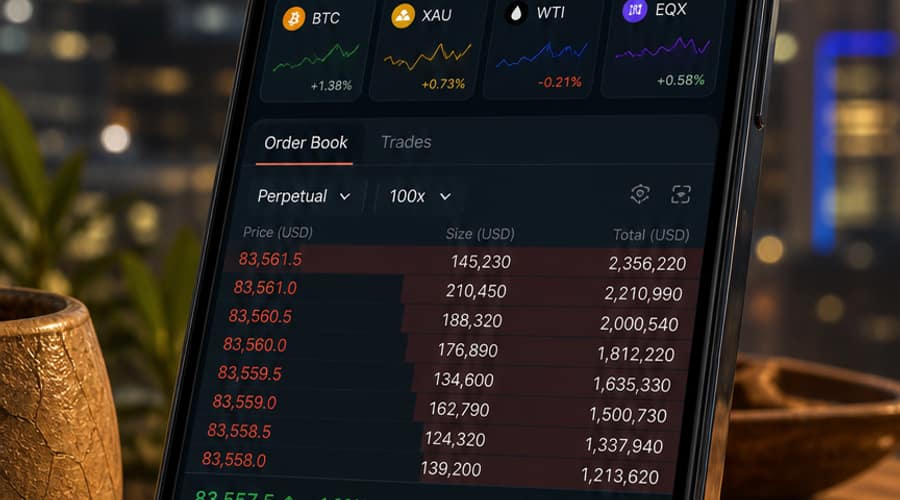
VALR is giving its users Hyperliquid's perpetuals market without asking them to become DeFi users first, and that is the real story in this deal.
Starting Monday, July 6, VALR says you'll be able to trade more than 200 perpetual futures markets inside its app, including crypto, oil, gold, silver, copper, forex pairs, listed equities such as Nvidia, Tesla and Apple, and pre-IPO names including SpaceX. Mobile access is expected to follow shortly after. The range is striking, but the market list isn't the point. The point is who is running the order book behind the VALR screen.
VALR isn't building that matching engine itself. It's plugging into Hyperliquid, the on-chain layer-1 protocol that already runs one of the busiest perpetuals venues in DeFi. According to the joint announcement from VALR and Hyperliquid, this is the first native integration of Hyperliquid's liquidity and execution layer by a centralized, regulated exchange, and Hyperliquid's first direct CEX partnership. Gianluca Sacco, VALR's chief operating officer, said the launch puts "over 200 perpetuals markets directly inside the VALR app" with "24/7 access to crypto, commodities, currencies, and equities, both listed and pre-IPO, all through the regulated exchange our customers already trust."
That last phrase is the whole pitch. VALR isn't asking its 1.9 million registered users to open a self-custody wallet, bridge funds, or learn how an on-chain order book works. You keep the login, the fiat rails and the regulated exchange relationship. Behind that familiar interface, the execution comes from a protocol VALR does not run.
Hyperliquid didn't need VALR for liquidity. It needed VALR for distribution, especially among the kind of trader who is curious about perpetuals but won't go near a wallet extension. DeFi protocols have spent years running into the same wall: the people who might want on-chain execution often don't want the operational burden that comes with it. Routing through an exchange with a South African FSCA license and a provisional Cayman Islands license gives Hyperliquid access to users it could not easily reach by telling them to move funds on-chain themselves.
For VALR, the calculation runs the other way. Building a derivatives engine across 200-plus markets, with enough depth to support leveraged exposure to crypto, commodities, currencies and equity-linked products, is an enormous infrastructure job. Renting that capability from Hyperliquid is the same logic a retailer uses when it plugs into Stripe instead of writing its own payment processor. You don't need to own every layer of the stack to compete at the top of it.
Here's the part worth sitting with. A regulated exchange choosing to outsource core execution to an on-chain protocol flips the old crypto dependency story on its head. For years, the assumption was that DeFi needed centralized exchanges for fiat on-ramps, compliance and normal users. VALR's move shows the dependency can run in the other direction too. A CEX can borrow execution from DeFi while keeping the customer relationship, the account structure and the regulatory wrapper on its own side of the glass.
Frankly, the pre-IPO market angle deserves more attention than it usually gets in coverage of these launches. A user seeing SpaceX exposure listed beside Bitcoin, oil and Nvidia in the same trading interface is not looking at a normal brokerage menu. These are perpetual contracts, not ownership of the underlying asset, and that distinction matters. But access to price exposure in names that were once the preserve of private markets is still a meaningful change for retail traders who have been locked out of those rails.
The risk sits in the same place as the opportunity. If VALR's users treat these markets like a new tab in a familiar app, leverage can feel less dangerous than it is. Perpetuals are not spot trades with a different label. They are instruments built around margin, funding rates and liquidation risk. VALR can make the route simpler, but it can't make leveraged trading forgiving.
So the test beginning July 6 is not whether the announcement sounds ambitious. Crypto has plenty of ambitious announcements. The test is whether Hyperliquid's infrastructure can handle the flow VALR sends into it, and whether VALR's users understand that a cleaner interface does not make a leveraged perpetual any less sharp.
Also read: NOBLE becomes the first major police group to endorse the CLARITY Act • Strategy stock breaks back above 100 dollars as bitcoin rebounds and Saylor tightens the leash on spending • Thailand's Zero Crypto Tax Break Is Entering Its Busiest Year Yet