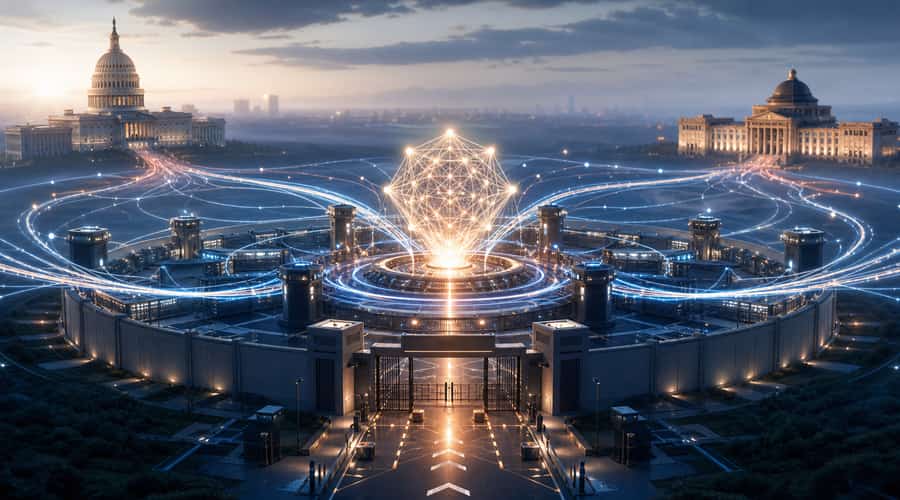
The U.S. and China are talking about AI safety, but the bigger story is power. Guardrails are becoming a way to shape who gets access to the strongest models, and who gets left behind.
Scott Bessent has put a new label on the AI race. Speaking during President Donald Trump's Beijing summit with Chinese President Xi Jinping, the Treasury Secretary said U.S. and Chinese delegations are discussing guardrails for artificial intelligence and a protocol of best practices to keep non-state actors away from the most powerful models.
That sounds like safety policy. It is also industrial policy. The conversation is not only about stopping criminals, rogue groups or cyber attackers from using frontier systems. It is about deciding whether the next generation of large language models will be treated more like consumer software, critical infrastructure or strategic technology that sits closer to chips, cloud capacity and national security.
According to Reuters, Bessent told CNBC that maintaining the U.S. lead over China in AI is of utmost importance, and argued that America can have this conversation because it is ahead. That framing matters. Washington is not entering the discussion as a neutral referee. It is entering as the country that believes its labs, chip suppliers and cloud platforms still set the pace.
There is a practical reason for the two countries to talk. Frontier models are beginning to move from chatbots toward systems that can help find software flaws, automate parts of cyber operations and assist users with more complex technical work. That does not mean every advanced model is a weapon. It does mean the release decision is no longer just a product question.
Axios reported this week that AI guardrails were expected to be on the summit agenda as officials weighed model-release and cyber-risk controls. It also reported that the White House has been debating where advanced AI testing should sit, with one camp looking toward the Commerce Department and another toward national security agencies. That split captures the problem neatly. AI is a commercial race, but the risks look increasingly governmental.
The concern around non-state actors is not abstract. If a model can speed up vulnerability discovery, help automate phishing operations or lower the skill barrier for cyber intrusion, then access rules start to matter. The hardest cases will not be obvious criminals. They will be shell companies, foreign intermediaries, loosely controlled research groups and users who appear legitimate until the system is already being misused.
That is why a U.S.-China protocol could have value, even if it is thin at first. The two countries do not need to agree on democratic values, censorship or the future of the internet to agree that uncontrolled model leakage would create problems for both. Rival governments can still share an interest in keeping the most dangerous tools out of the hands of actors they cannot deter.
Guardrails can also protect incumbents
The more difficult question is whether the word guardrails becomes a diplomatic wrapper for advantage. Export controls already restrict China's access to advanced chips. Cloud rules and model-access policies could become another layer of the same strategy, especially if Washington decides that the most capable systems should only run inside trusted infrastructure.
That would favor the companies already at the center of the AI economy. OpenAI, Google, Microsoft, Anthropic and the major cloud providers can afford compliance teams, security reviews and government relationships. Smaller labs and open-source developers usually cannot. A serious safety regime may reduce risk, but it may also make the market harder for challengers to enter.
OpenAI is already leaning into that geopolitical role. Bloomberg reported that Chris Lehane, the company's vice president of global affairs, said OpenAI would support a U.S.-led global AI governance body that includes China, similar in spirit to institutions built for nuclear oversight. That is a striking position from a private company. It shows how quickly AI firms are becoming policy actors, not just policy subjects.
Bessent's comments about expected step-function jumps from Google's Gemini and OpenAI point to the same pressure. If the next models are meaningfully stronger, governments will not wait for the market to decide how they should be released. The companies building them will be pushed into a bargain: keep moving fast, but accept more state involvement around testing, deployment and access.
China has its own reasons to engage. Beijing wants access to global markets, chips, research flows and legitimacy in AI governance. It also wants to avoid a world where U.S. companies write the rules and Chinese firms are treated mainly as security risks. Talking about guardrails gives China a seat in the room without requiring Washington to relax its broader technology controls.
For entrepreneurs, the signal is clear. AI safety is moving out of the ethics department and into the machinery of trade, procurement, security and market access. Startups building frontier models, cyber tools, AI infrastructure or enterprise agents should assume that regulation will increasingly follow capability, not company size. The more powerful the system, the more likely governments will ask who can use it, where it runs and what happens before release.
The next phase will be judged less by summit language than by implementation. Watch whether the U.S. and China create real testing channels, shared incident procedures or common standards for high-risk model access. If they do, guardrails may become one of the few areas where rivals cooperate. If they do not, the word will still matter, because it gives both governments a cleaner way to defend the same old race for control.
Also read: OpenAI's trial puts AI governance on the witness stand • Qwen is pushing image AI forward by fixing the compression layer • Princeton is turning to proctored exams as AI tests campus trust