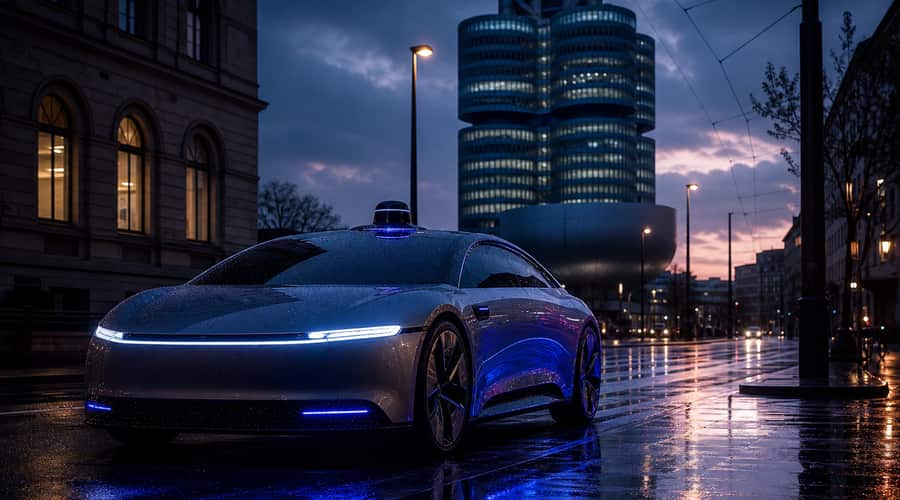
Waymo has registered a German subsidiary in Munich and started hiring around Berlin and Munich, which tells you the London launch is not the end of its European plan. It is the start of the fight for the continent.
The filing was quiet, but the signal is not. Waymo Germany GmbH was incorporated on May 13 and entered in Munich's commercial register on June 15, 2026, with a purpose that covers autonomous transport services and support for third-party operators. Frankfurter Allgemeine Zeitung reported the registration and linked it to roles for test drivers and vehicle trainers in Berlin and Munich, while Transdev has advertised for an autonomous driving manager focused on the Munich metropolitan area. You don't hire people to sit in test vehicles in two German cities because you're only curious.
Waymo has not announced a German launch date. That matters less than it looks. The company usually does the dull work first: legal entity, mapping, local operators, safety drivers, regulatory conversations. By the time a public launch window appears, much of the real groundwork has already happened.
The move also fits the calendar. Waymo announced in 2025 that London would become its first international commercial robotaxi market in 2026, with fleet services handled by Moove. The Verge reported that Waymo planned to begin with supervised data collection before moving toward driverless Jaguar I-Pace rides through its own app, subject to UK approval. London is the public test of whether Waymo's U.S. playbook travels. Germany is where the argument becomes harder.
Munich is a deliberate place to start. It is BMW's home city. Stuttgart, where Mercedes-Benz is based, is close enough to make the point obvious. Volkswagen's software unit CARIAD has been trying to build the autonomous driving stack that VW Group can use across its brands. These companies know German roads, German regulators and German politics. Waymo walking into that market is not a routine expansion. It is a challenge to the local incumbents on their own pavement.
There is money behind the challenge. Bloomberg reported in February that Waymo raised $16 billion from Alphabet and outside investors, valuing the company at $126 billion, with the funding aimed at expanding its robotaxi business into more cities. That is the number to keep in your head when the German filing looks small. A GmbH registration is a modest document. It sits inside a very expensive plan.
Germany is a harder test
Germany is not just another pin on a robotaxi map. Its vehicle safety approval culture is demanding, and autonomous driving companies have to deal with regulators who will not treat software confidence as proof of road readiness. In June, Germany joined France, Italy and other EU countries in a declaration meant to coordinate autonomous vehicle testing across Europe. That is progress, but it is not a free pass.
Waymo arrives with scale, but also with fresh baggage. Road & Track and other outlets reported this month that Waymo recalled 3,871 Jaguar I-Pace robotaxis in the U.S. after some vehicles entered closed freeway construction zones in Phoenix and the San Francisco Bay Area. No injuries were reported, and the fix is software-based, but German regulators will notice. Construction zones are not an edge case in Europe. They are daily driving.
That is why the hiring pattern matters. Test drivers and vehicle trainers point to local data collection and local road behavior, not a sales push. Berlin and Munich do not drive like Phoenix or Mountain View. Cyclists, tram lines, narrow streets, construction signage and different right-of-way habits all have to be learned in practice. You cannot import that from Arizona.
The competitive field is already moving. Baidu has said it plans to bring its RT6 robotaxi to the Lyft app in Germany and the UK in 2026, pending regulatory approval. Uber and Chinese autonomous driving company Momenta have announced plans for European testing, including Munich. Mobileye, Intel's autonomous driving unit, is not building the same kind of fleet business as Waymo, but its driver-assistance and autonomous systems are already tied deeply into global carmakers. Germany will not lack bidders.
Here is the thing: Waymo does not need Germany to be first. It needs to be early enough to shape the standards, the partnerships and the public expectations before somebody else does. If Baidu, Momenta, Mobileye or a German automaker gets there with a credible local service first, Waymo's U.S. lead will matter less than investors assume.
Waymo declined to comment on the German registration, according to FAZ. That is normal for a company doing careful market entry, but it should not be mistaken for inaction. A legal entity in Munich, hiring in Berlin and Munich, and a London launch window in the same year tell a clear story. Waymo is preparing for Europe city by city, before Europe has fully decided how quickly it wants robotaxis on its streets.
Also read: Unconventional AI raises $475 million at a $4.5 billion seed valuation to cut AI's power bill by a factor of 1,000 • Moody's warns that the data center boom is creating fiscal risks governments cannot ignore • Andreessen Horowitz bets $15 million that network automation is the next AI infrastructure bottleneck