
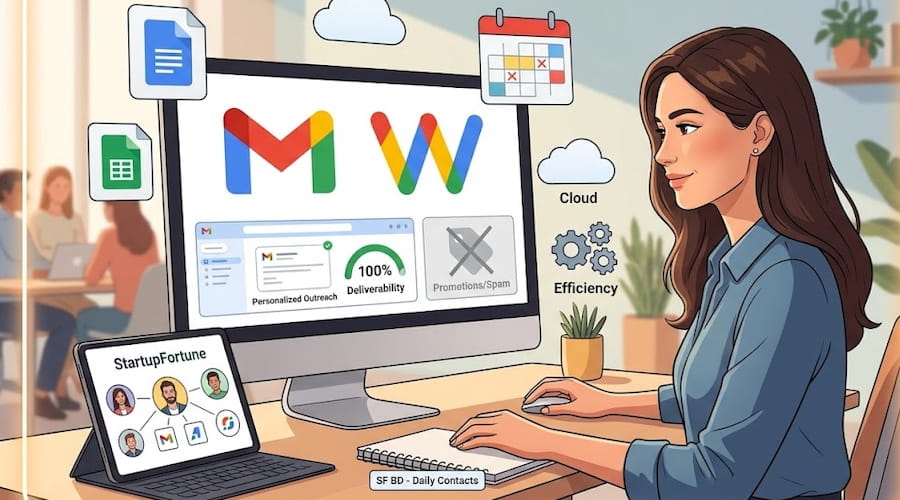
Choosing standard email infrastructure over a custom company domain ensures personalized business development pitches land directly in a founder primary inbox instead of getting lost in aggressive corporate spam filters.
Every single day, founders ask me why an executive from a major media platform is hitting their inbox from a standard Google address rather than a branded company domain name. As a Business Development Executive here at StartupFortune, my entire job revolves around identifying high potential startups and helping them scale their online visibility through our advanced media placements. With over a decade of platform authority, a domain authority score above 70, and a monthly reach exceeding 200,000 readers, our placements in deep feature stories and founder interviews are highly coveted because they rank exceptionally well on search engine results pages and Google News. Connecting with busy builders requires an outreach strategy that prioritizes absolute deliverability over corporate aesthetics, which is exactly why I choose to route my workflow through the most stable communication framework available today.
The mechanics of modern email infrastructure have created a landscape where custom corporate domains face incredibly harsh scrutiny from automated filtering algorithms. When you manage active business development pipelines that require sending dozens, sometimes hundreds, of highly targeted messages each week, the traditional corporate email setup becomes a massive liability. New or highly active custom domains are frequently flagged by automated inbox gatekeepers, sorting perfectly legitimate communication into promotions tabs or, worse, the junk folder. By maintaining my communication pipeline through standard Google architecture, I bypass the technical volatility that frequently plagues custom company servers, giving my outreach the best possible mathematical chance of being seen by a decision maker.
The Necessity of Guaranteed Inbox Placement
Our operation at StartupFortune has taught us that high impact media outreach requires an infrastructure built entirely around verified deliverability. I do not engage in bulk sending of emails or any automated campaigns, at all, as every single message I send represents a highly calculated, personalized invitation to a founder whose project I have personally vetted. I take the time to thoroughly study each startup, analyze their project, and confirm that their vision aligns perfectly with our editorial standards before I ever draft a message. Spending hours researching an upcoming Web3 protocol or an innovative enterprise software company only to have the final pitch buried under an algorithmic spam filter is an unacceptable operational inefficiency, which makes a resilient gateway like Gmail an absolute necessity for my daily workflow.
As Forbes recently pointed out, email deliverability has become one of the most critical and overlooked bottlenecks in modern B2B client acquisition strategies. When an entrepreneur is focused on building a disruptive product, they do not have the time to hunt through their spam folder for media opportunities, meaning that if your message does not land in their primary tab, it effectively does not exist. Utilizing an enterprise ecosystem anchored by Google Workspace provides an unmatched level of baseline sender reputation that a younger custom domain simply cannot replicate out of the box. This operational choice ensures that my highly specific, manually researched observations about a founder technology actually reach their eyes, allowing us to kickstart a meaningful branding relationship without technical friction.
Workflow Speed and Editorial Collaboration
Beyond the advantages of better email deliverability, relying on Google Workspace gives me access to a unified suite of productivity tools that keeps my work completely synchronized with our editorial team. My role involves a dual responsibility: I onboard growing companies to our premium marketing features, but I also act as an editorial-help to our writers, flagging exceptional projects that deserve organic editorial coverage. Managing this continuous influx of data requires moving between emails, drafts and documents, and active databases at a really high pace without losing critical context along the way.
The native integration between live spreadsheets, cloud documents, and shared team calendars allows me to transition a startup from an initial cold pitch to an active interview slot seamlessly. If a founder agrees to a deep dive feature story, I can instantly port our introductory notes into a shared document for our journalists, coordinate schedules via integrated invites, and track the production status inside a centralized system. This level of internal velocity is essential when handling the volume of daily inquiries required to sustain a platform of our scale. By choosing efficiency and reliable inbox delivery over a superficial domain name, I keep our outreach flawless and ensure that up and coming founders get the visibility they need to scale successfully.