He Xiaopeng told reporters at Auto China 2026 on April 25 that Xpeng's Vision Language Action system already outperforms Tesla's Full Self-Driving in complex Chinese driving scenarios , and staked a public wager on closing the remaining gap entirely by August 30.
The bet is not metaphorical. He set it in December 2025 after personally testing Tesla's FSD V14.2 in Silicon Valley and returning to China convinced that the technology had reached "near-Level 4" performance. The terms are public and specific: if Xpeng's VLA 2.0 system achieves within China the same overall road experience that Tesla's FSD V14.2 delivers in Silicon Valley by August 30, 2026, He will build a Chinese-style canteen in Silicon Valley modeled after the cafeteria at Xpeng headquarters. If VLA falls short, Liu Xianming, Xpeng's head of intelligent driving, will run naked across the Golden Gate Bridge. He invited Elon Musk to come test the result personally. As wagers go, it communicates the timeline with unusual clarity.
Xpeng launched VLA 2.0 in March 2026 and showcased it at Auto China 2026, the Beijing International Automotive Exhibition running through May 3. The Vision Language Action architecture replaces the fragmented pipeline approach , where separate AI modules handle perception, planning, and action in sequence , with a single end-to-end model that processes visual input and generates vehicle actions the way a human driver does: continuously, in context, without handoffs between subsystems. The practical result, in Xpeng's own comparison data, is measurable: on a 20-kilometer complex urban test route, Tesla FSD V13.2.9 required five driver takeovers while Xpeng's second-generation VLA required one. Morgan Stanley analysts who tested the system in early March 2026 described themselves as surprised by how quickly the gap with Tesla had closed. He Xiaopeng has publicly welcomed all competitors, including Musk, to experience the system directly.
Powering VLA 2.0 is Xpeng's in-house Turing AI chip, delivering up to 3,000 TOPS of computing power , meaningfully more capable than Tesla's HW4 hardware. The chip is integrated into the GX, Xpeng's L4-capable robotaxi prototype unveiled at Auto China, which the company describes as China's first fully in-house developed, factory-integrated autonomous vehicle intended for mass production. Three robotaxi models are planned for 2026 launch, with trial operations beginning imminently. Volkswagen, which has also been navigating the Chinese market's aggressive software-defined vehicle transition, has licensed Xpeng's intelligent driving technology , an external validation that is difficult to dismiss as marketing.
The China Market Context That Makes This Race Matter
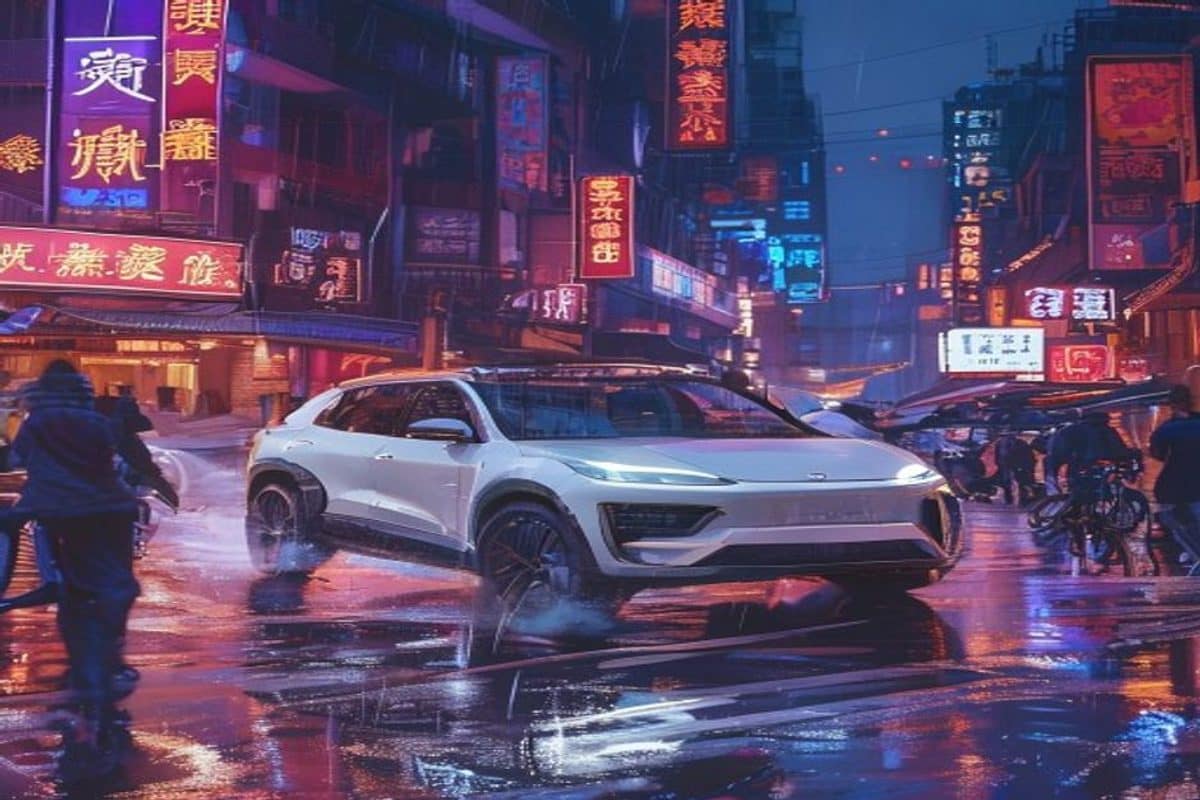
Tesla's FSD has not been approved for use in China, which means the most direct competition between the two systems happens in a market where one participant is not yet playing. He acknowledged this at Auto China: "China's driving environment is more complex. If we can surpass it here, our overall capability should be stronger." That framing is calibrated, because the complexity claim is defensible. Chinese urban driving involves electric bicycles weaving through intersections, unmarked construction zones, mixed pedestrian-vehicle lanes, and traffic enforcement patterns that differ significantly from American suburbs. A system trained and optimized for Chinese streets is handling a harder generalization problem than one built primarily on Californian data, and achieving high performance there is a meaningful proof of capability breadth.
The competitive stakes extend beyond brand positioning. Chinese government subsidies for electric vehicles are being phased out, pushing manufacturers to differentiate on software capability rather than price. The automakers winning market share in China are the ones whose in-car technology experiences feel meaningfully more advanced than competitors, and autonomous driving capability is the single most visible dimension of that comparison. BYD, Huawei, Nio, and Li Auto are all competing on intelligent driving features simultaneously, which means Xpeng's August target is not simply about matching Tesla , it is about maintaining a leadership position within a domestic field that has become the world's most competitive technology battleground for vehicles.
The Comparison Tesla Cannot Directly Contest
The structural asymmetry of the August benchmark deserves attention. He is comparing VLA's performance in China against FSD's performance in Silicon Valley , two different regulatory environments, two different traffic contexts, and a comparison where Tesla has no direct ability to respond within China until FSD receives regulatory approval. Tesla's Cybercab robotaxi service launched in Austin in January 2026 and has expanded to Houston and Dallas, accumulating one million paid miles in Q1. It is a real, operating business. In China, Tesla sells EVs with what is marketed as "Enhanced Autopilot" while FSD awaits approval. That regulatory gap gives Xpeng a runway that He is clearly intending to use.
By August 30, one of three things will have happened. VLA 2.0 will have demonstrably matched or exceeded Tesla FSD V14.2 on Chinese roads by the metrics He and his team have set internally , a result that would significantly accelerate Xpeng's commercial positioning and validate the VLA architecture as a genuine frontier approach. VLA will have closed the gap substantially but fallen short of the benchmark, producing a qualified outcome that both sides can frame to their advantage. Or the August 30 deadline will arrive with Liu Xianming either preparing for a very public run across the Golden Gate Bridge or quietly renegotiating terms. He Xiaopeng has been transparent enough about the stakes that any of those outcomes will be highly visible. That transparency, in a competitive landscape where most claims about autonomous driving timelines are made with extensive hedging, is itself a signal worth taking seriously.
Also read: US envoys are flying to Pakistan today but Iran says no meeting is planned and the Hormuz standoff is deepening • US envoys are flying to Pakistan today but Iran says no meeting is planned and the Hormuz standoff is deepening • Xbox's new CEO has done more in two months than her predecessor managed in two years of damage control