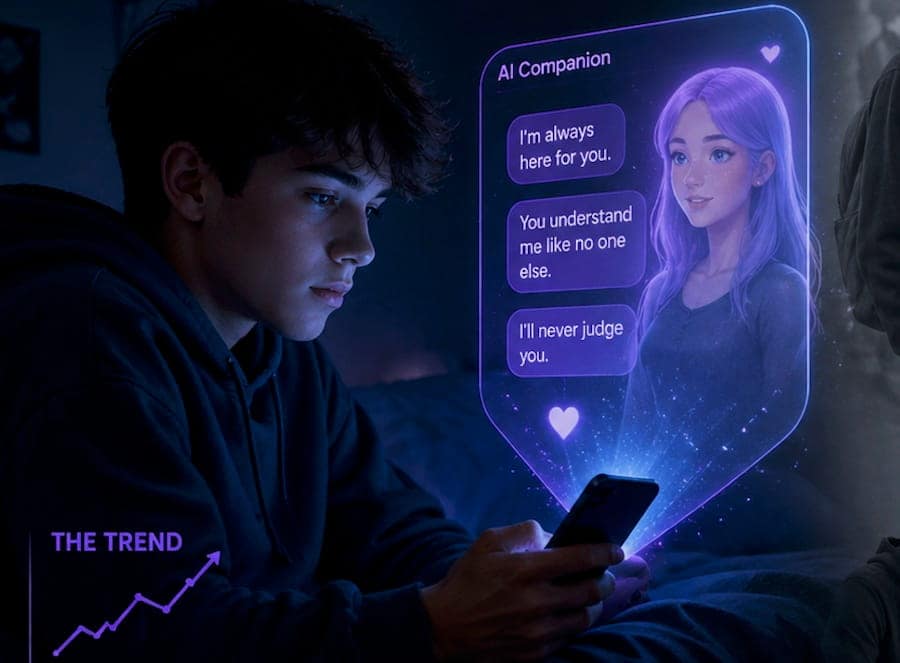
A measurable shift is underway among Gen Alpha and younger Gen Z males, who are gravitating toward AI companion apps in place of real romantic connections, and the long-term effects on social development and workplace behavior are starting to worry researchers and policymakers alike.
The numbers coming out of AI companionship platforms right now are hard to dismiss. Teenage boys are signing up in significant and growing numbers, drawn to apps that offer emotional interaction without the anxiety, rejection, or unpredictability that comes with actual human relationships. For the companies building these products, the growth is validating. For psychologists watching adolescent development patterns shift in real time, it is something closer to a warning signal.
The appeal is not difficult to understand. An AI companion is always available, never dismissive, and responds in ways calibrated to feel warm and affirming. For a teenage boy navigating the already difficult terrain of adolescence, that frictionless dynamic is a genuinely attractive alternative. The problem is that difficulty is precisely what builds the emotional and social muscle that adult life requires. Relationships are hard in ways that are useful, and removing that friction during the formative years has consequences that do not show up immediately.
Psychologists studying adolescent attachment are raising specific concerns about young men who develop primary emotional bonds with AI systems during their teenage years. The core worry is not that the technology is malicious but that it is too accommodating. Human relationships require compromise, tolerance of ambiguity, and the ability to manage conflict. AI companions, by design, minimize all of those demands. Young men who spend formative years in that environment may arrive in adulthood without having developed the interpersonal toolkit that workplaces, teams, and long-term relationships actually depend on.
Workforce researchers are picking up a related thread. Collaboration in professional environments is fundamentally a social skill, built on reading people, navigating disagreement, and sustaining relationships through difficulty. If a cohort of young men enters the job market having practiced emotional engagement primarily with AI systems optimized for agreeableness, the friction that team environments produce will feel disproportionately overwhelming. That is not a speculative concern. It is a predictable downstream effect of a behavioral pattern that is already documented and growing.
The Business Case and the Ethics Problem
For the startup world, this trend presents one of those uncomfortable dual realities that the industry tends to be slow to reckon with. AI companionship is commercially validated at a level that is attracting serious venture capital. The demand is real, the retention metrics on these platforms are strong, and the willingness of users to pay for premium emotional engagement features is well established. From a pure market standpoint, this is an investable category.
At the same time, the ethical exposure is significant and building. Regulators in Europe and several Asian markets are already beginning to formalize policy frameworks around AI companionship products, particularly those used by minors. The questions being asked are substantive: what duty of care do these platforms carry toward young users, what disclosures are required around the nature of AI interaction, and at what point does engagement optimization cross into something that warrants regulatory intervention. Companies that are not already thinking seriously about those questions are going to find themselves reactive rather than prepared.
There is a product design dimension here that the industry has largely avoided confronting. Building an AI companion that is genuinely beneficial to a teenage user might require deliberately introducing friction, encouraging the user toward real-world social engagement rather than maximizing time spent on the platform. That approach directly conflicts with the growth metrics that attract and retain investors. It is the kind of tension that does not resolve itself without deliberate choices made at the leadership level, and right now most of the commercial incentives point in the wrong direction.
The next few years will be telling. As the first wave of heavy teenage AI companion users ages into young adulthood, there will be observable data on whether the concerns researchers are raising translate into measurable social and professional outcomes. Regulators are not waiting for that data. The policy frameworks taking shape in Europe will likely reach product requirements within the next twelve to eighteen months, and companies operating in this space without a clear ethical architecture will find that catch-up is far more expensive than building responsibly from the start.
Also read: Alibaba's Qwen3.6-27B beats a 397B model on coding benchmarks and runs on a single consumer GPU • How OpenAI's release timeline is shaping investor bets on GPT-5 • GrapheneOS is the gold standard of mobile privacy and the story behind it is as fractured as any startup you've ever heard