Yum Brands' Nvidia partnership is no longer just a 2025 rollout promise. The more useful story now is how the restaurant giant is turning AI into operating infrastructure across its brands.
Yum Brands has moved its AI work beyond the language of pilots and into the harder question of scale. The company behind Taco Bell, Pizza Hut, KFC and Habit Burger & Grill announced its Nvidia partnership in March 2025 with a goal of deploying AI systems across up to 500 restaurants that year. A year later, the sharper signal is that Yum is still talking about AI as a core operating capability, not a side project for a few test stores.
That matters because restaurant AI is only useful if it survives the messy parts of the business. Drive-thru orders are noisy. Menus are full of substitutions. Game-day demand can overwhelm call centers. Store performance changes by hour, location and staffing mix. If the technology cannot handle those conditions, it does not matter how impressive the demo looked at a conference.
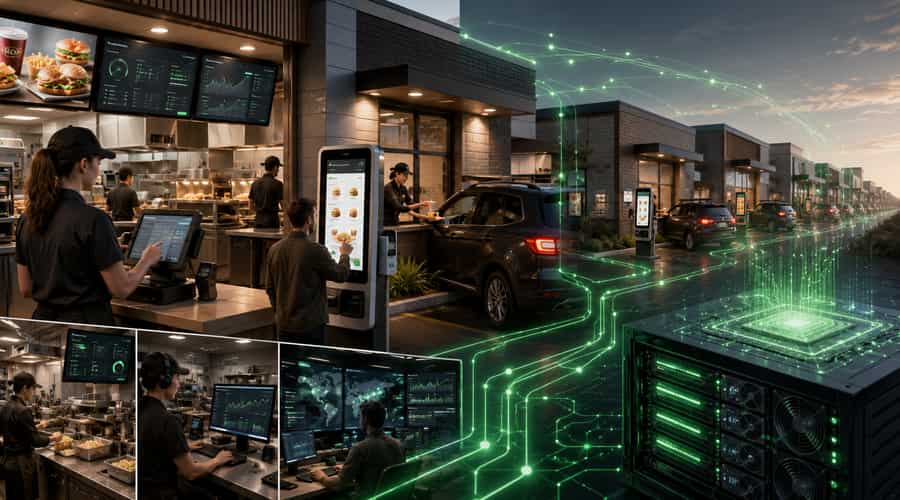
According to Nvidia and Yum's original announcement, the first wave focused on three practical uses: voice AI for drive-thru and call-center ordering, computer vision for restaurant operations, and AI-driven analytics for performance insights. Yum built voice ordering tools using Nvidia NIM microservices and Nvidia Riva, then connected that work to Byte by Yum!, its in-house digital and AI platform.
The important point is not that a fast-food chain is experimenting with voice ordering. That has been happening across the industry for years. The point is that Yum is trying to own more of the intelligence layer itself. That gives the company more control over restaurant data, workflow design and the pace at which new capabilities can be rolled out across brands.
Yum now operates more than 63,000 restaurants globally, which makes even a limited deployment meaningful. A system that works in a few hundred locations can teach the company more than a small lab test ever could, especially when those restaurants span different menus, customer habits and service models. Scale turns operational software into a learning system.
Why the scale matters
The 500-restaurant target was always small compared with Yum's global footprint, but it was large enough to function as a serious benchmark. Restaurant technology often fails between the pilot and the rollout, where training, franchise economics, integration costs and messy edge cases begin to matter. Yum's advantage is that it can test those problems across a large base and still keep the work tied to a central platform.
As Yum recently noted in an update on Byte by Yum!, the company has been refining smaller language models for restaurant ordering, including work that improved accuracy in selecting the right tool or function during complex multi-step orders. That kind of detail is more useful than a broad AI claim because it shows where the hard work actually sits. The value is not in a chatbot sounding fluent. The value is in getting the order right when a customer changes a taco, adds a drink, swaps a side and expects the total to be correct.
For restaurant operators, this is where AI becomes practical. Better voice systems can reduce bottlenecks at peak times. Call-center automation can absorb demand spikes without forcing stores to choose between answering phones and serving customers in line. Computer vision can help managers see operational problems faster, from queue buildup to process breakdowns. None of that is glamorous, but it is exactly where margins are won or lost.
For startups selling into restaurants, Yum's approach raises the bar. Buyers are moving past small pilots and asking whether a product can integrate with existing systems, work across locations and improve measurable outcomes without creating more complexity for already stretched teams. A clever feature is not enough. The product has to fit into the store.
There is also a wider market message for Nvidia. The company is not only selling chips into the AI boom. With NIM microservices, Riva and Nvidia AI Enterprise, it is trying to become part of the software layer that large companies use to deploy AI in the real world. Yum gives Nvidia a consumer-facing proof point in a business where speed, accuracy and uptime are easy to measure.
The risk is also clear. Customers are not forgiving when ordering systems get basic things wrong, and quick-service restaurants have already seen public skepticism around AI ordering. McDonald's ended a high-profile AI drive-thru test with IBM in 2024 after errors drew attention online. Yum will have to show that its systems improve service without making the experience feel brittle or impersonal.
That is why this story still matters in 2026. The headline is not simply that Yum put Nvidia technology into restaurants. It is that large service businesses are beginning to treat AI as part of their operating stack, in the same category as payments, scheduling and point-of-sale systems. Watch what Yum does next with Byte by Yum!, because the bigger test is whether AI can become boring, reliable infrastructure inside thousands of restaurants.
Also read: AI backlash is moving from niche anger into the mainstream • AI backlash is moving from Reddit into real business risk • Startups should design AI that avoids sparking an anti-AI revolt