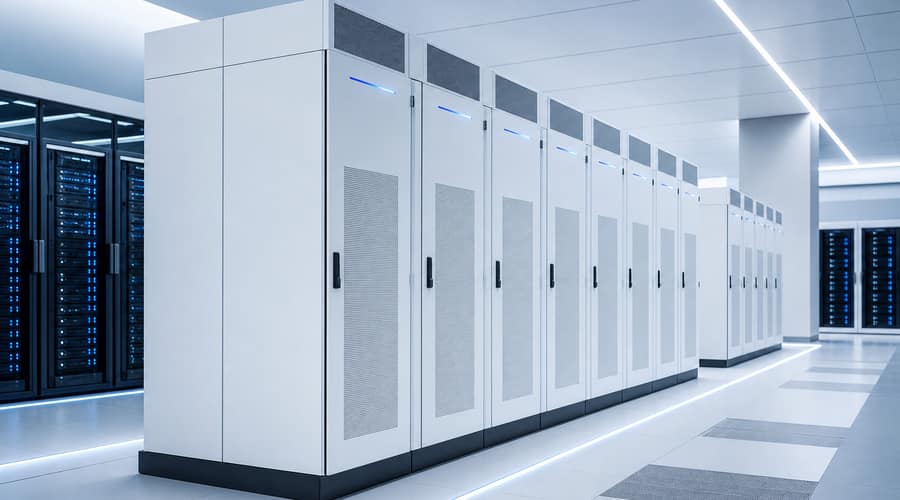
ZincFive's planned Nasdaq listing puts a quiet but important part of the AI buildout in the public-market spotlight: backup power for data centers that cannot afford to fail.
ZincFive is trying to turn a battery chemistry decision into a public-company story. The Oregon company announced on June 11 that it would merge with Spark I Acquisition Corp, a SparkLabs Group-backed SPAC, in a deal valuing ZincFive at a $600 million pre-money equity value and giving the combined company a pro forma enterprise value of about $752 million.
That is not the loudest corner of the AI infrastructure market. It may be one of the more practical ones. ZincFive makes nickel-zinc battery systems for data center uninterruptible power supplies, the layer that keeps servers alive when the grid blinks. Every GPU cluster training or running large models depends on that sort of equipment, even if it rarely gets the attention given to chips, networking gear, or power purchase agreements.
According to ZincFive's announcement, the company has nearly 2 gigawatts of systems shipped or under contract globally, an $81 million commercial backlog, and 2025 revenue of about $66.9 million, roughly double the prior year. Those figures matter because public investors have become much less patient with infrastructure stories built only on future demand. ZincFive is still asking the market to believe in a growth curve, but it is doing so with revenue, customers, and a product already installed in the field.
Spark I Acquisition Corp raised $100 million in its Nasdaq IPO in October 2023 under the ticker SPKL. Its sponsor, SparkLabs Group, has invested across the AI ecosystem, with names such as OpenAI, Anthropic, and xAI in its broader portfolio. That gives the deal a clearer logic than many blank-check mergers from the last cycle. This is not a consumer app looking for a valuation shortcut. It is an infrastructure supplier attaching itself to the capital needs created by AI data center expansion.
ZincFive's central argument is chemistry. Its systems use proprietary nickel-zinc cells rather than the lithium-ion batteries common in many modern data center UPS deployments. Lithium-ion has obvious advantages, including energy density and a mature supply chain, but it also carries fire and thermal runaway concerns that data center operators must manage through design, spacing, suppression, permitting, and insurance.
Nickel-zinc is pitched as a safer alternative at the cell level. ZincFive says its chemistry does not have the same thermal runaway pathway, which can reduce the need for specialized suppression infrastructure associated with lithium-ion battery rooms. For a hyperscale or colocation operator trying to pack more compute into a constrained building, that distinction can affect more than safety language in a procurement document. It can shape layout, approvals, usable floor space, and operating risk.
The company has also been tailoring its products to the way AI changes power demand. Its BC 2 AI system, announced in November 2025, was designed for data centers that must handle both dynamic AI workload spikes and the steadier backup needs of traditional IT infrastructure. That matters because AI facilities are not simply bigger versions of older server farms. Their power profile is more volatile, their rack densities are higher, and the margin for downtime is thin.
ZincFive already has named deployments that support the case. Corscale has used ZincFive systems at its Gainesville Crossing campus in Northern Virginia since 2022, and Wyoming Hyperscale has also been identified as a customer. Those examples do not prove nickel-zinc will displace lithium-ion across the market, but they show the product has moved beyond lab validation into real data center settings.
The SPAC route is the other story
The choice of a SPAC deserves its own caution. The 2021 blank-check boom left investors with enough broken promises to make the structure feel toxic for a while. Many targets came public on projections that did not survive contact with higher rates, slower growth, and public-market reporting discipline. Redemptions rose, regulators tightened scrutiny, and the market cooled sharply.
ZincFive is entering a different environment. The SPAC market has been showing signs of life again, helped by sponsors targeting companies tied to AI infrastructure, energy, defense, and other capital-intensive sectors. The distinction is important. A SPAC does not make a business stronger by itself. It only changes the route to public capital. The business still has to prove that its revenue, margins, supply chain, and customer concentration can stand up under quarterly scrutiny.
For ZincFive, the appeal is clear enough. A traditional IPO can take longer and depends heavily on market windows. A SPAC merger can provide a faster path to a listing, a public acquisition currency, and potentially more visibility with large customers. In data center infrastructure, timing has value. Power capacity is scarce, construction schedules are tight, and suppliers that can scale production credibly may win contracts before slower competitors get organized.
The risk is that battery chemistry alone will not decide the market. ZincFive still has to prove it can manufacture at scale, price competitively, and convince operators with existing lithium-ion deployments that switching is worth the disruption. Incumbent suppliers will not stand still, and large data center buyers are careful about anything that touches uptime.
Still, the deal captures where the AI economy is moving. The market has spent years focusing on the models and the chips. The next phase is about everything underneath them: power, cooling, backup systems, land, permitting, and grid access. ZincFive's SPAC is only the mechanism. The larger bet is that the infrastructure behind AI needs better batteries, and that public investors are ready to fund the companies building them.
Also read: Plaud is putting Singapore at the center of its Asia expansion • The ECB just raised rates for the first time in nearly three years and European startups need to recalculate everything • South Korea hands Coupang a $409 million data fine that should alarm every tech platform operating in Asia