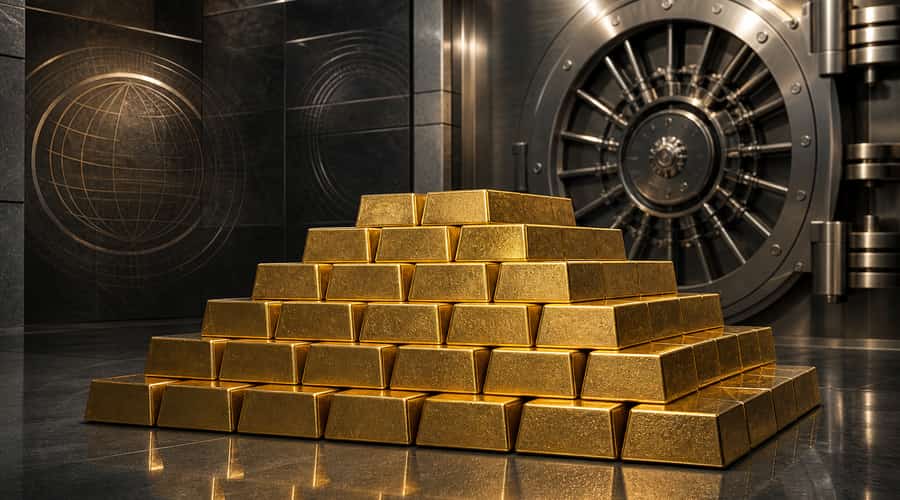
China just made its biggest monthly gold addition in more than a year, and the timing matters. Central banks are still buying bullion even after a volatile run, which gives the gold market a stronger floor than price charts alone suggest.
The People's Bank of China added 8 tonnes of gold to its reserves in April, its largest monthly purchase since December 2024 and its 18th straight month of accumulation. That is not a small footnote in the metals market. It is a signal from one of the world's most important reserve managers that gold still has work to do inside a serious national balance sheet.
As the World Gold Council noted on May 14, China's official gold holdings rose to 2,322 tonnes after the April purchase, equal to about 9% of total reserves. ChinaDaily, citing data released by the People's Bank of China, put the move in troy-ounce terms: reserves climbed by 260,000 ounces to 74.64 million ounces from 74.38 million at the end of March.
That matters because gold has already had plenty of reasons to wobble. Prices have been elevated, investors have been reassessing rate-cut expectations, and every sharp move higher has invited the obvious question: has the trade gone too far? China's answer, at least for now, appears to be no. Not because the central bank is trying to chase a short-term price, but because bullion plays a different role for governments than it does for retail traders.
Central banks do not buy gold for the same reason a household buys a coin or an investor buys an exchange-traded fund. They are not looking for a quick flip. They are managing currency exposure, geopolitical risk and trust in the global financial system. In that context, gold is not just a commodity. It is an asset with no issuer, no default risk and no direct dependence on the policy decisions of another country.
China's steady buying fits a wider pattern. The World Gold Council reported that central banks bought 244 tonnes of gold on a net basis in the first quarter of 2026, keeping official demand above its five-year quarterly average. China was not the only buyer, but its role attracts more attention because of the size of its reserves and the long-running question of how quickly Beijing wants to diversify away from dollar-heavy assets.
That does not mean China is abandoning the dollar. Its foreign exchange reserves remain enormous, and gold still represents a minority share of the reserve book. But the direction is clear. When a central bank adds gold for 18 months in a row, the point is not one monthly number. The point is persistence.
This is where the gold story becomes more interesting for investors. A market supported mainly by speculative demand can reverse quickly when momentum fades. A market supported by official-sector buying has a different character. Central banks can be price-sensitive, but they also tend to operate with longer horizons and deeper strategic motives.
Retail investors should not read this as a free pass
For individual investors, China's latest purchase is supportive, but it is not a guarantee. Gold can still fall hard when the dollar strengthens, real yields rise or investors decide they no longer need as much protection. The recent volatility is a reminder that even a structurally favored asset can punish people who buy without a plan.
The better lesson is about position size and purpose. If gold is being used as portfolio insurance, it should be judged differently from a growth stock or a short-term trade. Its job is to reduce dependence on paper assets, provide liquidity in stressful periods and act as a hedge when confidence in currencies or policy weakens. That can be valuable, but only if the investor understands why it is there.
China's buying also helps explain why dips in gold have been met with interest rather than panic. When official demand remains active near elevated prices, it tells the market that large buyers still see value beyond the next inflation print. That can change the risk-reward balance, especially for investors who have been waiting for a cleaner entry after a sharp rally.
There is another practical point. The rise in China's domestic gold ETFs in April, with holdings reaching 301 tonnes according to the World Gold Council, shows that institutional reserve buying is not happening in isolation. Local investors are also using gold as a store of value at a time when confidence in other assets is uneven. Central banks and households may have different motives, but they are responding to the same broad environment: uncertainty, currency risk and a desire for something tangible.
The next thing to watch is whether the pace continues. One large monthly addition does not rewrite the global reserve system, but it strengthens a trend that has already been visible for more than a year. If China keeps adding gold while prices remain high, the message will be difficult to ignore. Gold is not just benefiting from fear. It is being treated as a monetary asset again, and that is a more durable story than a price spike.
Also read: India's gold duty hike will test buyers and bullion markets • The metals selloff shows gold and silver are trading like liquidity assets • The Boot of Cortez tests the trophy market for physical gold