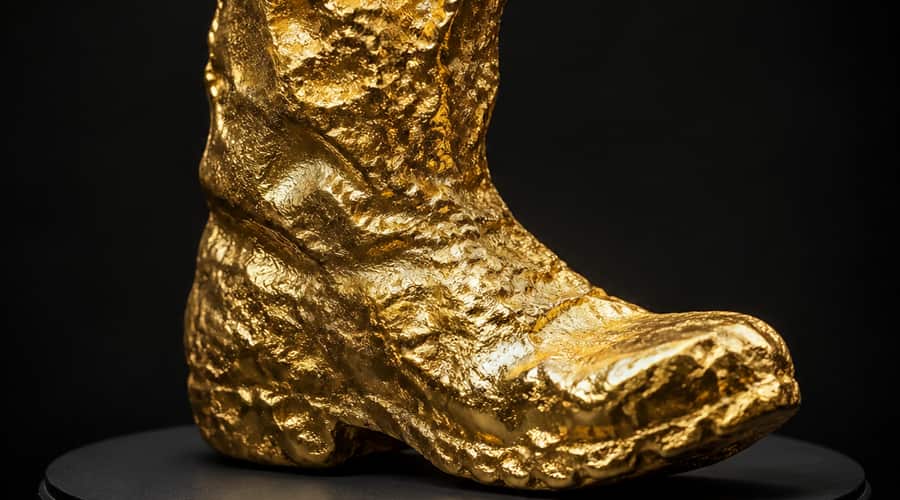
A 26.2-pound natural gold nugget is heading to auction while gold prices are already high. The real question is not what the metal is worth, but how much collectors will pay for rarity on top of it.
The Boot of Cortez is not coming back to market as a curiosity. It is arriving as a hard-asset test, one that sits between bullion, natural history and trophy collecting at a moment when gold has already done much of the work for sellers.
EJ's Auction & Appraisal in Glendale, Arizona, has scheduled the sale for June 12, 2026, at 1 p.m. local Arizona time, with bidder registration required by June 9. The auction house lists a $1 million opening bid and a confidential reserve, while its catalog places the estimate at $3 million to $7 million. That wide range says a lot. This is not a normal gold trade. It is a price discovery exercise for one of the rare physical objects that can make bullion look ordinary.
The specimen is listed at 383.10 troy ounces, or 26.2 pounds, and independent analysis arranged for the sale puts it at approximately 98% gold. It was discovered in 1989 near Caborca, Sonora, Mexico, by a prospector using a Radio Shack metal detector, and has been marketed as the largest surviving natural gold nugget found in the Western Hemisphere. The boot-like shape is part of the appeal, but the more important feature is that it survived at all. Many large nuggets were melted because the metal was easier to sell than the story.
At recent spot gold levels around $4,705 per troy ounce, the Boot's gold content implies a melt value of roughly $1.77 million after adjusting for 98% purity. That makes the $1 million opening bid look less like a valuation and more like a door-opener. The reserve is the real line, and EJ's has not disclosed it.
The estimate is where the rarity premium becomes visible. A $3 million result would value the nugget at about 1.7 times melt. A $7 million result would put it close to four times melt. That upper end would echo the last time the Boot of Cortez became a public market event, when gold was far cheaper and collectors still paid far above bullion value for the specimen.
There is one useful wrinkle in the historical record. Heritage's archived lot page shows the nugget sold on January 20, 2008, for $1,314,500, while a Heritage magazine item later described the January 2008 sale at $1,553,500 and noted that gold was near $900 an ounce at the time. Either way, the message was clear. Buyers were not paying only for gold. They were paying for scale, provenance and the fact that the object could not be replaced by another 26-pound bar from a refinery.
That distinction matters more in a high-price cycle. When gold rises, almost every coin, bar and scrap piece gets pulled upward by the same market force. Trophy objects are different. They still benefit from the metal price, but their final value depends on whether enough wealthy buyers decide the premium is justified. If the Boot clears near the low end of the estimate, the market will have confirmed a healthy but controlled rarity premium. If it pushes toward the top end, collectors will be saying that exceptional natural gold deserves a valuation closer to art than bullion.
Hard Assets Are Competing For Attention
This auction also lands in a broader market where investors have become more comfortable treating physical objects as stores of value. Rare coins, important watches, sports memorabilia, fine minerals and historical artifacts have all benefited from buyers who want something outside public markets. That does not make them liquid in the way gold futures are liquid. It makes them emotional, scarce and sometimes surprisingly resilient.
The Boot of Cortez sits in a particularly strong corner of that market because it has both commodity backing and narrative backing. A collector can calculate its gold content in seconds, but that calculation does not capture its museum history, its survival in natural form or the simple drama of finding a Western Hemisphere-scale nugget with a consumer metal detector in the Sonoran desert.
There is risk here, too. A natural gold specimen is not the same as a standard bullion position. The buyer pool is narrower, transaction costs are higher and resale timing matters. If the winning bid runs far beyond melt, the owner will need another collector to recognize the same premium later. That is why this sale is interesting beyond the headline weight. It will show whether today's appetite for hard assets extends to the kind of object that asks buyers to value story and scarcity alongside ounces.
For the gold market, the auction will not move spot prices. It is too small for that. But it may say something useful about sentiment at the high end of the physical market. When buyers are willing to pay a steep premium for an object whose melt value is already high, confidence has moved beyond hedging. It has become collecting with conviction.
That is what makes June 12 worth watching. The Boot of Cortez will either sell like a famous gold nugget in a strong bullion cycle, or it will sell like a trophy asset that happens to be made of gold. The difference between those two outcomes is the market signal.
Also read: Kevin Warsh takes the Fed chair as crypto watches the dollar • JPMorgan says gold can still climb to $6,300 this year • India raises gold and silver tariffs to cool imports and steady the rupee