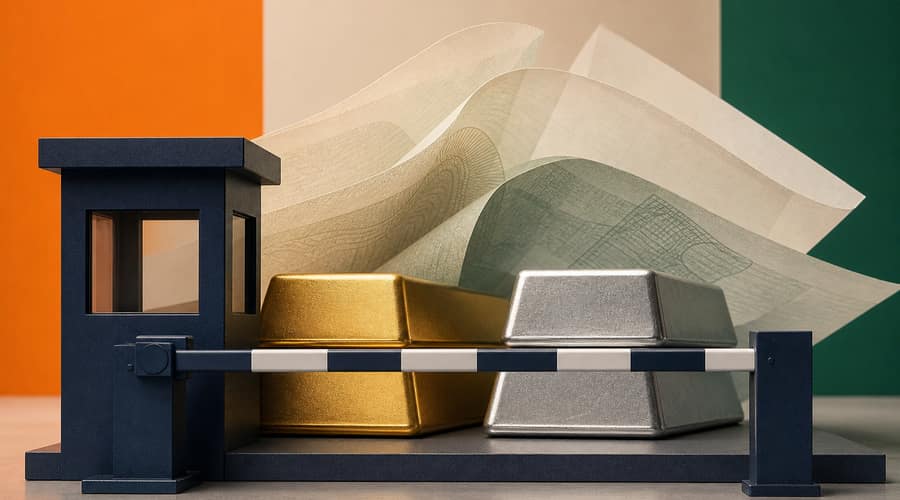
India has made gold and silver imports much more expensive, and the effect will run beyond jewellery counters. The real test is whether higher duties cool demand or push more trade outside formal channels.
India's decision to lift the effective import duty on gold and silver to 15% is not just another tax change for wedding shoppers. It is a direct intervention in one of the world's most important bullion markets at a moment when gold has already been drawing strong investor attention and the rupee has been under pressure.
The new structure took effect on May 13, 2026, and raises the burden from 6% to 15%, made up of a 10% basic customs duty and a 5% Agriculture Infrastructure and Development Cess. According to Reuters, the move is aimed at curbing overseas purchases of precious metals and easing pressure on India's foreign exchange reserves, which is where the consumer story becomes a wider market story.
India matters because it is not a marginal buyer. The World Gold Council's latest India focus described the country as second in both jewellery and investment demand, which means changes in Indian buying behavior can move more than local shop prices. When India imports less gold, the effect can show up in bullion flows, dealer premiums, bank inventories and even the signal global traders read from physical demand.
For households, the first effect is straightforward. Imported gold and silver become costlier, and jewellers have to decide how much of that extra duty can be passed on to customers already dealing with high bullion prices. That will be especially sensitive in India, where gold is not just a luxury purchase but also a savings product, a wedding asset and a cultural store of value.
Higher import duty can reduce formal demand, but it does not erase the underlying desire to own gold. That distinction matters. A family buying jewellery for a wedding may delay a purchase or reduce weight, but it may also bring old ornaments back to the jeweller for exchange. This is where organised retailers and local jewellers will lean harder into old-gold schemes, recycling, buyback offers and lighter designs that protect volume without asking customers to absorb the full price shock.
The banking channel was already unsettled before this announcement. Reuters had reported that India's April gold imports were set to fall to around 15 metric tons, a near 30-year low, after banks halted shipments following a 3% integrated goods and services tax demand from customs. Banks later resumed imports after agreeing to pay the tax, but the episode showed how quickly supply can tighten when tax treatment changes.
That matters because physical gold markets run on trust and steady logistics. If banks, refiners and importers cannot read policy clearly, they adjust by holding more inventory, widening spreads or slowing fresh orders. Consumers see the final price, but the larger cost is friction in a market that depends on smooth formal imports.
The gray market risk is back
India has been here before. High duties can help protect foreign exchange in the short term, but they also widen the gap between official domestic prices and offshore prices. Once that gap is large enough, smuggling becomes more attractive. That does not mean every buyer suddenly moves underground, but it does mean the incentive structure changes.
The government had previously reduced duties in 2024 partly to reduce unofficial flows. Raising them again shows that currency defense has moved back up the policy agenda. That may be understandable if the rupee is weak and import bills are rising, but bullion is unusually difficult to control because it is compact, valuable and deeply embedded in household finance.
Silver brings its own complication. It is not only a jewellery and investment metal, but also has industrial demand tied to electronics, solar equipment and other manufacturing uses. A higher import duty can therefore hit both households and businesses, even if gold gets most of the attention. For manufacturers that rely on imported silver inputs, the added cost may squeeze margins unless it can be passed through.
Global markets should not overread the move as a permanent collapse in Indian demand. Indian buyers are price sensitive, but they are also persistent. When prices rise too far, demand often shifts from new jewellery to coins, bars, smaller pieces or exchanges of old metal. The form changes before the attachment disappears.
The more important question is whether the policy succeeds on its own terms. If legal imports fall and the rupee gets some relief, officials may see the duty hike as useful. If premiums rise, smuggling revives and jewellers struggle with uneven supply, the market may simply move into less visible channels. That would protect headline import numbers while making the trade harder to monitor.
For investors, this is the signal to watch. India's duty hike may cool some near-term physical buying, but it also confirms that gold has become important enough to sit inside currency and trade policy again. When governments start managing bullion flows more aggressively, gold is no longer just reacting to fear or inflation. It is being pulled into the machinery of financial stability, and that is usually a sign the next phase of the market will be more political, not less.
Also read: The metals selloff shows gold and silver are trading like liquidity assets • The Boot of Cortez tests the trophy market for physical gold • Kevin Warsh takes the Fed chair as crypto watches the dollar