
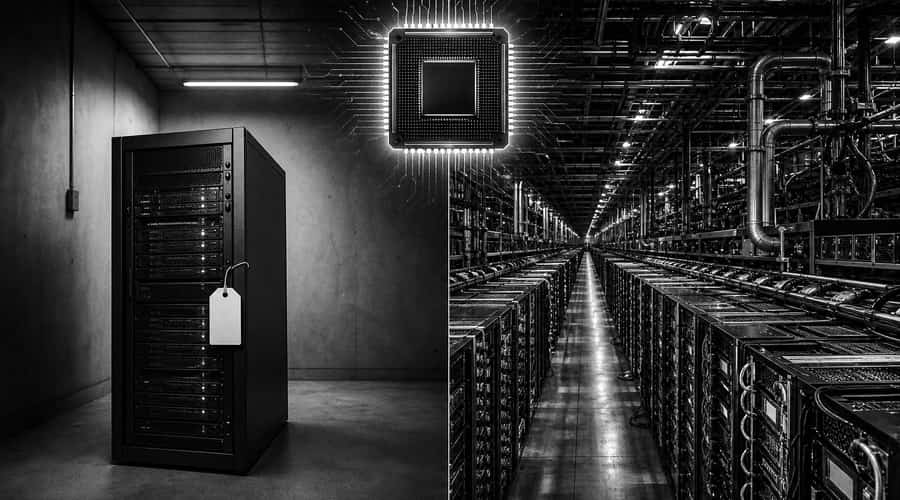
DeepSeek trained its flagship V3 model for about $5.6 million, a fraction of the $50 million to $100 million OpenAI is estimated to have spent on GPT-4, and the gap is reigniting a debate that never really went away.
On r/LocalLLaMA, a thread with more than 900 upvotes and 200 comments is doing what that community does best: pulling apart a frontier model line by line to figure out how it works. This time the subject is DeepSeek, and the question driving the thread is simple. How does a Chinese lab operating under U.S. chip export controls keep matching or beating labs with ten times its budget?
The answer, as far as the thread's most upvoted replies go, isn't one trick. It's three, stacked on top of each other. DeepSeek-V3 uses a mixture-of-experts architecture with 671 billion total parameters, but only 37 billion of them activate for any given token, so the model skips most of the compute work a dense model its size would require. It trained on 14.8 trillion tokens over 55 days using roughly 2,048 Nvidia H800 GPUs, chips that are themselves a workaround, the cut-down version Nvidia sells into China to comply with export rules. And it trained largely in FP8, an 8-bit numerical format that cuts memory and compute costs compared with the 16-bit or 32-bit precision most Western labs default to.
None of that is secret. DeepSeek published the engineering details in its own technical papers. What's new is the pattern holding up over a full year of follow-on releases.
In April 2026, DeepSeek shipped V4, a trillion-parameter model tuned to run on Huawei's Ascend chips rather than Nvidia's, according to Reuters. The move mattered enough that Chinese tech firms reportedly scrambled to lock in Huawei supply right after the launch, with Huawei planning to ship around 750,000 Ascend 950PR units this year. Three months later, V3.2 landed at $0.14 per million input tokens and $0.28 per million output tokens, pricing that undercuts most frontier competitors by three to five times while, by several independent benchmarks, delivering 85 to 95 percent of the quality of top-tier rivals like Qwen3-Max.
That's not a lab experiment anymore. That's a pricing strategy.
The efficiency story now has a valuation attached to it. A Chinese stock exchange filing disclosed on July 16, spotted first by Reuters, showed a fund tied to Anhui Korrun, a Chinese luggage maker, holding a 0.8265 percent stake in DeepSeek for 2.9 billion yuan, or about $427.9 million. Do the math on that stake and DeepSeek's implied valuation comes out to roughly $51.8 billion. That figure lines up with DeepSeek's first outside funding round in June 2026, when it raised about $7.4 billion at a valuation near $60 billion from investors including Tencent and CATL, the world's largest electric vehicle battery maker. DeepSeek is reportedly now weighing a fresh round that could push it to $71 billion to $74 billion, with an IPO filing aimed at Shanghai's STAR Market and a possible debut in 2027.
Here's the thing that should worry chipmakers more than the valuation number. If DeepSeek can hit frontier-adjacent performance on a fraction of the GPU hours, and increasingly on domestic silicon instead of Nvidia's, the argument that AI progress requires massive capital spending, the one propping up valuations at Nvidia, OpenAI, and Anthropic, gets harder to defend.
What it means for Nvidia's chip demand
Nvidia's own numbers already show the export controls biting. China's share of Nvidia's revenue fell to 9.1 percent in fiscal 2026, down from 13.1 percent a year earlier, and the company halted H200 production for the Chinese market entirely in March. Yet Nvidia has kept spending anyway, funneling close to $38.8 billion into the broader AI ecosystem this year through investments in the same companies that buy its chips, according to an analysis by BigGo Finance. Critics call it circular financing. Nvidia backs the buyer, the buyer buys Nvidia. Oracle disclosed roughly $50 billion in fiscal 2026 capital spending, much of it tied to Nvidia and Meta partnerships, which is exactly the kind of number that makes the DeepSeek thread relevant to people who have never opened a terminal.
Frankly, the r/LocalLLaMA crowd isn't wrong to be fixated on this. If a model trained for $5.6 million keeps trading blows with one that cost $100 million, the premium everyone is paying for frontier compute needs a better justification than being the only way to get there. DeepSeek hasn't proven that premium is worthless. It's proven the premium is a choice, not a law of physics.
Also read: Kimi K3 Recreated a Playable Super Mario 64 Clone From a Single Prompt • Kimi K3 Forces Wall Street to Question America's Grip on AI Leadership • Anthropic Limits Claude Fable 5 Access as It Runs Out of Compute