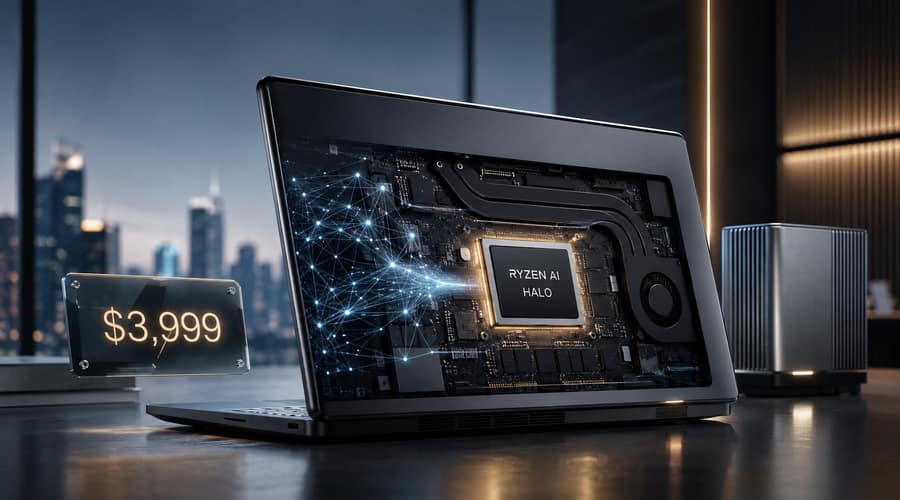
AMD's Ryzen AI Halo is moving from CES promise to priced local AI hardware, with a reported $3,999 developer box aimed at keeping larger models off the cloud.
AMD's Ryzen AI Halo now has a real market test: whether developers will pay workstation money for a compact box that keeps more AI work on the desk. Recent reporting has put the high-end configuration at $3,999, pairing a Ryzen AI Max+ 395 chip with 128GB of unified LPDDR5x memory and a 2TB SSD, while AMD's own product page frames the system as a local AI development platform rather than another premium mini PC.
That distinction matters. Halo is being sold around a clear promise: run larger models locally, reduce dependence on remote inference, and give developers a more private workflow when prompts, code, or customer data should not keep leaving the machine. AMD highlights Windows and Linux support, full ROCm compatibility, day-zero support for leading AI models, and a setup designed to work out of the box for AI development.
The headline specification is the 128GB unified memory ceiling. AMD lists the Ryzen AI Max+ 395 platform with 16 Zen 5 CPU cores, Radeon 8060S graphics, an integrated NPU rated at up to 50 TOPS, and overall AI performance quoted at up to 126 TOPS. Those numbers are not just marketing decoration. For local AI, memory capacity often decides what a developer can realistically load before performance or usability falls apart.
Once a desktop system reaches 128GB of shared memory, models in the 70B class become more practical for independent developers, small research teams, and startups that want to experiment without treating every prompt as a cloud cost. It does not make a compact workstation equal to a data center GPU cluster. It does make local prototyping a more serious option.
The pricing is the sharper part of the story. $3,999 is not cheap, and several Strix Halo-based mini PCs already compete below or around that range. But the comparison for AMD is not only against consumer desktops. It is against cloud inference bills, rented GPU instances, and Nvidia's DGX Spark, the personal AI system first shown as Project DIGITS and positioned for running models up to 200 billion parameters on a single unit.
AMD is selling control as much as compute
AMD is not entering an empty category. Nvidia has already made compact AI workstations feel like a real product class, while Apple, Intel, Framework, Corsair, Minisforum, and others are all pressing into high-memory local computing from different angles. The market is still early, but the direction is clear: more AI work is moving closer to the user, even when training and large-scale deployment remain in the cloud.
Halo's pitch is a specific compromise. It offers a familiar PC-style form factor, serious memory headroom, and a software stack that AMD wants developers to recognize across local and cloud workflows. The reported $3,999 price signals that AMD sees local AI hardware as a procurement decision for developers and small teams, not just an enthusiast experiment.
For startups, that can be useful if the workload fits. A founder building an internal coding tool, a legal document assistant, or a customer support prototype may not need to send every test through a paid API. Local hardware can lower latency, keep sensitive data closer, and make experimentation feel less meter-driven. The trade-off is equally clear: buyers give up the elasticity and mature software ecosystem that cloud platforms and Nvidia hardware still provide.
That software gap is the part AMD still has to close. ROCm support has improved, and AMD is clearly trying to make Halo feel less like a hobbyist setup and more like a polished developer machine. But in AI tooling, Nvidia's CUDA ecosystem remains the default assumption for many teams. Hardware value only matters if the models, libraries, and workflows developers actually use behave reliably.
The market signal is bigger than one box
The more interesting point is what Halo says about AI compute in 2026. The race is moving downmarket, but not toward cheap hardware. It is moving toward ownership: compact machines that can absorb workloads once reserved for remote clusters, especially during product development and private testing.
AMD's reported pricing makes that shift easier to see. The company is not arguing that local boxes replace cloud infrastructure. It is arguing that some AI work should never have needed a cloud round trip in the first place. That is a practical message for developers who want faster iteration and tighter control without building a full workstation around discrete server hardware.
For readers building on top of large language models, the takeaway is straightforward. Local AI hardware is becoming a real budget line, not a side project. Ryzen AI Halo will have to prove itself on performance, software reliability, and availability, but the broader direction is already visible: more teams will split their AI workflow between owned machines for experimentation and cloud services for scale.
Also read: Commerzbank ties €350m cost-cut pledge to AI as pressure on European banks intensifies • China's Nvidia gaming chip ban widens the chip war beyond AI • AustralianSuper hires head of AI as pension funds formalise model governance