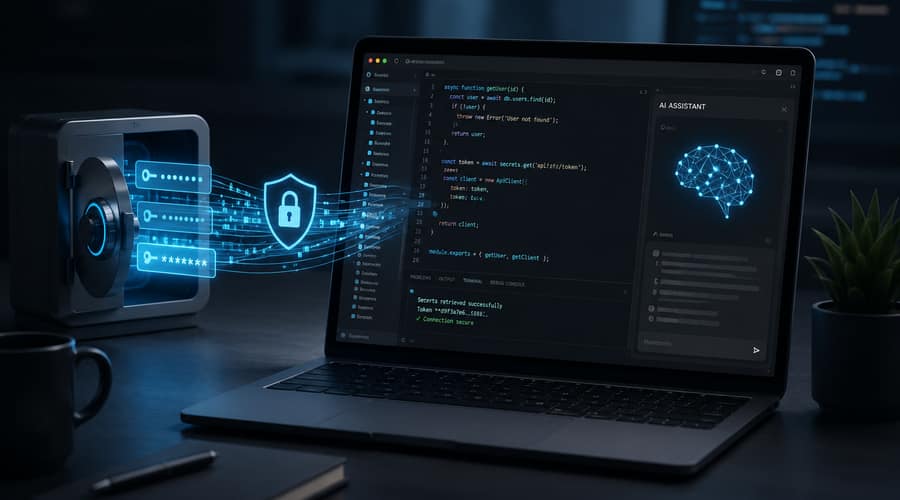
1Password is trying to solve one of the ugliest problems in agentic coding, giving AI tools access to secrets without handing them the keys.
OpenAI's Codex is becoming more useful, and that makes it more dangerous. As the coding agent gets closer to production systems, 1Password and OpenAI are now pushing a simple idea: let the agent use credentials at runtime, but never let those secrets live in prompts, files, terminals, or model context. 1Password said on May 20 that its new Environments MCP Server for Codex is meant to act as a trusted access layer, while OpenAI's own agent security team has argued that the integration helps developers ship faster without copying credentials into repositories or local files.
The timing matters. OpenAI has been expanding Codex beyond a basic coding helper, adding mobile access through ChatGPT, desktop background execution, and browser-based workflows in recent weeks, which makes the agent more useful but also more exposed to real-world infrastructure and sensitive data. That is exactly where the security problem starts. Once an agent can touch databases, APIs, deployment pipelines, and other live systems, hardcoded secrets and broad ambient credentials stop looking like a minor convenience and start looking like an operational liability.
1Password's pitch is straightforward: coding agents should be able to ask for access when they need it, not carry credentials around as if they were human developers. In the company's announcement, the Codex integration uses a local MCP server that connects the OpenAI tool to 1Password's Environments product, with user authentication required at the moment of access. The company says the secrets are mounted, used, and discarded inside a secure runtime environment, which means the agent can configure an app or run a task without ever seeing the raw value of the secret.
That is a meaningful shift from the way many teams still work. 1Password says credentials are often left in .env files, scripts, and repositories, where they are easy to exfiltrate and difficult to govern. The new integration is designed to catch secrets at the source, move them into 1Password, and replace them with references that Codex can use without exposing plaintext. For engineering teams, the benefit is not just cleaner code. It is a way to let AI do more of the work without widening the blast radius if something goes wrong.
What it signals for startups
For startups building on top of Codex or similar agentic tools, the bigger signal is that secrets management is becoming part of the core stack, not a back-office concern. If an AI agent is going to write code, connect to a database, or trigger a deployment, it needs a controlled way to authenticate. 1Password is positioning itself as that layer, and it is doing so with the same zero-knowledge architecture it uses for human users, now extended to machine workflows.
That matters because the market is shifting quickly. OpenAI's recent Codex releases show that the company wants the agent to live inside more of a developer's day, not just in a single chat window. As those workflows mature, the risk of credential leakage becomes harder to ignore, especially when researchers and security teams keep pointing to secrets exposure as one of the most acute threats in the agent-first software stack. 1Password is betting that teams will not adopt these tools at scale unless the access layer is built in from the start.
There is also a broader platform story here. 1Password says the Codex integration fits into its Unified Access approach, which is meant to govern access for humans, machine identities, and AI agents through one identity-first model. That is a more ambitious claim than a simple product tie-up. It suggests the company sees agent authentication as a category in its own right, one that will need the same kind of policy, approval, and auditability that companies already expect for employees and service accounts.
For now, the practical takeaway is clear. As AI coding agents move from experimentation to execution, the companies that control access may become as important as the models themselves. 1Password and OpenAI are making a case that the next layer of agent infrastructure is not just better code generation. It is safer credential handling, built into the workflow before the agent ever reaches production.
Also read: SpaceX prepares to make S-1 public, turning private-valued Starlink into a market benchmark • OpenAI's IPO talks would mark a rare disclosure moment for AI • Intuit cuts 3,000 jobs as it rebuilds around AI