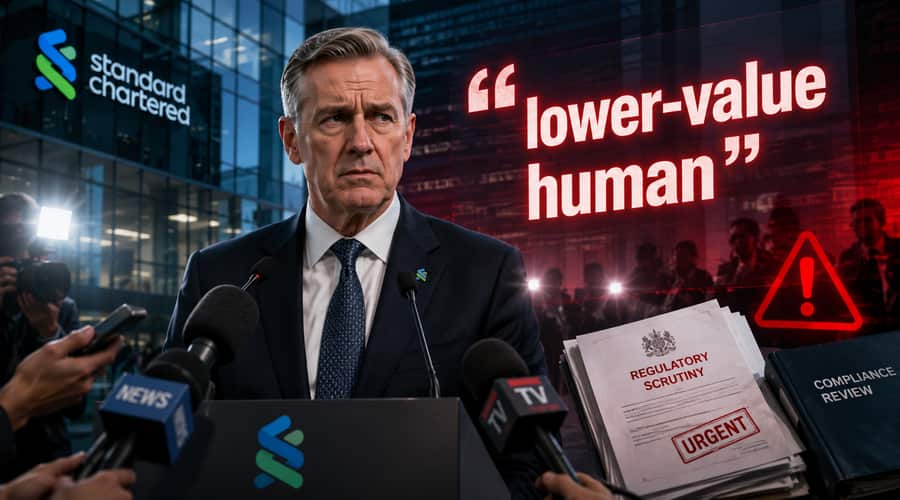
Standard Chartered CEO Bill Winters thought he was explaining AI efficiency. Instead, he gave regulators and employees a phrase they could not ignore.
Standard Chartered is now dealing with the kind of backlash that can turn a cost plan into a governance problem. Winters' comment about replacing "lower-value human capital" with technology landed just as the bank was outlining thousands of job cuts tied to automation, and regulators in Hong Kong and Singapore have started asking questions.
According to a Reuters report on May 21, citing Bloomberg News, the Hong Kong Monetary Authority and the Monetary Authority of Singapore sought clarity from Standard Chartered after the remarks. The HKMA asked whether the lender was using artificial intelligence as a pretext to cut staff, while MAS pressed for details on the possible local impact. That matters because Standard Chartered is not a distant player in either market. It has deep roots in Hong Kong and about 9,000 employees in Singapore.
Winters made the comment during an investor briefing in Hong Kong after the bank discussed plans to eliminate more than 7,800 back-office roles by 2030. "It's not cost-cutting; it's replacing in some cases lower-value human capital with the financial capital and the investment capital we're putting in," he said. The phrasing drew quick criticism from former Singapore president Halimah Yacob, who described it as disturbing and demeaning in a Facebook post.
Why regulators care about AI language
The regulatory response is not only about the number of roles being cut. It is about how the bank is framing the cuts. If AI is presented as a blanket explanation for shrinking headcount, supervisors will want to know whether the technology is genuinely changing work or simply giving management a cleaner story for layoffs that were already planned.
That distinction is important in banking. A lender cannot treat automation as a simple productivity upgrade if the change affects operational resilience, customer service, controls, outsourcing, data handling, or local employment commitments. Once regulators ask for details, the bank has to show its homework. Which roles are changing? Which systems are being automated? What risks are created? How will affected staff be treated? These are not public relations questions. They are supervision questions.
Standard Chartered is also not acting from distress. The bank reported record first-quarter results on April 30, with operating income up 9 percent at constant currency to $5.9 billion and pre-tax profit up 17 percent to $2.45 billion. That makes the optics sharper. This is not a lender fighting for survival. It is a profitable institution reallocating capital from payroll toward technology while telling investors it can lift returns over the next several years.
There is a reasonable business case inside that strategy. Banks have large support functions, complex legacy systems, and years of pressure to improve efficiency. AI and automation can reduce manual processing, speed up compliance work, and help staff spend less time on repetitive tasks. But Winters' wording made a defensible operating plan sound like a judgment on human worth, and that is where the damage began.
The damage control memo came too late
The morning after the backlash, Winters sent a memo to employees trying to clarify the point. He said the bank's future depended on the talent, judgment, relationships, and commitment of its people, and stressed that roles falling away reflected changes in work rather than the value of employees. The message was necessary. It was also late.
Former JPMorgan Chase CEO Jamie Dimon, who once worked with Winters, offered a diplomatic defense on Bloomberg Television, calling the phrasing an "inartful way to say something." That may be true, but it also understates the lesson. For a regulated bank, language is not cosmetic. It signals culture, intent, and the quality of management judgment. A careless phrase can invite scrutiny even when the underlying plan is legal and commercially rational.
What this means for founders and startups
For startup founders, the StanChart episode offers a clear warning. AI efficiency narratives that sound crisp in a board deck can backfire in public, especially when they touch jobs. Investors may reward a company for doing more with fewer people. Employees, customers, and regulators hear a different message if the company sounds indifferent to the people being displaced.
The risk is even sharper for startups selling automation tools into banks. A product that clearly improves productivity may be attractive. A product marketed mainly as a way to remove staff may create compliance headaches for the buyer. Banks will still buy efficiency, but they will be careful about tools that appear to weaken controls, reduce accountability, or create social and political risk in major markets.
The next thing to watch is whether the HKMA or MAS move beyond questions and require more formal reporting from Standard Chartered. No enforcement action has been announced, and the bank still has room to explain its plans. But the signal is already clear. As AI moves deeper into white-collar work, companies will have to explain automation with more discipline. Calling employees "lower-value human capital" is not discipline. It is a reminder that the wrong phrase can become the story.