AI data centers have moved from zoning agendas into campaign ads, and that changes the risk calculation for the companies financing the buildout.
The first broad consumer backlash to the AI boom is not about chatbots taking office jobs or models scraping books. It is about power bills, water, farmland, gas turbines, and whether a town gets stuck hosting the physical cost of someone else's computing demand.
According to a Business Insider and POLITICO analysis published June 13, more than 200 data centers are planned or under construction across dozens of competitive House districts. The sharper number is this: 40 of the 69 House districts expected to be competitive in the 2026 midterms have at least one data center planned or already being built. That puts AI infrastructure inside the races that will decide control of the House.
This is a different kind of risk from the one investors usually discuss when they talk about AI infrastructure. Permits can be modeled. Transformer lead times can be tracked. Power purchase agreements can be priced. A voter who believes a hyperscaler is raising her electricity bill is harder to put into a spreadsheet.
POLITICO's analysis used Data Center Map information, geocoding and public sources, with the data current as of April 30. It found about 1,500 data centers planned or being built across 232 congressional districts, with a nearly even partisan split. More than 2,500 facilities are already operating across 373 districts, and more than one in three Americans live within five miles of an operating data center.
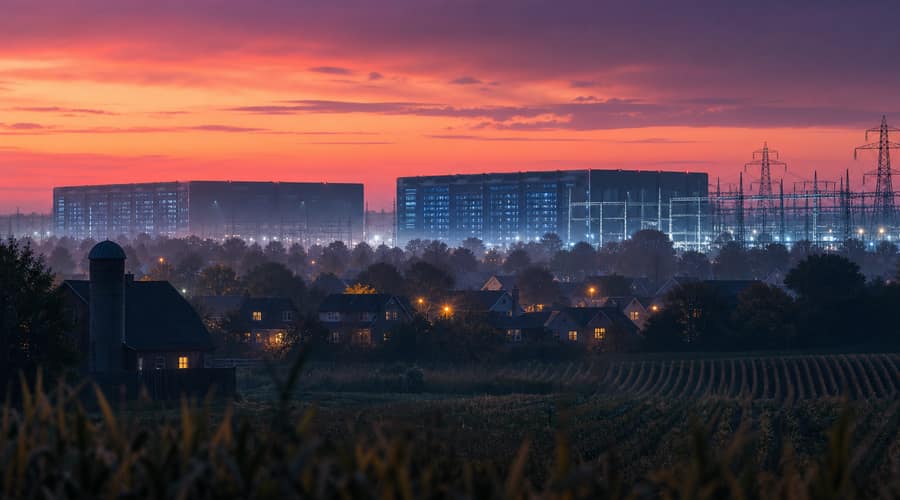
A data center is not an invisible cloud when it lands near homes. In many communities it is a windowless building, a substation fight, a water question, and a utility bill debate wrapped into one.
Neither party has found a comfortable message. Republicans often want the economic development and national security language around AI. Democrats often want the affordability and environmental language around utility costs and water. Both parties have candidates sitting in districts where the issue is already local, noisy, and personal.
Business Insider reported that Democratic Rep. Marcy Kaptur, who is defending Ohio's 9th District, told a spring hearing that anti-AI signs in her region were more visible than candidate signs. In Iowa, Republican Rep. Zach Nunn represents a competitive district with 31 planned data centers and 33 already operating, more than any other Republican incumbent in a competitive race. His position is the kind many candidates will try to hold: support AI leadership, but reject higher utility bills and sweetheart deals for out-of-state tech companies.
That balance will get harder as ads make the issue simpler. Business Insider said every congressional and gubernatorial ad identified by AdImpact that mentioned data centers was critical of the facilities. One Priorities USA ad tied AI data center electricity demand to an expected 3% increase in residents' electric bills and used that point against Pennsylvania Republican Scott Perry. Perry then told POLITICO he did not support data centers in his Harrisburg and York district.
There is also a tech money problem sitting underneath the policy problem. Candidates who go too hard against data centers risk alienating an industry with money, lobbyists, and a national argument about keeping the United States ahead in AI. Candidates who sound too close to Big Tech risk looking as if they are asking local voters to pay for someone else's server farm.
Local moratoriums are becoming a warning sign
The newest local moves show how quickly the politics can turn operational. Seattle's City Council voted unanimously on June 9 for a one-year moratorium on new data center projects. TechRadar reported that proposals for as many as five large facilities could have used 369 megawatts of energy, roughly one-third of the city's usage. For a city that is home to Amazon and near Microsoft, that is not a symbolic vote. It is a sign that even tech-heavy places are willing to slow the buildout when the local bargain looks weak.
Charlotte moved the same week. Axios reported that the city approved a 150-day moratorium on new data center construction so planners could study electricity costs, water use, noise, environmental effects, and where these facilities should be allowed. Denver approved a one-year pause in May. These are not fringe towns rejecting the internet. They are cities trying to write rules after discovering that the AI boom arrived faster than their zoning codes.
Amazon can see the pressure. Axios reported on June 11 that the company said it was 75% of the way toward its 2030 goal of replenishing more water in communities than its data centers consume. Amazon also said its data centers are seven times more water-efficient than the industry average, though Axios noted that the benchmark is not directly reported by the industry. The company said it cut water use in Northern Virginia by 42% in 2025 while computing demand kept growing.
Those figures help Amazon's case, but they do not settle the politics. Gallup polling released in May found that 71% of Americans oppose AI data center construction in their area, with resource use such as water and electricity the top concern among opponents. The Verge noted that opposition crossed party lines, with 75% of Democrats, 74% of independents, and 63% of Republicans against new construction near them.
The hard cases will define the issue. In Memphis, residents are fighting Elon Musk's expanding xAI Colossus supercomputer. Business Insider cited POLITICO reporting that the facility burns enough methane gas to power 280,000 homes. Once a project is described in those terms, the argument is no longer only about data capacity or AI leadership. It becomes about who gets the power, who gets the pollution, and who gets the bill.
For AI investors, this should change the discount rate. A data center project can have demand from a hyperscaler, a signed power deal, and a clean financial model, then still run into a campaign season where candidates discover that opposing it is good politics. The AI boom still needs buildings, chips, cooling systems and transmission lines. From now through November 2026, it also needs voters who believe the trade is worth making.
Also read: Bill Gates warns Washington is changing the rules for tech • Disney is turning AI coding into an operating discipline • UAL's Nerve Lab puts children's screen time under a sharper lens