The Boring Company is reportedly trying to raise about $4 billion at a $20 billion valuation. That price only makes sense if you believe Las Vegas is the start of a repeatable transit business, not a clever local project with Elon Musk attached.
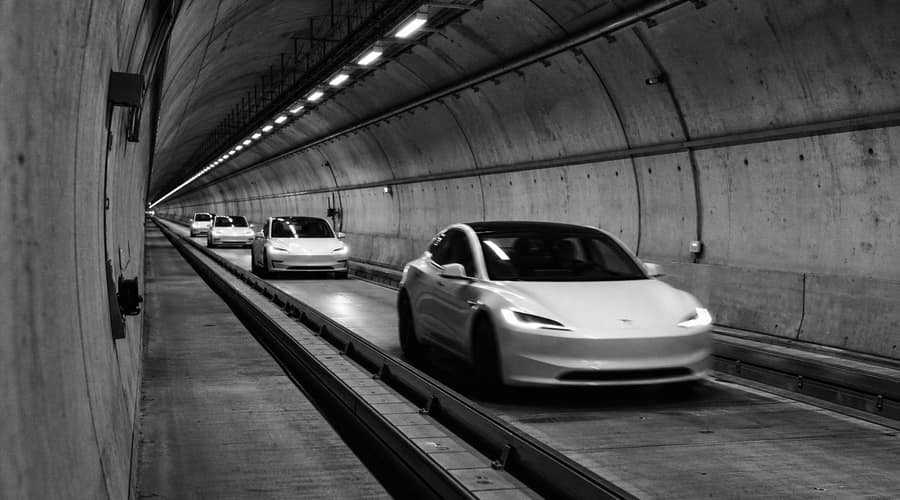
The Boring Company has done the part most infrastructure startups never reach: it built a working system people can ride. That matters. The Vegas Loop now carries passengers in Tesla vehicles through tunnels serving the Las Vegas Convention Center and nearby Strip resorts. It works. The harder question is whether it works well enough to carry a $20 billion private-market price.
According to The Wall Street Journal, Musk's tunneling company is in talks to raise roughly $4 billion in a round that could value it at about $20 billion. The same report put its last major valuation at $5.7 billion in 2022, when it raised $675 million from investors including Vy Capital, Sequoia Capital and Founders Fund. That's a heavy jump. It asks investors to treat The Boring Company as one of the world's most valuable infrastructure startups before it has proved its model in a normal city commute.
Las Vegas is real evidence, but it is also a special case. The Boring Company's own projects page says Vegas Loop has moved more than 4 million passengers through 11 stations, with 68 miles of tunnel and 104 stations approved by Clark County and the City of Las Vegas. The Las Vegas Convention Center portion is smaller and more concrete: about 2.1 miles and five stations, after an expansion in 2024. That distinction matters. A functioning convention and resort network is not the same as a citywide transit system.
Vegas is the proof and the loophole
Here's the uncomfortable part for anyone looking at this round. Vegas gives The Boring Company exactly the kind of concentrated demand it needs: convention halls, resorts, airport traffic and tourists who already expect to pay for short trips. The LVCC rides are free for convention attendees, while public trips outside the campus require tickets, according to the Las Vegas Convention and Visitors Authority. That is not how most public transit works. It is closer to a private mobility layer around places where the customer is already spending money.
That can be a good business. It may even be the right business. But you should not confuse it with a proven replacement for urban transit in dense cities with buses, trains, unions, budget fights and angry commuters who don't care who founded the company. Chicago, Baltimore and Los Angeles were among the earlier places where Boring Company proposals attracted attention and then failed to become operating systems, as the Journal noted. Las Vegas is the company's best argument. It is not yet the whole case.
Look at Nashville. The Boring Company now lists Music City Loop as under construction, connecting downtown Nashville, Lower Broadway, West End Avenue and Nashville International Airport. Its Dubai Loop is under contract, with a pilot phase planned at 6.4 kilometers of tunnel and four stations, beginning construction in late 2026. Those projects are the real test. If they move from announcement to operation, the $20 billion pitch starts to look less like Musk premium and more like a company building a repeatable playbook.
Until then, investors are paying for option value. That's the bet. They are not buying a mature transportation business with decades of operating data. They are buying the chance that faster boring machines, privately funded tunnels and Tesla-based passenger service can be copied city by city before competitors or regulators slow it down.
The Musk premium cuts both ways
The old version of this story would have leaned on SpaceX's private-market valuation as proof that Musk-linked companies deserve unusual patience. That comparison is now too stale to use cleanly. SpaceX went public in June, and recent market reports put its valuation around $1.5 trillion to $1.6 trillion after the stock fell below its IPO price. The point still holds, but in a sharper form: investors have made enormous money by believing Musk early, and they have also learned that public markets can punish the same ambition once the numbers arrive every quarter.
The Boring Company is nowhere near SpaceX in maturity. It has no Starlink equivalent throwing off global customer growth, no public filings for readers to inspect, and no operating history across multiple large transit networks. What it has is a working Las Vegas system, new construction in Nashville, a Dubai contract and a founder whose companies can still pull capital toward difficult engineering projects when other founders would be laughed out of the room.
Don't mistake fundraising for proof. Going from $5.7 billion to a possible $20 billion on paper is the easy part if the market wants another Musk story. Building tunnels, securing permits, managing safety, pricing rides and making the economics work outside a casino corridor are the parts that decide whether this becomes a transportation company or remains a very expensive demonstration of what Las Vegas can absorb.
For founders and investors, the useful lesson is plain enough. A working wedge in one market can justify a big valuation only if the next market is already in motion. The Boring Company now has that setup in Nashville and Dubai. If those projects slip, the Las Vegas Loop starts to look less like the beginning of a network and more like the one place where the model was always going to make the most sense.
Also read: How to get your first 100 SaaS customers without a dollar in ad spend • Managing AI agents is now the most valuable engineering skill you can have • Bank of America says the US deficit will hit $2 trillion in 2026 and the bill is coming due for startups