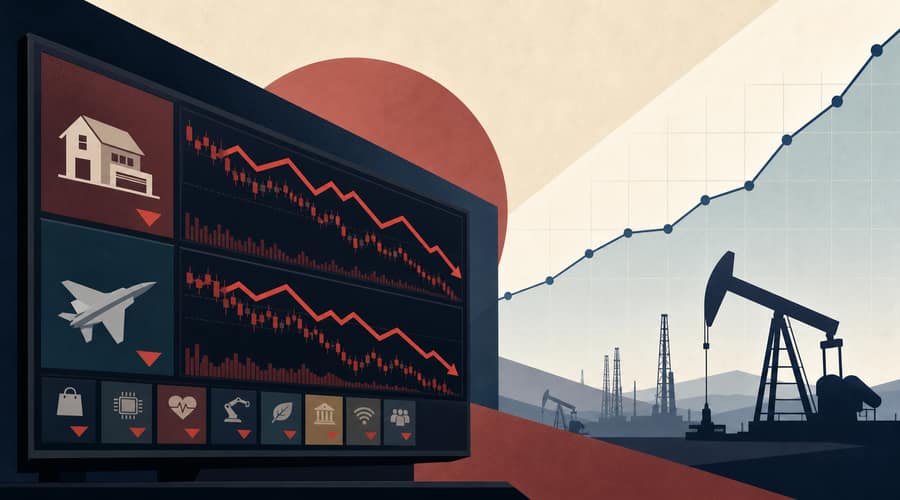
Ned Davis Research's Trump Trade index has fallen roughly 16% since May, according to Bloomberg, and the Iran conflict showed why the bet was too neat. Tariffs and re-shoring sounded simple until the Middle East moved the other way.
It sounded like a clean trade. Donald Trump wins, tariffs go up, manufacturing comes home, defense budgets expand, homebuilders get relief from deregulation. A dozen ETFs packaged that logic neatly, and early in 2026 the basket built by Ned Davis Research was beating the S&P 500 by a wide margin. Then May arrived. Iran didn't cooperate.
Bloomberg reported on July 25 that the Ned Davis Trump Trade Index, made up of 12 ETFs tied to homebuilding, defense spending and the return of industrial production to the United States, has dropped about 16% since May. Several of the funds are now negative for 2026. The S&P 500, by comparison, was up about 8% for the year in the same Bloomberg report, which is enough to make the underperformance hard to explain away as a broad market problem.
That's the story. Investors didn't lose money here because every Trump policy failed. They lost because they priced the trade as if policy were the only force in the room.
Iran broke the spreadsheet
The mechanism isn't complicated. The Iran conflict lifted oil prices, revived inflation worries, pushed Treasury yields higher and strengthened the dollar. Bloomberg said Ned Davis tied the decline in the Trump Trade directly to those pressures, and the detail matters because this basket was built around sectors that need the opposite conditions. Homebuilders need mortgage rates to ease. Industrial reshoring names need financing costs to stay tolerable. A stronger dollar makes imported goods cheaper relative to American-made products, which cuts against the whole buy-at-home argument.
The market reaction has been visible in real time. The Associated Press reported on July 8 that oil rose and stocks fell after Trump said the Iran agreement was "over," with the Dow down about 1% and the S&P 500 lower on the day. Reuters reported through MarketScreener on July 22 that Brent crude settled around $94 a barrel as the US and Iran traded strikes and shipping risk grew around the Strait of Hormuz. Two days later, AP reported Brent had moved above $100 as Middle East tensions spread into Red Sea tanker attacks.
That isn't background noise. It's the trade being hit in its weakest place.
JPMorgan had already put a number on the danger, warning that an attack on Iran could push oil to $120 a barrel and drive US inflation to 5%, according to a report carried by The Economic Times. You don't need that full scenario to hurt this basket. Even a smaller oil shock can keep the Federal Reserve cautious, pull mortgage rates higher and make capital-heavy factory plans look less attractive on a spreadsheet.
Defense ETFs were supposed to be the safer corner. More conflict, more spending, right? Not exactly. Defense contractors benefit from budgets, appropriations and procurement cycles, not from an oil shock that pulls investors out of cyclical trades in a hurry. Bloomberg's report noted that Global X Defense Tech was one of the ETFs that had gained at least 20% at points in the first quarter before giving back ground. The war trade can still work, but it doesn't float above the rest of the market.
The problem with policy bets
For founders and venture investors leaning on the re-shoring story, this is a useful warning. The macro conditions were doing more work than the political slogan. Cheap capital and contained inflation made domestic manufacturing sound investable. A softer dollar and stable shipping routes made the pitch feel almost obvious. Remove one, then another, and the same pitch starts to feel heavier.
Re-shoring isn't dead. It isn't. Companies still have good reasons to reduce exposure to China, and tariffs can still redirect supply chains at the margin. But there's a difference between a structural trend and a crowded trade. Bloomberg's source report quoted Pat Tschosik, Ned Davis Research's chief thematic strategist, tying the damage to Iran and inflation, with tariffs, wars and supply chain disruptions keeping fresh supply shocks in the market. That's the uncomfortable part. The policy that was meant to help some of these trades also adds volatility that can hurt them.
Truth Social's God Bless America ETF, ticker YALL, shows how messy the branding can get. Bloomberg reported that the fund, which has exposure to energy, industrials and financials, has seen net outflows every month since the start of the war and was down more than 4% for the year, while the S&P 500 was still positive. Despite the name, it doesn't own Trump Media & Technology Group. That sort of detail is why you should read the holdings, not the label.
Founders raising for domestic manufacturing, clean energy infrastructure or defense-adjacent technology should expect a harder room. LPs and venture investors are no longer just asking whether Washington likes the theme. They're looking at oil futures, the 10-year Treasury yield and the dollar before they believe the deck. That's a more demanding audience than the one that existed earlier this year.
The broader market holding up makes the Trump Trade's decline more telling, not less. If everything had sold off together, this would be a risk-off story. It isn't. The point is narrower and sharper: a basket built around policy tailwinds got caught by the real-world costs of the same geopolitical style that made the trade attractive. Frankly, that was always the flaw. Policy can pick favorites, but oil and rates still get a vote. So does the currency.
Also read: Tesla's Cybercab is no longer a pilot and the numbers are starting to show it • Intel just had its best revenue quarter in 15 years and still reported an $11 billion loss • Bank of America says the US deficit will hit $2 trillion in 2026 and the bill is coming due for startups