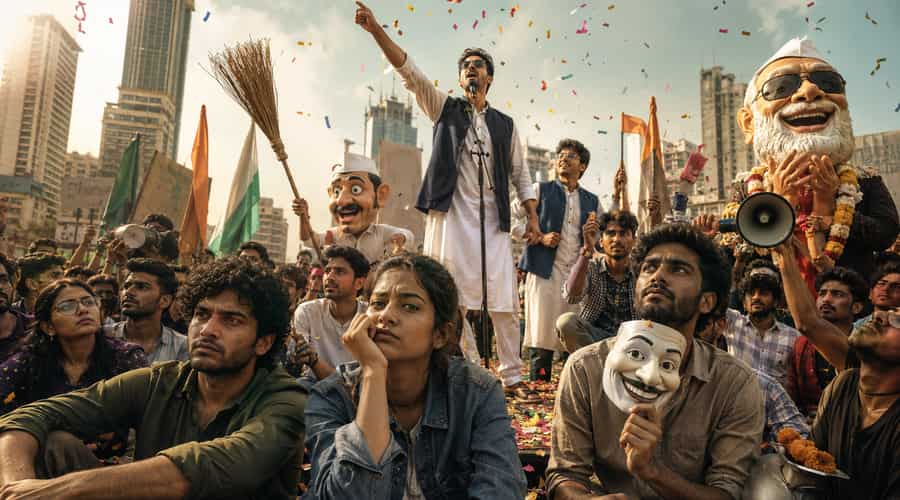
The Cockroach Janta Party is not a registered force in Indian politics, but its sudden rise shows how quickly ignored voters can turn a joke into pressure.
The Cockroach Janta Party began as satire and moved at the speed of a grievance. Within days of launching online on May 16, 2026, the parody movement had become a meeting point for young Indians angry about unemployment, exam disruptions, deleted voters, institutional privilege, media capture and the feeling that politics talks about them but rarely listens to them.
That is why the manifesto matters, even if the party itself is built out of memes, sarcasm and internet timing. Its five demands are blunt: no Rajya Sabha seat for any retiring Chief Justice of India, UAPA accountability for legitimate vote deletions, women’s reservation raised to 55 percent, time-bound action against Election Commission officers responsible for confirmed voter-roll deletions, and political literacy and civic infrastructure for young Indians entering public life.
According to AP, the movement had crossed 15 million Instagram followers by Thursday, May 21, far above the 8.8 million followers of Prime Minister Narendra Modi’s Bharatiya Janata Party on the platform. That number is the story. Not because followers equal votes. They do not. But because attention is now the first currency of political organization, and CJP acquired it faster than many formal campaigns could imagine.
Satire works when it gives people a language they were already looking for. The cockroach symbol is crude, memorable and oddly precise. It speaks to people who feel they are expected to survive inflation, exam leaks, layoffs, unpaid internships and political contempt without being counted as serious citizens.
Founder Abhijeet Dipke, identified in Indian reports as a 30-year-old with past Aam Aadmi Party social media experience, has positioned CJP as a protest vehicle rather than a conventional party machine. Financial Express described him as the public face of the movement, while AP reported that the account emerged after Chief Justice Surya Kant’s courtroom remarks comparing some unemployed young people and activists to cockroaches. Kant later clarified that his comments were aimed at people using fraudulent degrees, not at India’s youth broadly.
That origin explains the tone. The manifesto does not read like a policy paper from a think tank. It reads like a provocation from people who believe polite language has failed them. The demand on judicial retirement benefits takes aim at the perceived revolving door between high office and political reward. The demand on voter deletion frames franchise loss as an attack on citizenship itself. The women’s reservation demand pushes beyond India’s current 33 percent framework and refuses to treat symbolic inclusion as enough.
The Election Commission demands are the most combustible. Calling for UAPA action against the Chief Election Commissioner if legitimate votes are deleted is not a neutral administrative proposal. It is political maximalism, designed to invert a harsh security law and aim it at the state instead of citizens. That is why the manifesto is powerful online and difficult in the real world. Viral politics can say what formal parties hesitate to say, but governing demands evidence, procedure and legal durability.
Platform Power Has Entered The Story
The movement became more interesting when the pushback began. MediaNama reported that CJP’s X account was withheld in India after gaining more than 200,000 followers, with the platform displaying a notice that access had been restricted in response to a legal demand. Republic World and Outlook India also reported the account restriction on May 21, while Dipke announced a new handle shortly after.
This is where a meme page turns into a test of political speech. If the account had remained a joke, it might have burned out naturally. By being restricted just as it was gaining scale, it acquired the one thing internet movements need most: proof that someone powerful is paying attention.
That does not mean CJP will become an electoral force. Most digital surges fade. Young followers may enjoy the performance without doing the slower work of registration, local organization, candidate selection, fundraising and booth-level mobilization. Indian politics is not won by viral posters alone. It is won through caste arithmetic, coalition building, ground networks and patience.
Still, businesses and political operators should not dismiss this as a passing trend. The audience behind CJP is exactly the group many institutions struggle to reach: young, online, economically anxious and fluent in ridicule. They are not waiting for old parties to define what counts as serious politics. They are using humor to make the system react.
The practical lesson is simple. When people feel invisible, absurdity becomes a form of organization. The Cockroach Janta Party may never contest a seat, or it may splinter into smaller campaigns, creator networks and protest groups. Either way, its rapid rise shows that political entrepreneurship no longer starts with an office, a donor list or a television slot. Sometimes it starts with a name that sounds ridiculous, a manifesto that hits a nerve, and a crowd large enough to make everyone else look up.
Also read: CVC and GBL launch €10.7B bid to take Recordati private • Qwen3.7-Max prioritizes agent reliability over open weights • Ukraine's ground robot held a position for 45 days