Waymo’s latest service pause is not just a bad weather story. It is a reminder that robotaxis still have to prove they can handle the messy conditions cities produce without warning.
Waymo has temporarily stopped driverless taxi service in Atlanta and four Texas cities after its cars encountered flooded roads, turning a weather problem into a business problem for the most closely watched company in autonomous driving.
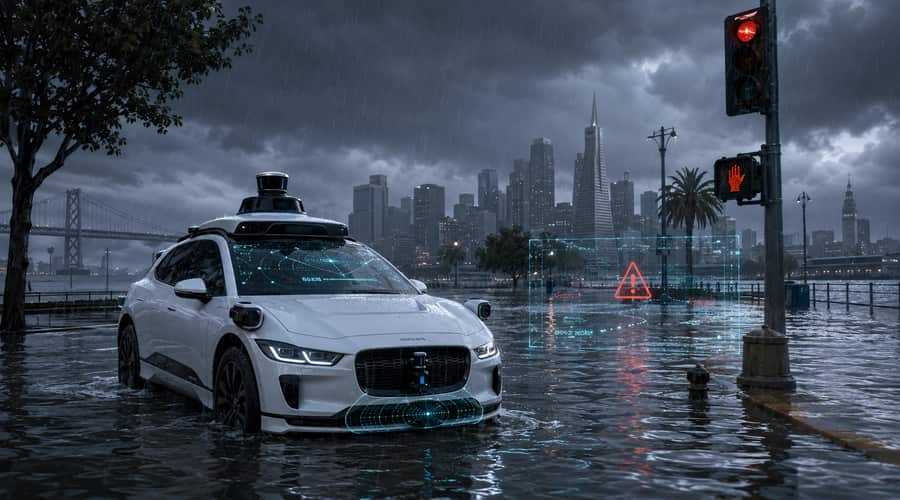
The Alphabet-owned company confirmed that service was paused in Atlanta, Austin, Dallas, Houston and San Antonio as storms and flooding hit parts of the South. The Atlanta pause followed an incident on Wednesday in which an unoccupied Waymo vehicle entered flood water during heavy rain and stopped before being recovered. At least one other vehicle was also affected during the storm, according to reporting from the Associated Press.
This is exactly the kind of incident autonomous vehicle companies have spent years trying to push out of the conversation. Waymo can point to millions of miles driven, sophisticated sensors, and a safety record it believes compares well with human drivers. But when a driverless car goes into standing water, the public does not debate statistical baselines. It asks a simpler question: why did the car go there at all?
That question matters because Waymo is not a lab project anymore. It has been expanding from its established markets into newer cities, including Texas and the Southeast, while also working with Uber in Atlanta and Austin. Robotaxis are moving from novelty to infrastructure. Once that happens, every operational failure becomes part of the case for or against wider deployment.
The flood problem was already serious before the latest pause. Earlier this month, the National Highway Traffic Safety Administration acknowledged a Waymo recall covering 3,791 fifth and sixth generation automated driving systems. The defect description was direct: the software may allow a vehicle to slow and then drive into standing water on higher speed roadways.
That is not a minor edge case. Entering a flooded roadway can cause a vehicle to lose control, creating risk for passengers, other road users and emergency responders. NHTSA’s filing said Waymo’s final remedy was still under development, while the company had made interim changes to weather constraints and vehicle maps.
The Atlanta incident shows why interim fixes are hard to defend when the operating environment changes faster than the system expects. TechCrunch reported that Waymo said flooding in Atlanta began before the National Weather Service had issued a flash flood warning, watch or advisory. That detail is important. If a robotaxi relies partly on formal alerts to adjust its behavior, a fast-moving storm can expose the gap between official data and what is happening on the street.
Human drivers fail at this too. Every major storm produces stranded cars, blocked intersections and bad judgment. But autonomous vehicle companies are not selling the public an average human driver. They are selling a system that should be calmer, more consistent and more aware of risk. That raises the bar.
Regulators now have a cleaner argument
For regulators, the flood incidents create a straightforward oversight case. They do not need to argue that robotaxis are broadly unsafe. They can focus on a defined operational question: what should an autonomous fleet be allowed to do when weather conditions change quickly and road-level hazards are not reflected in maps or alerts?
That could lead to tighter rules around severe-weather operations, mandatory reporting, geofenced shutdowns or clearer standards for how companies prove their cars can detect standing water. For a company with Waymo’s resources, those requirements may be expensive but manageable. For smaller autonomous driving and robotics startups, they could become a real barrier.
This is where the business implications become sharper. Investors have been looking for signs that autonomous vehicles are moving from long-cycle research spending into commercial scale. Waymo has been one of the few companies able to support that argument. If even Waymo has to pause multiple cities because of a weather-related software risk, then weaker players will face harder questions about burn rates, insurance, liability and local approvals.
The competitive impact is not only about direct robotaxi rivals such as Tesla or Amazon’s Zoox. It also reaches delivery robots, autonomous trucking, mapping systems and the many startups building software around machine perception. A single flood-related recall can influence how cities think about every machine that asks for more freedom on public roads.
Waymo’s decision to pause service may be the right operational call. Pulling cars off the road during dangerous weather is far better than pretending the problem is solved. But the pause also makes the next phase more demanding. The company now has to show that its vehicles can identify the difference between a wet road, a deep puddle and a roadway that should not be entered.
The bigger lesson is simple. Autonomy will not be judged only in clean weather, mapped neighborhoods and predictable traffic. It will be judged when drainage fails, alerts arrive late and the road ahead no longer looks like the data set. That is the test investors, regulators and riders will be watching next.
Also read: Howie Liu is backing founders building AI agent companies • Howie Liu is turning Hyperagent credits into a seed-stage weapon • MoonPay brings crypto buying inside ChatGPT.